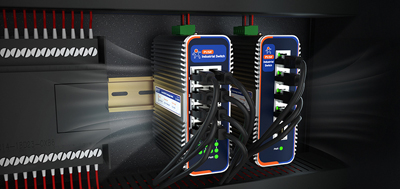
From Industrial Modem to Industrial LTE Router: Substation Room Remote Monitoring — O&M Efficiency Tripled After Upgrading the Communication Solution
Preface: This isn't a technical article. It's a "chronicle of lessons learned the hard way."
I've been doing communication solutions for substation room O&M for 9 years now.
In 9 years, I've personally swapped out no fewer than a thousand communication devices. From the earliestindustrial modems, to 4G data cards, to today's industrial LTE routers— every generation change came with a bellyful of blood and tears.
Today's article: no specs, no protocols, no technical jargon that gives you a headache.
I'm just telling you one thing: how we went, step by step, from "it transmits, good enough" to "stable and reliable" over these 9 years — what pits we fell into, how much tuition we paid, and why we finally chose the industrial LTE router.
If you're doing substation room remote monitoring right now, and you're losing sleep over the communication solution — this article might save you three years of trial and error.
I just started in the industry.
Back then, substation room remote monitoring was just getting off the ground. The communication solution almost everyone used was one thing — theindustrial modem.
What's an industrial modem? Simply put, it's a little box that converts serial port to 4G. You connect your sensor's RS485 cable to the industrial modem, the modem packages the data, and sends it out over the 4G network.
Simple in principle, and it did work — data actually got transmitted.
The whole industry was celebrating: "No more pulling Ethernet cables! No more running to sites in person!"
But after six months, the problems started.
Problem 1: Only supports serial devices.
A substation room doesn't just have RS485 sensors. There are also IP cameras, network temperature/humidity meters, smart meters… These devices use Ethernet ports, not serial ports. The industrial modem can't connect to them. You have to buy a bunch of converter devices separately, stuffing the cabinet until it looks like a spider's web.
Problem 2: Single SIM, single network — one break and you're done.
The industrial modem only takes one SIM card, only connects to one carrier. The moment that carrier's base station goes under maintenance, gets congested, or the signal fluctuates — data drops. On your platform, all you see is a sea of "device offline."
I remember this vividly. Summer of 2016, industrial modems at a project site all went offline simultaneously. After half a day of investigation, we found out China Mobile was upgrading base stations in that area — the entire area's 4G signal was down for 4 hours. For 4 hours, we had no idea what was happening inside the substation room.
Problem 3: Zero intelligent management capability.
When the industrial modem lost connection, it wouldn't reconnect on its own. When it froze, it wouldn't reboot on its own. You had to send someone to the site to manually restart it.
Think about it — the substation room is on underground level B2. You send a young O&M guy to run over at midnight to restart a little box — what is that? That's using human labor to patch a technological hole.
What was our O&M state like in the industrial modem era?
Data transmitted, but unstable. Devices online, but uncontrollable. When something went wrong, you could only rely on people.
Those three years, my phone was never on silent. Not because there were too many devices — but because I never knew which device would drop offline and when.
Around 2018, 4G data cards started getting popular.
Compared to the industrial modem, the data card was indeed a big step up — it was a full router, with an Ethernet port. You could connect cameras, connect sensors, no more messing around with serial-to-Ethernet converters.
We were thrilled. We thought, "We finally found the right thing."
But after a year, we discovered the new pits were even deeper.
A data card is made for laptops, not for substation rooms. What's the environment like inside a substation room? Summer temperatures hit 50°C, humidity above 90%, electromagnetic interference so strong your phone can't finish charging overnight.
A data card in that environment? Lifespan is shockingly short. We tracked it — the average lifespan of a regular 4G data card in a substation room is 4–6 months. Replacing a batch every six months — the consumable cost alone is enough to make you cry.
When a data card loses connection, it doesn't auto-reconnect. You see "offline" on the platform, and all you can do is call someone to go check the site. Many times, the O&M guy shows up and finds — it was just a momentary signal fluctuation. A reboot would have fixed it.
But that trip — gas money, labor, time — all wasted.
Although data cards are more flexible than industrial modems, most of them are still single-SIM, single-network. The carrier has a problem? You're dead.
I ran the numbers: those three years, the time we spent "sending people to sites to restart communication devices" accounted for35% of our entire O&M workload.
One-third of our manpower wasn't doing O&M — it was cleaning up after the communication solution.
Tell me that doesn't make you want to scream.
The turning point came in 2021.
That year, we started trying industrial LTE routers to replace data cards and industrial modems.
At first, I was skeptical too — it's just a router, right? How different can it be?
After using it, I realized — the difference is night and day.
An industrial LTE router and a regular data card aren't even the same species.
Difference 1: Three-network coverage. Always online.
The industrial LTE router supports China Mobile, China Unicom, and China Telecom SIM cards inserted simultaneously, with intelligent switching. Whichever carrier has the stronger signal, it uses that one. If one drops, it automatically switches to another.
What does that mean? It means you never have to worry about "the entire site goes offline because one carrier is doing base station maintenance" ever again. The probability of all three carriers having a problem at the same time is lower than you getting struck by lightning.
Difference 2: Industrial-grade protection. It can take whatever the substation room throws at it.
Wide temperature range (-40°C to 75°C), moisture-proof, dust-proof, EMI-resistant. You put it in a substation room — one year, two years, three years — no replacement needed.
We have one industrial LTE router that's been running in an underground B2 substation room for a fulltwo years and four monthswithout a single failure. Try that with a data card? It'd be dead in four months.
Difference 3: Watchdog + auto-reconnect. True "unattended operation."
This is what I value most. The industrial LTE router has a watchdog mechanism — it continuously monitors the network status. The moment it detects a disconnection, it auto-reconnects. No phone call from you. No dispatching someone. It handles it itself.
You can finally sleep soundly at 3 AM.
I know you might think "tripled" is an exaggeration.
It's not. Let me show you our own data:
| Metric | Industrial Modem Era | Data Card Era | Industrial LTE Router Era |
|---|---|---|---|
| Avg. communication device failures/month | 8 | 5 | 0.3 |
| Times sending people to restart comms/month | 12 | 7 | 0 |
| Platform device online rate | 78% | 85% | 99.6% |
| O&M staff effective work time ratio | 65% | 72% | 94% |
See that?
From industrial modem to industrial LTE router, our O&M staff went from"65% of their time doing real work"to"94% of their time doing real work."
What happened to that saved 30% of time? Preventive maintenance. Data analysis. Energy efficiency optimization — these are the things O&M should be doing, not running to a substation room at midnight to reboot a router.
That's what "tripled efficiency" really means — not that you have more people. It's that people can finally do what people are supposed to do.
In 2023, we took on a substation room retrofit project for a commercial complex.
The project had 16 substation rooms, spread across underground B2, ground-floor podium, and rooftop equipment rooms. The previous solution was 4G data cards — 82% online rate, an average of 3 communication failures per month.
We replaced the communication solution in all 16 substation rooms withindustrial LTE routers.
Three months later:
One time, an underground B2 substation room experienced simultaneous signal fluctuation on both China Mobile and China Unicom (nearby base station expansion). Under the old solution, that substation room's data would have definitely dropped.
But the industrial LTE router automatically switched to China Telecom's network in0.8 seconds. Not a single frame of data was lost.
Nothing showed up on the platform. The O&M guy slept like a baby that night.
Honestly, the industrial LTE router category has gotten really competitive in the last couple of years. Lots of options.
But for the substation room scenario, there are a few hard requirements you can't compromise on:
Must support all three networks— Don't even consider single-network models. The substation room environment is too complex for single-network to handle.
Must be industrial-grade— IP30+ protection rating, wide temperature design. This is the baseline.
Must have watchdog + auto-reconnect— Without this, it's no different from a data card.
Must support Ethernet port access— Your cameras and sensors use RJ45, not serial ports.
Filter by those four criteria, and the choices actually shrink quite a bit.
We use theUSR-G806w by USR IoTin our own projects. Three-network switching, industrial-grade, watchdog, dual Ethernet ports — it has everything. And the price isn't much higher than a data card, but the stability is two orders of magnitude better.
Of course, there's more than one product on the market that meets these criteria. Filter by the four rules I mentioned, and you won't go wrong.
After 9 years of substation room O&M communication, my biggest takeaway is one sentence:
With substation room remote monitoring, the first half is about "what equipment you installed." The second half is about "whether the data can get out reliably."
The first half? Everyone's about the same. Same sensors, same cameras.
The second half? That's where the gap opens up. Some people's data is rock-solid. Some people's data comes and goes. Some people sleep soundly at night. Some people get up at midnight and run to the site.
That gap isn't an equipment gap.It's a communication solution gap.
From industrial modem to data card to industrial LTE router — this isn't just technological progress. It's a lesson paid for with countless sleepless nights by O&M people.
If you're still using industrial modems right now, or still toughing it out with data cards —
It's not that they're bad. It's that they don't belong in a substation room anymore.
It's time to upgrade.