How Many Points Do You Lose Per Remote Monitoring Dropout? You Might Be Calculating Wrong—A Real Bill From the Front Lines of Distribution O&M
This was the final assessment score that Operations Team Leader Old Zhang from a certain power supply station received at the end of last year. Just because of that 0.3 percentage points, the entire station's annual performance dropped from Grade A to B+. Not only did bonuses shrink significantly, but next year's distribution network renovation project budget was also slashed.
Old Zhang was furious:"All our terminals are online. Where's the problem?"
It wasn't until he pulled three months of backend logs that he discovered the truth—remote monitoring data had massive amounts of"silent packet loss"during nighttime peak hours: the platform showed terminals online, heartbeats normal, but core monitoring data like current, voltage, and temperature—over 30% of the time, it simply wasn't being transmitted.
It wasn't a dropout. It was"living dead data."
In today's world of escalating digitalization rate assessments every year, what kills your performance isn't usually the obvious, visible dropouts—it's the invisible"data disconnection"you can't even see.
Let me do the math for you first.
The core KPIs for State Grid's distribution network digitalization assessment typically include:
| Assessment Dimension | Weight | Target | What Happens When You Fail |
|---|---|---|---|
| Terminal Online Rate | 30% | ≥99.5% | One dropout, online rate crashes below the red line |
| Data Completeness Rate | 25% | ≥98% | Data lost, completeness rate plummets |
| Fault Response Time | 20% | ≤30 min | Missed report causes timeout, double penalty |
| Equipment Availability | 15% | ≥99% | Cellular wifi router reboot/crash, availability hits zero |
One "silent packet loss" triggers all four dimensions simultaneously. It's not minus 1 point—it's minus 4 points at once.
And the digitalization rate total accounts for 15%–20% of the annual comprehensive assessment. In other words, a cellular wifi router dropping a few packets where you can't see it could drop your entire power supply station's year-end rating by one grade.
Have you ever thought: you spent so much effort tuning terminals, optimizing the master station, coordinating signals with the carrier—but have you ever seriously looked at that cellular wifi router stuffed in the collection box, covered in dust, never touched by anyone?
It's the quietest, most easily overlooked, yet most devastating link in your entire data chain.
At distribution automation, box transformer monitoring, and ring main unit monitoring project sites, I've talked to too many O&M engineers. Their mindset when picking a cellular wifi router is almost identical:
"As long as it connects to 4G."
"As long as it has an Ethernet port."
"Cheapest one, it's just a relay anyway."
And then? Install it. First three months: smooth sailing. Starting month four—
Internal temperature in the collection box hits 60°C. The cellular wifi router starts rebooting cyclically. You think it's a signal problem, swap three SIM cards—no help. Turns out the cellular wifi router's thermal protection kicked in.
One lightning strike, two cellular wifi routers fried. You think it's bad luck. Actually, the communication interfaces had no surge protection—a 4kV pulse punched straight through the motherboard.
Full signal bars, but data won't upload. You blame the carrier, file three complaints—nothing changes. Actually, electromagnetic interference caused the 4G module's error rate to spike, data packets got massively discarded—only heartbeats are still flying.
You think the terminal is broken, send someone to site—terminal is fine. Actually, the cellular wifi router has a memory leak. Data packets are being quietly dropped in the queue. Only heartbeats, with their high priority, are still sending normally.
You see "online." The assessment system sees "data missing." You didn't drop offline—but you got penalized. And you'll never know why.
Inseego stated plainly in its tech blog:"Cellular routers typically have built-in failover capabilities that allow them to automatically switch from their primary connection source to a secondary source, in the event of an outage, minimizing network disruption."
Automatic failover is a basic function of a cellular wifi router. But does the one at your site have it?
Most don't.
Perle goes even further, putting the bill right on the table:"For a small site, even with 99.5% fixed-line availability, downtime costs can exceed $1 million per year. In the industrial sector, a single minute of downtime can adversely affect customers, operations, and revenue."
$1 million is an industrial scenario number. But in State Grid's assessment system, the logic is identical—you don't need a total outage. You just need incomplete data, and your digitalization rate is finished.
After all these pain points, what kind of cellular wifi router can actually withstand assessment pressure at a distribution site?
I won't recite specs. I'll tell you the six things you actually need on-site:
Nobody installs AC in distribution boxes. 60°C in summer is normal. What you need is a cellular wifi router that, after 72 hours at full load, has a heatsink you can touch with your hand that's just warm—not hot. No fan means no dust buildup, no three-month cooling degradation spiral.Quietly alive, stably running, causing you zero trouble.
10kV switchgear, capacitor banks, transformers—all interference sources. You need deep EMC optimization, built-in multi-stage surge protection on comm interfaces, able to withstand 4kV+ surges.Full signal bars AND data actually uploading—that's "truly online."
You've got 5 DTUs, 8 FTUs, 3 fault indicators on one line—they all need to transmit simultaneously, no queuing, no silent discarding. Data completeness rate can't be dragged down by a cellular wifi router that can't keep up.
Ethernet, serial, DI/DO, USB—everything you need. Multiple sizes for any collection box or panel. Supports router, gateway, bridge modes with one-click switch, just as Perle says:"IRG routers can be easily configured as Router, Gateway, or Bridge."No master station changes, no re-debugging.
IEC 60870-5-104, IEC 61850, Modbus TCP/RTU, DNP3—all mainstream power protocols supported. Compatible with the vast majority of SCADA systems and distribution master stations on the market.The cellular wifi router adapts to your system, not the other way around.
No annual subscription fees, no hidden license fees—buy it, it's yours. But more importantly:your O&M staff don't need to run to site every month anymore.The labor, fuel, and assessment penalties saved add up to far more than the device price difference.
Perle said something every distribution O&M engineer should remember:"If network availability is vital to your success, choose quality products."
In State Grid's assessment system, network availability isn't "important"—it's the lifeline.
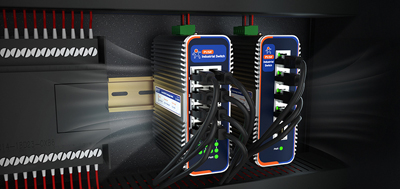
If you've checked each of those six points, you'll find—the USR-G809s cellular wifi router was designed almost point-by-point against your pain points.
We ran an extreme test: full load for 72 hours straight, then touched the enclosure heatsink—warm, not hot. No fan, no noise.
What does that mean? It means stuffed into a 60°C outdoor collection box, it won't heatstroke. It means no fan dust buildup leading to a cooling collapse three months later. It means your O&M staff don't need to climb a pole every month to clean dust, reboot, or replace fans.
Inseego emphasizes:"Cellular routers offer advanced security features, including WPA2/3 encryption and VPN support."The G809s supports VPN and multiple security protocols—data transmission encrypted, assessment data safe and sound.
Stable Performance, Fast Operation: Multi-Terminal Concurrency, No Queuing, No Discarding
The G809s's processing power supports 10+ terminals on the same line transmitting simultaneously. Every frame of monitoring data arrives alive at the master station.
Your data completeness rate won't be dragged down by a cellular wifi router that can't keep up.
Deep EMC optimization, built-in multi-stage surge protection on comm interfaces, withstands 4kV+ surges. In the harshest electromagnetic environment next to switchgear cabinets, data still transmits steadily.
Full signal bars AND data actually uploading—that's "truly online," that's what survives the assessment system's data pull.
Multiple sizes, perfect fit for any collection box or panel. Ethernet, serial, DI/DO, USB—everything in one box. Supports router, gateway, bridge modes with one-click switch. No master station changes, no re-debugging—pull the old one out, install the G809s, import the config, go live. Ten minutes, done.
Supports IEC 60870-5-104, IEC 61850, Modbus TCP/RTU, DNP3, and other mainstream power protocols. Compatible with the vast majority of SCADA systems and distribution master stations on the market.
You don't need to change your entire system for one cellular wifi router.
No annual subscription fees, no hidden license fees. But true cost-effectiveness isn't a cheap device—it's your O&M staff not running to site every month anymore.
The labor saved, the fuel saved, the assessment penalties saved—added together, that's the real "cost-effectiveness."
Perle puts it well:"Robuste et Fiable. Les Routeurs LTE Perle ont des temps moyens entre pannes (MTBF) élevés."
The G809s follows the same logic:you don't need a cellular wifi router that needs you to serve it. You need one that serves you.
Back to Old Zhang's story from the beginning.
Later, he swapped out the cellular wifi router, removed the dusty device from the collection box, and installed the G809s. Three months later, he pulled the backend logs again—data completeness rate went from 96.2% to 99.1%.
The terminals didn't get better. The signal didn't get stronger.It was that cellular wifi router that finally stopped "silently dropping packets."
Digitalization rate assessments escalate every year. You spend massive effort optimizing terminals, debugging the master station, fighting with signals. But you never seriously looked at that cellular wifi router stuffed in the corner—it's the most fragile, most easily overlooked, yet most decision-making link in your entire data chain.
Inseego says:"Cellular routers empower rural and mobile operations."
Perle says:"If network availability is vital to your success, choose quality products."
What I want to say is—in today's world of escalating State Grid digitalization rates, you don't need a cellular wifi router that "can connect to the internet." You need one that "keeps your data alive all the way to the assessment system."
The USR-G809s was born for this scenario.
It won't automatically raise your digitalization rate. But it can ensure—every point you deserve won't be stolen by a cellular wifi router.
Device online isn't enough. Data online—that's enough.
Data online isn't enough. Data still there at assessment time—that's enough.
If your distribution network's digitalization rate is being dragged down by "fake online," contact us for the USR-G809s's detailed specs and distribution deployment plan.
Your performance shouldn't be lost to a cellular wifi router.