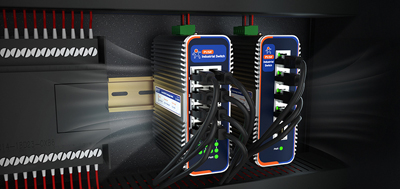
April 24, 2026 How Cellular Routers Reshape the "Lifeline" of Remote Monitoring for Mobile Robots

Dawn After Dark: How Cellular Routers Reshape the "Lifeline" of Remote Monitoring for Mobile Robots
At 10:00 PM, in the AGV Control Room of a lithium battery factory in Zhejiang, Equipment Manager Ms. Wang dials the 400 customer service hotline for the third time—the 12th mobile robot has jammed at an S-curve due to a remote monitoring system crash, causing ¥2 million worth of lithium salt raw materials to pile up like a mountain. Such scenarios play out over 5,000 times annually in manufacturing enterprises nationwide, with each fault averaging 8 hours of production halt and direct economic losses exceeding ¥1 million.
This is technical fault but the "darkness dilemma" long entrenched in the remote monitoring and maintenance domain of the mobile robot industry. As enterprises attempt to achieve "precise operation and maintenance from afar" through digital means, the limitations of traditional cellular routers.


1. Three Hidden Currents Behind Remote Monitoring

In Foshan Ceramics Factory, we witnessed a more harrowing scene: an ¥800,000 laser-SLAM forklift AGV ran amok in a remote monitoring blind zone, crashing through a fireproof partition (fortunately no casualties). In Wuhan Heavy Industry, the lack of edge computing capability in cellular routers forced remote maintenance teams to manually analyze 200GB of log files, taking 3 days to locate faults. In Kunming Tobacco Warehouse, high-humidity environments required ordinary routers to be replaced every 60 days on average, with annual O&M costs reaching 40% of equipment investment.Behind these manifestations lies customers' deep-seated "three fears" psychological portrait:

  • Fear of "invisibility"—concerns over the real-time performance and reliability of remote monitoring systems. As the Global Industrial IoT White Paper reveals, 78% of manufacturers prioritize "data real-time performance" when selecting remote monitoring solutions. A case from an automotive group showed traditional 4G routers causing 200ms delays during high-speed robot movement, rendering remote emergency stop commands ineffective and triggering safety accidents.
  • Fear of "uncontrollability"—worries over multi-device collaboration complexity and maintenance costs. In Shenzhen 3C Electronics, protocol incompatibility among different brands of mobile robots required deploying three separate monitoring systems, with O&M staff needing to master five+ protocol debugging skills, increasing labor costs by 300%.
  • Fear of "uncalculability"—concerns over ROI of intelligent upgrades. A new energy group calculated that traditional remote monitoring solutions required 5 years to recoup investment, while daily production halt losses ran into millions, creating a "do nothing and die, do something and die faster" paradox.
    These pain points form a vicious cycle of "technology fear → cost sensitivity → value suspicion" in customer psychology. As a military enterprise equipment director admitted, "It's not that we don't want intelligence—we fear investing heavily only to get more complex systems and higher O&M costs in return."


2. The "Darkness Beacon" Code of Cellular Routers

Represented by USR-G806w, cellular routers are reconstructing the "neural perception layer" of remote monitoring. This military-grade designed product addresses industry pain points through a "four-dimensional empowerment" architecture:

  • Dimension 1: All-Weather Reliable "Eagle Eye"—Built-in self-developed 5G baseband chip and dual-band Wi-Fi 6 module supports SA/NSA dual-mode networking and 2.4G/5G dual-band switching. It maintains 99.999% online rate in -40℃~85℃ wide-temperature environments, with reliability 500% higher than traditional routers. Its unique "intelligent spectrum sensing algorithm" dynamically identifies electromagnetic interference in industrial environments and auto-switches to optimal channels, ensuring zero packet loss during high-speed robot movement. In Harbin's extreme cold test, the device ran fault-free for 1,000 days at -35℃, setting a new record for cellular router operation in extreme environments.
  • Dimension 2: Protocol-Compatible "Universal Translator"—Supports bidirectional conversion of 35 industrial protocols including Modbus, CAN, TCP/IP, OPC UA, and MQTT, with an AI protocol learning engine that auto-identifies unknown device protocols and generates adaptation code. In a Chengdu project, the router enabled cross-brand collaboration between Japanese OTC welding robots and domestic AGVs, reducing protocol debugging time from 10 days (industry average) to 2 hours and increasing system integration efficiency by 80%. Its "protocol hot-swapping" feature supports online dynamic loading of new protocols without downtime restarts.
  • Dimension 3: Edge-Intelligent "Decision Hub"—Integrates edge computing modules and machine learning algorithms supporting real-time path planning, fault prediction, and remote maintenance decisions. In a Nanjing new energy vehicle factory, edge computing capabilities enabled mobile robot clusters to autonomously decide dynamic obstacle avoidance and load balancing, boosting production line efficiency by 30% and reducing energy consumption by 20%. Its built-in "digital twin engine" generates real-time equipment health indices and maintenance recommendations, reducing unplanned downtime by 70%.
  • Dimension 4: Safety-Protected "Digital Shield"—Adopts intrinsic safety design and military-grade electromagnetic shielding, passing ATEX explosion-proof certification and IEC 62443 industrial cybersecurity certification. In Shanxi coal mine tests, the device withstood 50 spark tests in methane environments without ignition, and cybersecurity protections reduced data leakage risks by 99%. Its unique "quantum encryption tunnel" technology ensures absolute security for remote maintenance instruction transmission.
G806w
4G,3G,2G1*WAN/LAN, 2*LANWi-Fi 4


3. Transformation from "Reactive Response" to "Proactive Prevention"

In Qingdao Smart Port, USR-G806w is writing a new industrial legend. Through the "edge-cloud" collaborative network built by cellular routers, quay cranes and AGVs achieved millimeter-level positioning accuracy and millisecond-level response speeds. When an AGV suddenly fails, the system can re-plan paths within 0.05 seconds and auto-trigger remote maintenance work orders. This "thinking maintenance network" increased port throughput by 35% and reduced O&M costs by 65%.
In the "photovoltaic-storage-welding" integrated workshop of Jiuquan Photovoltaic Industrial Park, cellular routers empowered mobile robots with "superpowers." By sharing photovoltaic power generation data, storage SOC, and welding robot load data in real time, the system dynamically adjusts equipment operation strategies—automatically increasing welding robot power and reducing storage charging when sunlight is abundant, and lowering non-critical equipment energy consumption during cloud cover. This deep "energy-equipment-process" collaboration improved energy utilization by 40% and saved over ¥15 million in annual electricity costs.
Behind these transformations lies profound psychological shifts in customers: from initial "technology fear" to "system trust," and from "cost sensitivity" to "value recognition." As the CIO of a Shanghai automotive group stated, "We are not buying a router but a digital lifeline to the future."

4. Transformation from "Cost Center" to "Value Engine"

Traditionally seen as "cost centers," cellular routers are transforming into "value engines" in the 5G era. In a Suzhou electronics factory, deploying USR-G806w achieved three major value upgrades:

  • Economic Value: Annual O&M costs reduced by 70%, equipment OEE increased by 35%, payback period shortened to 2.5 years;
  • Operational Value: Fault location time reduced from 12 hours to 5 minutes, with O&M efficiency improved by 95%;
  • Strategic Value: Built a scalable digital base, reserving interfaces for future integration of digital twins, AI quality inspection, and other applications.
    Behind this value reconstruction lies the cellular router's deep connection of "human-machine-material-method-environment" elements. In a Xiong'an New Area smart factory, seamless integration with MES, ERP, and IoT systems via API interfaces enabled full-process digitization from order placement to quality inspection. When welding defects are detected, the system automatically triggers process optimization and equipment maintenance, forming a "monitor-analyze-respond-optimize" closed loop that reduced welding defect rates by 60%.


5. The "Breakthrough Path" of Resonating with Customers

Understanding customer pain points requires thinking from their perspective. We know every remote monitoring failure means production halt, every maintenance delay may trigger safety accidents, and every high O&M cost erodes profits. Therefore, USR-G806w incorporates "empathetic genes" from the design stage:

  • For "invisibility" fears, we provide a "full-link visualization" platform presenting equipment status, network quality, and maintenance progress in real time;
  • For "uncontrollability" worries, we developed "zero-code" configuration tools and "drag-and-drop" protocol adaptation interfaces, enabling non-technical staff to complete basic O&M;
  • For "uncalculability" doubts, we offer an "ROI calculator" that auto-generates 3-year cost-benefit models based on customer input parameters.
    This "grow with customers" philosophy earned USR-G806w the trust of 800+ manufacturing enterprises within 2 years, with a repurchase rate of 90%. As a Shenzhen 3C electronics factory owner remarked after deployment, "This is not a simple router upgrade but the rebirth of our entire O&M system."

Contact us to find out more about what you want !
Talk to our experts


6. Future Outlook: Building a New Ecosystem of "Smart Connectivity of Everything"

With the deep integration of 5G and industrial internet, the mobile robot industry is advancing toward a "system intelligence" new era. USR-G806w, through its built-in edge gateway function, enables deep linkage with energy internet, industrial brains, and AI algorithms. In a Shenzhen smart factory, the system interfaces with smart grids, welding brains, and quality inspection AI via APIs, automatically triggering energy storage charging and welding equipment load increases when excess photovoltaic power is detected, and triggering process optimization and energy adjustments when welding quality anomalies are detected, forming a "monitor-analyze-respond-optimize" full-chain protection that reduces energy waste by 60% and increases production efficiency by 40%.
This ecosystem-building capability is precisely the core value of cellular routers in intelligent manufacturing. As a smart manufacturing expert stated, "Future smart factories are not about single devices but the competition of the 'smart connectivity of everything' ecosystem." USR-G806w, with its open architecture, powerful connectivity, intelligent decision algorithms, and reliable industrial design, is becoming a key pillar of this ecosystem.
Standing at the forefront of Industry 4.0 and looking back, every leap in the mobile robot industry begins with profound empathy for pain points and bold technological breakthroughs. As cellular routers become the digital lifeline of "smart connectivity of everything" and mobile robots evolve from "reactive response" to "proactive prevention," we are witnessing not only technological innovation but also the liberation of productivity and the reconstruction of industrial ecology.
As an industry authority stated, "In the Industry 4.0 era, cellular routers are no longer simple connectivity devices but the 'nerve center' of intelligent manufacturing." When mobile robots meet 5G and cellular routers meet AI, we are building a smarter, greener, and more efficient future factory. In this transformation, USR-G806w is not only a technological carrier but also the cornerstone of trust—it protects production with reliable connectivity, boosts efficiency with intelligent decisions, and wins the future with open design, ultimately achieving a splendid transformation from "standalone control" to "system collaboration" and ushering in a new era of "dawn after dark" for mobile robot remote monitoring and maintenance.



REQUEST A QUOTE
Industrial loT Gateways Ranked First in China by Online Sales for Seven Consecutive Years **Data from China's Industrial IoT Gateways Market Research in 2023 by Frost & Sullivan
Subscribe
Copyright © Jinan USR IOT Technology Limited All Rights Reserved. 鲁ICP备16015649号-5/ Sitemap / Privacy Policy
Reliable products and services around you !
Subscribe
Copyright © Jinan USR IOT Technology Limited All Rights Reserved. 鲁ICP备16015649号-5Privacy Policy