From Smart Meters to Edge Gateways: How Cellular WiFi Routers Hold Up the "Last 100 Meters" of Power IoT?
— And Why Your Equipment Can't Clear the EMC Hurdle in Chemical Plants
Let's start with an uncomfortable fact.
Power IoT project: 1,000 devices deployed. Three months after go-live, the online rate dropped to 68%. You checked the terminals. You checked the platform. You checked the SIM cards. The one thing you never suspected — the gateway you assumed "just forwards data."
The problem is exactly there.
From smart meters to edge gateways, this "last 100 meters" is the most fragile link in the entire power IoT chain. And the EMC test in a chemical plant? That's the magic mirror that exposes this fragile nerve.
Most people think power IoT is just "meter → router → cloud platform." Three steps, done.
Reality: from a smart meter to your monitoring dashboard, data passes through at leastfive layers of protocol conversion:
| Layer | Typical Devices | Communication Protocols |
|---|---|---|
| Perception | Smart meters, temp sensors, fault indicators | DL/T 645, Modbus RTU |
| Aggregation | Distribution terminals FTU/DTU, fault locators | IEC 104, Modbus TCP |
| Edge | Edge gateways, cellular WiFi routers | MQTT, OPC UA, HTTP |
| Transport | Cellular WiFi routers / 4G modules | 4G/5G, wired backup |
| Platform | Cloud TMS/OMS | JSON/RESTful API |
Five protocols. Five syntaxes. All relying on the edge gateway to "translate."
Modern edge gateways are no longer the dumb boxes that just pass data through. They come with 200+ industrial protocol drivers built in, support Modbus-to-MQTT and OPC UA-to-HTTP conversion, and enable hot-swappable protocol modules via dynamic loading. Real-world case from an energy group: a single edge gateway simultaneously connected to five types of PLCs — Siemens S7, Mitsubishi FX, and others — added IEC 61850 protocol support without shutting down, completing equipment upgrades across 200 substations.
But here's the catch —protocols can be converted, but that doesn't mean the data survives the last 100 meters.
Especially in a chemical plant.
If you've never done power IoT in a chemical plant, it's hard to understand the kind of despair involved.
VFDs humming around the clock. High-power motors starting and stopping repeatedly. High-voltage lines just meters away. Walkie-talkies and dispatch systems operating simultaneously in explosion-proof zones. The entire plant is one massive electromagnetic interference source.
The EN 61000 series EMC standards require equipment to survive two rounds of testing:
Round 1: EMI Emission — You must not interfere with others.
Radiated emissions (RE) must stay within limits across 30 MHz ~ 1 GHz. Conducted emissions (CE) must stay within limits across 150 kHz ~ 30 MHz. Chemical plants are full of harmonics and high-frequency noise. If your gateway's PCB ground plane is incomplete, if analog ground and digital ground are shorted together at the power entry, high-frequency noise couples from the ground line to the antenna interface —RE test fails immediately. You're out.
Round 2: EMS Immunity — Others must not interfere with you.
| Test | Requirement |
|---|---|
| ESD (Electrostatic Discharge) | ±4kV: no crash. ±6kV: no damage. |
| EFT (Electrical Fast Transient) | ±2kV: no reset. |
| Surge | ±2kV: no damage. |
In dry seasons at a chemical plant, human body static easily reaches 8 kV. Surges induced by switching operations can instantly punch through a serial port with no TVS protection. Your device runs perfectly in the lab, then "lies flat" the moment it enters the chemical plant —it's not that the device is bad. It's that you never took EMC seriously during selection.
Three iron rules, plain and simple:
Rule 1: Protocol Layer — One Device Must Eat Them All.
DL/T 645, Modbus, MQTT, IEC 104 — if a device can do conversion, time synchronization, and data cleansing all in one box, that's a gateway you can actually use. Don't buy four gateways to patch four protocols — you'll be filling holes forever. A steel company's retrofit project proved it: one edge gateway unified 3,000+ device protocols into standard JSON, boosting data collection efficiency by 40% and cutting cloud-side parsing load by 65%.
Rule 2: EMC Layer — Selection Is Your Entry Ticket.
Radiated emissions, conducted emissions, ESD, EFT, surge — all five must pass to earn your chemical plant entry ticket. PCB star grounding, analog/digital isolation, interface TVS protection, common-mode choke + X/Y capacitor filtering — these aren't bonus points, they're basics. Wait until the test fails to fix it? Rework costs three times what getting it right the first time would have cost.
Rule 3: O&M Layer — The Device Must Save Itself.
You can't send someone into a chemical plant every day to press a reset button. The device must have built-in hardware + software watchdogs for auto-reboot on crash. It must support breakpoint resume and auto-reconnect. It must support remote O&M via site-to-site networking — fix it without entering the explosion-proof zone.
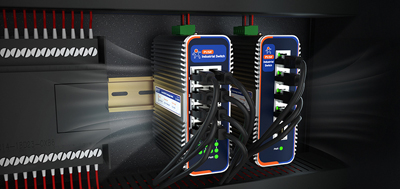
USR's G806w from Someone IoT has been deployed in quite a few projects like this. Qualcomm dual-chip solution, full-network 4G plus enhanced WiFi, wide temp -20~70°C, IP30 rating, built-in eSIM with three-network auto-switching, hardware watchdog plus multi-layer EMC protection — proven in power inspection and chemical plant scenarios. Of course, there's no single right answer for selection. Butget the direction right, and you won't have to rework everything down the road.
The most expensive cost in power IoT is never the equipment. It's rework.
Protocols don't connect — rework. EMC doesn't pass — rework. Online rate drops — rework.
And the starting point of all rework is almost always that gateway you thought "just needs to forward data."
A chemical plant won't go easy on you just because you're on a tight schedule. The electromagnetic environment won't lower its standards because your budget is tight. Whether the data from 1,000 smart meters survives the last 100 meters depends entirely on whether you got the EMC and protocol right on the very first gateway.
Don't wait until three months after go-live, when the online rate has dropped to 68%, to look back at the gateway.
By then, the magic mirror has already done its work.