Unmanned Oil and Gas Warehousing: How Fanless Industrial PC Enable AGVs to Operate Stably at -40°C Low Temperatures?
In the field of oil and gas warehousing, unmanned and intelligent operations have become an inevitable trend for industry transformation and upgrading. Automated Guided Vehicles (AGVs), as core equipment for unmanned warehousing, have stable operation that directly affects warehousing efficiency and safety. However, in extreme low-temperature environments, such as the frigid -40°C regions, AGV operation faces enormous challenges. The fanless industrial PC, as the "brain" of the AGV, has performance and stability that become the key factor determining whether the AGV can work continuously and efficiently at low temperatures. This article will explore in depth how fanless industrial PC help AGVs operate stably at -40°C low temperatures, solve deep customer pain points, and empathize with customers' psychological considerations during selection and application.
With technological progress and rising labor costs, the oil and gas warehousing industry is accelerating its transformation toward unmanned and intelligent operations. As an important carrier for unmanned warehousing, AGVs can autonomously complete tasks such as cargo handling and storage, significantly improving warehousing efficiency, reducing labor costs, and minimizing safety accidents caused by human errors. Therefore, the application of AGVs in oil and gas warehousing is becoming increasingly widespread.
However, in some oil and gas warehousing areas, such as within the Arctic Circle or high-altitude regions, winter temperatures can drop to -40°C or even lower. Such extreme low-temperature environments impose stringent requirements on AGV operation. Electronic components may experience performance degradation or even failure at low temperatures, mechanical parts may suffer increased wear due to thermal expansion and contraction, and battery life can be significantly shortened. These factors collectively form enormous obstacles to AGV operation in low-temperature environments.
Facing the challenges of extreme low-temperature environments, customers are often filled with concerns when selecting AGVs and their core components—fanless industrial PC. They worry about the stability and reliability of fanless industrial PC at low temperatures and whether they can meet long-term operational needs. These concerns stem from a lack of understanding of the technology, fear of unknown risks, and considerations of return on investment. Therefore, we need to help customers build trust in fanless industrial PC operating in low-temperature environments through in-depth technical analysis and real case sharing.
As the "brain" of the AGV, the fanless industrial PC is responsible for receiving commands, processing data, controlling movement, and communicating with external systems. In low-temperature environments, the performance of the fanless industrial PC directly affects the operational stability and efficiency of the AGV. Therefore, selecting a fanless industrial PC that can operate stably at low temperatures is crucial.
The impact of low-temperature environments on fanless industrial PC is mainly reflected in the following aspects:
Electronic component performance degradation: Low temperatures may cause changes in parameters such as conductivity and capacitance of electronic components, affecting signal transmission and processing speed.
Increased mechanical wear: The thermal expansion and contraction effect may cause changes in gaps between mechanical parts, increasing wear and failure risks.
Shortened battery life: Low temperatures reduce the chemical activity of batteries, leading to a significant drop in endurance.
Material embrittlement: Certain materials may become brittle at low temperatures, prone to cracking or damage.
To cope with the challenges of low-temperature environments, fanless industrial PC need to adopt a series of adaptive measures in their design:
Selecting low-temperature compatible components: Using electronic components that can work stably at low temperatures, such as low-temperature capacitors and resistors.
Optimizing heat dissipation and insulation design: Through reasonable heat dissipation structures and insulation materials, ensuring that the fanless industrial PC can effectively dissipate heat while maintaining stable internal temperatures at low temperatures.
Enhancing mechanical structural strength: Using high-strength materials and reinforced designs to improve the anti-wear and anti-embrittlement capabilities of mechanical parts.
Equipping low-temperature batteries or heating systems: Using batteries that can work normally at low temperatures or equipping battery heating systems to extend operating time.
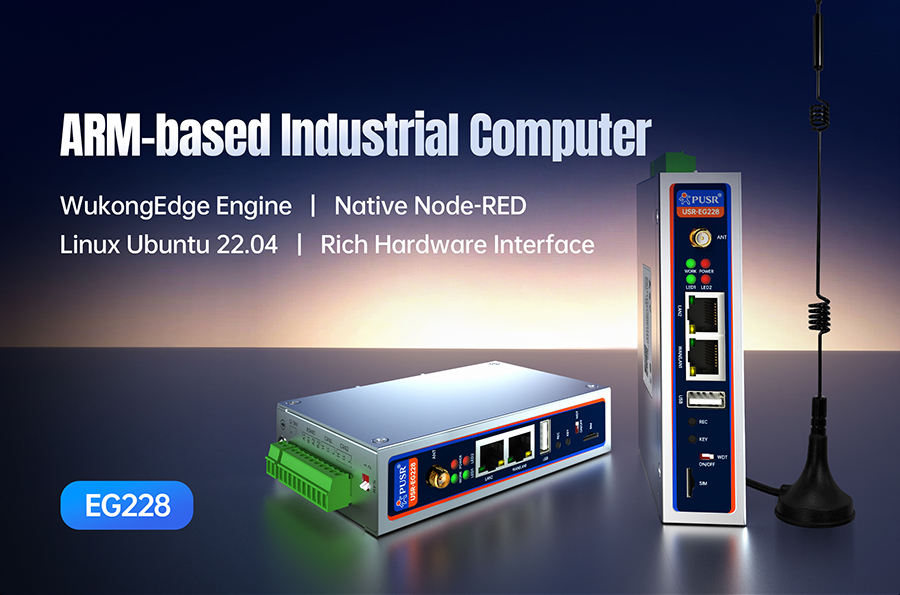
Among numerous fanless industrial PC products, the USR-EG228 stands out with its excellent low-temperature adaptability. It is specifically designed for extreme environments and can operate stably at -40°C low temperatures, meeting the demanding needs of oil and gas warehousing scenarios. The USR-EG228 adopts high-performance processors and low-temperature compatible components, ensuring data processing speed and signal transmission stability at low temperatures. At the same time, its optimized heat dissipation and insulation design, along with enhanced mechanical structural strength, enable the fanless industrial PC to maintain efficient operation and extend service life in low-temperature environments.
An oil and gas warehousing enterprise located within the Arctic Circle experiences winter temperatures consistently below -40°C. To achieve unmanned and intelligent warehousing, the enterprise introduced an AGV system equipped with the USR-EG228 fanless industrial PC. In practical application, the USR-EG228 fanless industrial PC successfully overcame the challenges of the low-temperature environment, ensuring stable AGV operation under extreme conditions. Whether for cargo handling, storage, or communication with external systems, the USR-EG228 demonstrated outstanding performance and reliability. This successful case fully proves the applicability and superiority of the USR-EG228 fanless industrial PC in low-temperature oil and gas warehousing.
Since introducing the USR-EG228 fanless industrial PC, the oil and gas warehousing enterprise has given high praise for its performance. The customer stated that the USR-EG228 not only improved the operational stability and efficiency of AGVs at low temperatures but also reduced maintenance costs and safety risks. At the same time, we have also continuously optimized and upgraded the USR-EG228 based on customer feedback and requirements. For example, we further optimized the heat dissipation and insulation design of the fanless industrial PC, improving its operational capability at even lower temperatures; we also enhanced the anti-interference capability of the fanless industrial PC, ensuring stable operation in complex electromagnetic environments. These optimization measures have made the USR-EG228 more suitable for the needs of low-temperature oil and gas warehousing, creating greater value for customers.
In the process of cooperating with customers, we are always committed to deeply understanding their needs and pain points. We understand that in the low-temperature oil and gas warehousing field, customers not only need a fanless industrial PC that can operate stably in extreme environments but also need a partner who can face challenges and solve problems together with them. Therefore, we not only provide high-quality products but also offer comprehensive technical support and after-sales service, ensuring customers have no worries during use.
We deeply understand that merely meeting customers' basic needs is far from enough. To win customer trust and loyalty, we must exceed their expectations. Therefore, we strive for excellence in every link of product design, production, sales, and after-sales service. We continuously optimize product performance, improve production efficiency, and reduce production costs, in order to provide customers with more competitive prices and better services. At the same time, we also actively communicate with customers, understand their feedback and suggestions, and continuously improve products and services to meet their growing needs.
In the wave of unmanned oil and gas warehousing, AGVs, as core equipment, are playing an increasingly important role. However, in extreme low-temperature environments, AGV operation faces enormous challenges. The fanless industrial PC, as the "brain" of the AGV, has performance and stability that become the key factor determining whether the AGV can work continuously and efficiently at low temperatures. The USR-EG228 fanless industrial PC, with its outstanding low-temperature adaptability, excellent performance and reliability, and comprehensive technical support and after-sales service, has become the ideal choice for the low-temperature oil and gas warehousing field. In the future, we will continue to dedicate ourselves to the R&D and innovation of fanless industrial PCs, providing more "warm" guarantees for low-temperature oil and gas warehousing and driving the industry's intelligent and unmanned progress.