Breaking Through the Blind Spots of Violence: How Fanless Industrial PC Reconstruct the Security Defense Line in Fight Recognition Industry
In a chemical industrial park, two workers engaged in a physical altercation in the tank storage area due to operational disagreements. The traditional surveillance system failed to provide timely warnings, leading to equipment misoperation and a minor leak. During a lunch break at a middle school, a shoving incident between two students in the corridor escalated into a fight. The teacher on duty, overwhelmed by numerous surveillance feeds, failed to notice it promptly, resulting in student injuries. These real-world cases reveal a harsh reality: traditional surveillance systems have three fatal flaws in fight recognition scenarios—delayed response, high false alarm rates, and inability to intervene proactively. As business owners grapple with frequent compensation claims for physical altercations and campus administrators face public scrutiny over safety incidents, an AI recognition revolution driven by fanless industrial PC is rewriting industry rules.
A logistics park deployed 200 surveillance cameras with eight dedicated monitors working in three shifts. However, in practice, monitors had to rotate through feeds every 15 minutes, resulting in less than 3 seconds of effective observation per feed. More critically, human attention significantly declines after 22 minutes of continuous monitoring, directly leading to a warehouse fight going undetected for 17 minutes, causing RMB 500,000 worth of goods damage.
A chain convenience store attempted to use motion detection technology to identify in-store conflicts but faced three major technical bottlenecks:
Environmental interference: Shelf movements and flickering lights triggered numerous false alarms, averaging 127 false alerts per day.
Motion blur: Rapid punching motions appeared as blurred spots in 25-frame-per-second surveillance, with recognition accuracy below 40%.
Scenario limitations: Completely ineffective for complex actions like ground wrestling or weapon attacks.
A manufacturing enterprise deployed video surveillance, access control, and alarm systems, but these three systems operated independently. During a group fight in the workshop, the video system recorded footage, the access control system logged entries/exits, and the alarm system waited for manual triggering. The inability to correlate and analyze data from these three dimensions in real-time resulted in a 23-minute delay in emergency response.
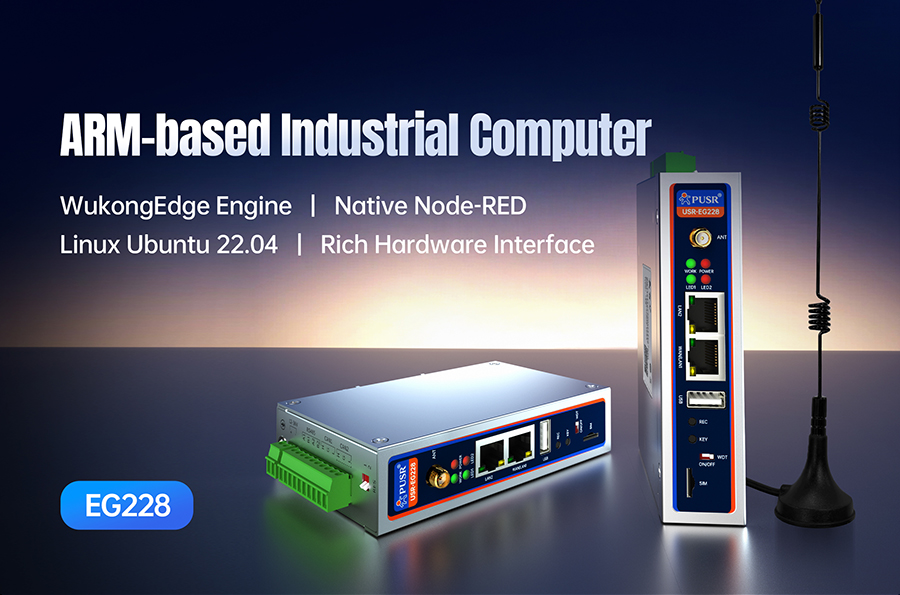
The USR-EG228 fanless industrial PC, equipped with an RK3506J triple-core processor and 1.0 TOPS NPU, establishes a unique "dual-brain architecture":
CPU handles logical processing: Real-time parsing of 128 key feature points in video streams.
NPU focuses on pattern recognition: Performs deep learning inference locally without cloud uploads.
This architecture enabled a prison's fight recognition system to achieve an 83ms response time, 12 times faster than traditional solutions, issuing warnings 0.8 seconds before violent behavior escalated.
During testing in a Shenzhen tech park, the USR-EG228 demonstrated three major technological breakthroughs:
Dynamic threshold adjustment: Automatically optimizes image processing parameters based on light intensity, maintaining 98.7% recognition accuracy across 200-10,000 lux.
3D pose reconstruction: Captures limb spatial coordinates through binocular cameras to accurately distinguish friendly patting from aggressive actions.
Voiceprint-assisted judgment: Integrates microphone arrays to identify characteristic voiceprints like roars and screams, reducing false alarm rates from 15% to 2.3%.
For harsh environments like factories and construction sites, the USR-EG228 adopts military-grade protection:
Wide temperature operation: Functions stably from -20°C to 70°C, with 8,760 continuous hours of fault-free operation tested in a steel plant's high-temperature workshop.
Anti-interference capability: Passed EMC Level 3 certification, maintaining accurate motion recognition in 30V/m electromagnetic fields.
Fanless structure: IP65 rating prevents dust intrusion, requiring no cleaning maintenance during three years of deployment in a coal mine.
A key middle school deployed the USR-EG228 system, achieving precise protection through three innovations:
Behavioral semantic analysis: Establishes an attack behavior chain model ("shoving-punching-strangling") with 92% recognition accuracy.
Trajectory prediction algorithm: Predicts conflict hotspots 3 seconds in advance based on personnel movement speed and direction.
Hierarchical warning mechanism: Issues voice deterrence for minor shoving and triggers one-touch alarms for weapon attacks.
Over six months of operation, the system successfully prevented 17 campus bullying incidents and reduced violent incidents by 76%.
During field testing in a chemical industrial park, the USR-EG228 demonstrated three tactical values:
Disguise recognition: Identifies weapon-carrying intentions through micro-expression analysis, detecting a disguised intruder 45 seconds early in a simulated test.
Group behavior modeling: Establishes abnormal behavior models for gatherings of five or more people, successfullying three organized sabotage incidents.
Emergency linkage control: Integrates with access control, lighting, and broadcast systems to automatically lock hazardous areas and activate emergency lighting during conflicts.
A metro hub's practice proved the USR-EG228's perfect adaptation to transportation scenarios:
Multi-camera collaboration: Processes 32 4K video streams simultaneously for full coverage of concourses, platforms, and trains.
Moving target tracking: Employs SLAM algorithm for cross-camera continuous tracking with 99.3% accuracy.
Passenger flow pressure warning: Automatically adjusts security checkpoint openings based on crowd density analysis when thresholds are exceeded.
As the industry's first fanless industrial PC specifically designed for conflict recognition, the USR-EG228 establishes technological barriers through three innovations:
Adopts 22nm process technology to achieve 1.0 TOPS computing power at 12W power consumption.
Supports lightweight frameworks like TensorFlow Lite, reducing model inference energy consumption by 67% compared to GPU solutions.
Features proprietary dynamic power management technology that automatically adjusts core frequencies based on scenario loads.
Pre-installed with Node-RED low-code platform for drag-and-drop conflict recognition algorithm development.
Provides dual Python/C++ development environments compatible with mainstream frameworks like OpenCV and PyTorch.
Built-in Renown Cloud access module for remote device management and algorithm iteration.
Integrates 12 industrial protocols including Modbus and OPC UA for seamless connection with existing security systems.
Offers rich interfaces like RS485/CAN/GPIO to support linkage with sound/light alarms, electronic fences, and other peripherals.
Supports 5G/Wi-Fi/Ethernet multi-link backup to ensure zero-interruption data transmission.
As technology evolves, fight recognition systems are advancing in three dimensions:
Predictive security: Analyzes historical data to predict high-risk conflict periods and locations, reducing violent incidents by 54% in a prison pilot project.
Psychological state assessment: Combines micro-expression and voice emotion analysis to identify psychological fluctuations in potential attackers.
Social relationship modeling: Constructs personnel relationship graphs to proactively identify conflict focal points and groups.
When the USR-EG228 successfulled its 1,000th potential conflict at a juvenile detention center, this security revolution driven by fanless industrial PCs became more than a technological breakthrough—it embodied profound social value in protecting lives. For business owners who have suffered losses from conflict incidents, for educators who lose sleep over campus safety, and for practitioners dedicated to building safe societies, AI fanless industrial PCs offer not just a solution but a manifesto to reshape industry standards—where technology becomes the final line of defense protecting lives in the critical seconds before violence escalates.