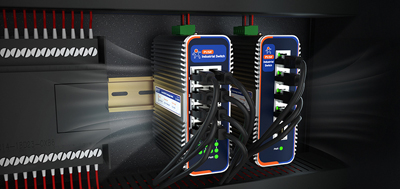
Scaling a cabinet at an edge or telecom site tends to follow the same pattern: every new function arrives as its own box — one for backhaul, one for protocol conversion, one for access, plus a few IO slices. Each unit brings its own power module, its own DIN-rail footprint and its own management address, and the site inventory list ends up longer than the network diagram. That is why the idea of a modular edge unit keeps resurfacing: folding several layers into one system that can be understood at a glance is more practical than stacking more hardware.
Where anindustrial gatewaysits in that system is the first thing to settle at the selection stage.
Small and mid-size edge sites break down into three layers:
One device covering all three layers is unrealistic at a mid-size or large site. At sites with a few dozen to a few hundred points, however, folding the backhaul layer and part of the access layer into a single gateway is common practice.
An industrial gateway is better described as the conversion and decision point between the field layer and the backhaul layer, rather than a drop-in replacement for a router or a switch. The interface layout of the edge computing gateway USR-M300 shows this division of labour: one RS232/485 port and one RS485 port face the field side, one WAN/LAN port and one LAN port face the network side, and 2 DI, 2 DO and 2 current-type AI channels handle local signals directly. Serial ports, Ethernet ports and IO can be acquired in parallel, with an acquisition ceiling of 2,000 data points stated by the vendor.
Functionally it does three things at once: protocol conversion for Modbus RTU/TCP and common PLC protocols; local logic through Node-RED graphical programming on Linux for data cleaning, threshold decisions and report conditions; and northbound reporting over standard MQTT and TCP to a public cloud platform or a private server.
It also carries routing, VPN and firewall capability. Whether a site needs a separate router therefore depends on how complex the network boundary is, not on whether the site needs internet access. On the hardware side it is rated for level 3 EMC protection, wide-voltage supply, a -25 to 75 °C operating range, and DIN-rail or wall mounting.
When all three appear at one site, responsibilities can be split as follows:
A clear boundary makes each layer replaceable: swapping the switch does not disturb acquisition configuration, and swapping the gateway does not disturb site routing policy. The reverse arrangement — a gateway doing both NAT and reporting while the switch also rewrites addresses — makes it hard to tell which layer altered a packet when something goes wrong.
Where point counts are low but data has to survive a network outage, USR-M100 is another option: cellular and WAN access, 300 to 1,000 data points, and SD card caching while the link is down, with cached data sent once the connection recovers.
A workable order for selection: fix the site scale and point count first, then the complexity of the network boundary, which decides whether a separate router is needed, and finally the depth of IO and local logic, which decides whether IO expansion modules and Node-RED c