Insurance Claims AGV's "High-Efficiency Operation": How Industrial Mini PC Achieves Fast Document Scanning and Transmission?
A batch of auto insurance damage assessment materials has just been delivered to the counter by an AGV. The system automatically triggers the scanning workflow. 30 pages of damage assessment forms, 12 on-site photos, 4 segments of dashcam video — all completed with OCR recognition, classification and archiving, and uploaded to the core claims system within 47 seconds.
Three years ago, the same job, handled manually by two claims adjusters, took an average of 40 minutes with an error and omission rate of 11%.
This isn't science fiction. This is the claims revolution happening right now.
And the behind-the-scenes driver of this revolution isn't some sky-high-priced AI system. It's something you've probably never given a second look — the industrial mini PCsitting inside that AGV.
People working on insurance claims projects say "efficiency" out loud, but what they're really thinking is something else:
"For the love of God, don't let me be the bottleneck."
Why? Because claims is the front line of an insurance company's reputation. The customer has already had an accident — they're in a bad enough mood. If the materials are submitted and there's no response in three days, one complaint call goes straight to the banking and insurance regulator.
So your AGV isn't just a "transport vehicle." It's amobile claims pre-processing center— documents should be scanned, transmitted, and classified while still on the vehicle, arriving at the counter ready to enter the review workflow directly.
But here's the problem:
These problems can't be solved by just "picking a good CPU." They are system-level pain points that require system-level answers.
Referencing Eurocoin and Nalarobot's industrial PC selection guides, they repeatedly emphasize one point:"Not every Industrial PC meets the necessary standards."
Applied to claims AGVs, this sentence stings even more.
Many projects focus their selection efforts on the AGV itself — payload capacity, navigation precision, obstacle avoidance sensitivity. The industrial mini PC? Just find any unit that "fits in the chassis."
This is the biggest trap.
Because the industrial mini PC in a claims AGV isn't doing something simple like "controlling whether the motor turns or not." It has to simultaneously run:
| Task Module | Real-Time Requirement | Data Volume | Failure Consequence |
|---|---|---|---|
| OCR Text Recognition | Single page < 2 sec | 30–100 pages/trip | Scan backlog, AGV queuing |
| Image Compression & Upload | Single image < 5 sec | 10–30 images/trip, 5–20MB each | Transmission timeout, task interruption |
| Video Clip Extraction | Real-time processing | 2–5 clips/trip, 100–500MB each | Storage overflow, system crash |
| Claims System API Integration | Response < 3 sec | 1 API call/trip | Data desync, manual re-entry |
| Local Cache & Resume Transfer | Millisecond-level switching | Cumulative GB/day | Data loss, escalated complaints |
Five tasks running simultaneously. If any one of them gets stuck, the entire AGV goes down.
And most industrial mini PCs that "fit in the chassis" simply cannot withstand this concurrent pressure.
Based on Corvalent and Eurocoin's selection frameworks, I've broken down the industrial mini PC requirements for claims AGV scenarios into four dimensions. These four dimensions are what you should really be staring at during selection:
The industrial mini PC in a claims AGV has very diverse interface demands:
Many industrial mini PCs only give you two USB 2.0 ports + one 100Mbps network port. This configuration is fine for data collection, but for claims scanning? Get ready for the queue.
During selection, you must confirm: Is there USB 3.0? Is the network port Gigabit or 100Mbps? Is there expansion space for a 4G module?
The characteristics of claims materials: fragmented, high-concurrency, continuous writes.
Scan a few PDF pages, transmit a few photos, cache a video segment. The storage system has to constantly switch between "small file random writes" and "large file sequential writes."
Ordinary SSDs in this scenario start slowing down in less than three months. Because once the SLC cache of TLC NAND is exhausted, the speed drops off a cliff — from 500MB/s down to 80MB/s.
Your AGV doesn't just run for one day. It runs for one year, two years, three years. Storage durability and sustained write performance are ten times more important than the rated speed.
Industry data shows (referencing Industrial Computing Alliance report) that storage failures causing unplanned downtime account for 23% of total failures in industrial scenarios. A claims AGV running dozens of trips a day — this ratio is only going to be higher.
Many people picking industrial mini PC love looking at core counts — eight cores, sixteen cores, the more the better.
But the claims AGV scenario isn't running rendering, isn't running AI training. What it needs is:multi-task parallel scheduling capability.
OCR engine running, network transmitting, storage writing, AGV navigation computing — four things happening at once. The CPU has to allocate priorities intelligently, not let OCR eat all the network bandwidth and cause upload timeouts.
ARM architecture actually has an advantage in this scenario — low power consumption, high multi-core scheduling efficiency, and many ARM industrial mini PC come with a built-in NPU that can hardware-accelerate OCR, 3–5× faster than pure CPU execution.
Eurocoin's guide also mentions this:"ARM-based industrial PCs are more energy-efficient but may have compatibility limitations."The key is whether your software stack can run on ARM. The good news is, mainstream OCR engines and claims systems already support ARM.
A claims AGV isn't a 9-to-5 device. It might get called up at 3 AM for an urgent job, or have only a 5-minute gap between two tasks.
If the industrial mini PC takes two minutes to reboot every time, that accumulates to tens of minutes of wasted time per day.
So you need a system that supports fast startup — from standby to fully operational, ideally within 10 seconds. Some industrial mini PC support S3 sleep instead of full shutdown, with wake-up times compressed to under 3 seconds.
This spec won't be on the datasheet, but it directly determines how many extra trips your AGV can run per day.
I've run the numbers for you (based on the industry data framework provided by Nalarobot):
| Metric | Ordinary Industrial Mini PC Solution | Properly Selected Solution | Gap |
|---|---|---|---|
| Single-trip document processing time | 3–5 minutes | 40–60 seconds | 4× efficiency gain |
| Daily effective trips | 40 trips | 55 trips | +15 trips |
| Monthly downtime due to industrial mini PC failure | 8 hours | < 1 hour | -7 hours |
| Annual manual re-entry cost | 120,000 RMB | 20,000 RMB | Save 100,000 RMB |
| Customer complaint rate | 3.2% | 0.8% | -75% |
The price difference for an industrial mini PC might be just two to three thousand RMB. But the efficiency gap and cost savings it brings? Over a hundred thousand RMB per year.
This is why I say: industrial mini PC selection isn't "cost saving" — it'sthe highest ROI link in the entire chain.
Going back to Eurocoin's article framework, I've summarized it into a"Claims AGV Industrial Mini PC Selection Checklist":
Honestly, the selection of industrial mini PC that can simultaneously deliver "ARM multi-core + NPU acceleration + USB 3.0 + Gigabit LAN + fanless + compact form factor" is pretty narrow.
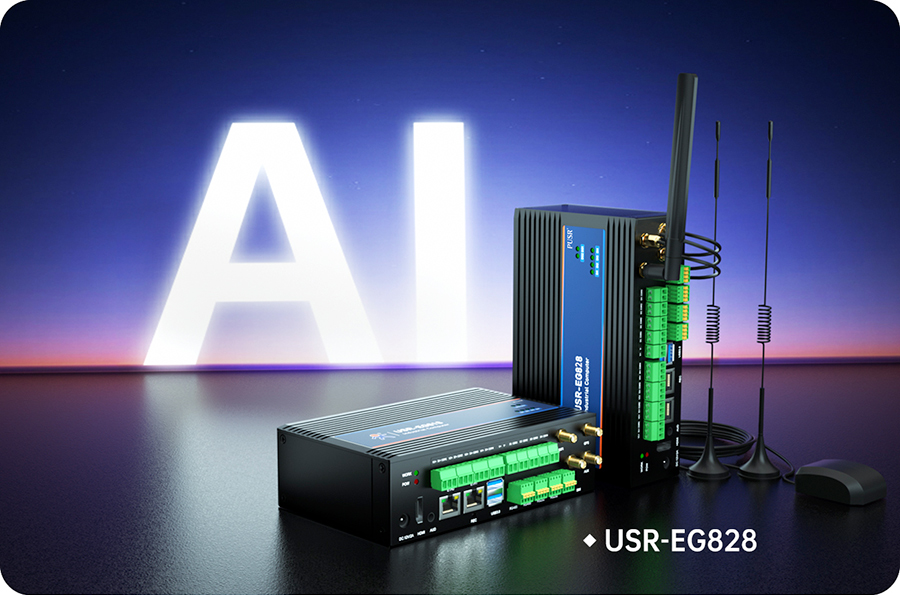
TheUSR-EG828is one of the options I've seen that fits the claims AGV scenario quite well. RK3568 quad-core processor with NPU — OCR hardware acceleration is its strong suit. Interface configuration is sufficient, storage supports expansion. Power consumption is kept very low, fanless design, fits into the AGV chassis without taking up space.
It's not the kind of "can do everything but masters nothing" jack-of-all-trades. It's a productivity tool specifically honed for this "high-concurrency document processing" scenario.
Of course, final selection should be based on your claims system integration situation. I recommend taking the checklist above and comparing item by item. Don't be fooled by the numbers on the spec sheet — the right machine is the one that can actually run your business workflow.
Working on a claims AGV project, the thing you fear most isn't that the AGV can't run fast. It's that the document processing step becomes the bottleneck.
No matter how fast the AGV runs, if the documents aren't scanned by the time it reaches the counter, it's a wasted trip. The longer the customer waits, the more complaints you get, the worse your project reputation becomes.
The industrial mini PC is the most underestimated yet most impactful link in the entire chain.
Don't wait until after deployment to discover "scanning is too slow," "transmission is lagging," "storage is full" — the cost of changing the plan at that point is ten times the cost of carefully comparing options during selection.
Pick the right industrial mini PC, and your AGV can truly go from "can run" to "can deliver."
That's where high-efficiency operation begins.