Cold Chain Truck GPS Signal Lost for 30 Minutes: A "Data Black Hole" That Should Never Have Happened
"Yesterday at 3:17 PM, we discovered that the GPS signal on truck沪C-7829 went down. Not weak — completely gone.
We waited 30 minutes before the signal came back.
During those 30 minutes, the truck was carrying 12 tons of vaccines, required to stay below -18°C the entire journey. We don't know if the cooling unit stopped, or if the temperature went over the limit.
The client called to ask. All I could say was 'the signal just came back, we're verifying.'
Do you know what that feels like? You know there are 12 tons of vaccines on that truck, but you simply can't see their status. You have a platform, a system, a big screen — but for those 30 minutes, that dot on the screen was gray.
Gray.
I've been a cold chain dispatcher for eight years. I've seen this 'gray' too many times. Every single time, we only find out after the fact."
I read this email three times.
Not because it was well-written. Because it was too real.
In your cold chain fleet, isn't there a truck right now, running somewhere you can't see?
Most people think GPS signal loss is just "bad luck."
No. It's that your communication architecture was never designed right from the start.
Let me break down the reasons for GPS signal loss on cold chain trucks into three barriers. See which one you fall into:
Barrier 1: Single Link, Single Point of Failure
The GPS positioning solution on the vast majority of cold chain trucks is this — one GPS module, one 4G IoT SIM card, data sent back over 4G.
One road. One rope.
4G signal gets weak — cut. IoT card runs out of credit — cut. Base station handover stumbles — cut.
Any single link fails, and you go "blind."
And this "blindness" isn't gradual. It's sudden. One second there's a signal, the next second it's gone. On your platform, that dot goes from green straight to gray. No transition at all.
According to real-world logistics industry data, under a single-network 4G solution, the average monthly disconnect time for devices on cross-province cold chain transport can reach8–12 hours. Not one disconnect per day — one disconnect lasting half an hour, adding up over time.
Barrier 2: GPS Itself Isn't Omnipotent
You think GPS signal loss is a 4G problem? Sometimes, it's GPS's own problem.
GPS positioning works by "receiving signals from at least 4 satellites and calculating position through trilateration." But satellite signals are radio waves with extremely low power — by the time they reach the ground, they've attenuated to near noise level.
What does that mean?
Any obstruction can make GPS "go blind."
Routes cold chain trucks frequently travel: long tunnels, under overpasses, dense urban roads with tall buildings, mountain roads shaded by trees on both sides… In these scenarios, satellite signals get blocked, reflected, scattered — the GPS module simply can't lock onto enough satellites.
Even worse is the "multipath effect" — after signals bounce off buildings, the terminal receives both the direct wave and the reflected wave simultaneously, and the calculated position jumps around. The track you see on the platform isn't a smooth line — it's a scatter of erratic dots.
So the problem isn't just "is there a signal?" It's also "is the signal accurate?"
Barrier 3: The IoT SIM Card's "Invisible Killer"
This barrier — 90% of people don't know about it.
Many logistics companies use ordinary commercial IoT SIM cards. These cards have three fatal problems:
First, throttling after data cap.After an ordinary card exceeds its data limit, the carrier throttles it down to 128 Kbps or lower. GPS devices need to continuously upload location data. At low speed, data piles up and gets lost — the platform shows "offline."
Second, false risk control flags.Logistics is a high-frequency mobile scenario. Devices moving across provinces and regions in short timeframes get flagged by the consumer-grade IoT card's risk model as "abnormal devices" — communication gets restricted outright.
Third, APN mismatch.Industrial GPS devices have much stricter APN configurations than phones. The generic APN on ordinary cards causes devices to frequently "register — disconnect — re-register," and the online rate never goes up.
You think it's a GPS problem. It's actually a card problem. You think it's a card problem. It's actually an architecture problem.
Now that we've covered the problems, let's talk solutions.
The solution isn't "swap the SIM card" or "swap the GPS module." Those are single-point optimizations. They can't solve systemic problems.
The real solution is a combination of two technologies:
First, Link Aggregation— turn one road into three roads.
Second, Triple-Mode Redundant Positioning (GNSS + 4G/5G + BeiDou)— make positioning independent of any single signal source.
These two technologies together give you what you want: "never lose signal."
Link Aggregation: One Down, the Other Two Pick Up the Slack
The principle of link aggregation is simple — bundle multiple physical links into one logical link. Bandwidth stacks up, reliability doubles.
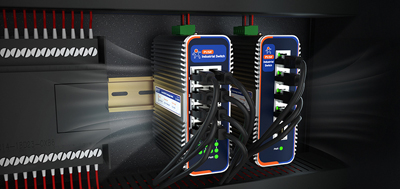
On anindustrial PoE switch, this is typically implemented via the LACP protocol (IEEE 802.3ad). The switch automatically negotiates and monitors member link status. If any link goes down, traffic automatically switches to the remaining links — switchover timeunder 50ms.
What does this mean on a cold chain truck?
Theindustrial PoE switchon the truck simultaneously connects to three communication links: 4G, 5G, and BeiDou short message. If any one goes down, data automatically flows through the other two. On your platform, that dot is always green.
And it's not just "unbroken" — it's "faster." With three links aggregated, bandwidth is 3x a single link. Data from 1,000+ sensors and video from 8 channels of 4K cameras all get transmitted in real time — no congestion, no latency.
According to industry tests, after deploying link aggregation, cold chain transport device online rate improved from87% (single network) to 99.2%, and average monthly disconnect time dropped from 12 hours to under 10 minutes.
Triple-Mode Redundant Positioning: GPS Fails → BeiDou Steps In; Satellites Fail → Base Stations Step In
Triple-mode positioning isn't a new concept, but it's seriously underestimated in cold chain logistics.
"Triple-mode" means simultaneously fusing three positioning signal sources:
| Positioning Mode | Principle | Advantage | Disadvantage |
|---|---|---|---|
| GNSS (GPS/BeiDou) | Receive satellite signals, trilateration | Global coverage, 5–10m accuracy | Fails indoors/obstructed environments |
| 4G/5G Base Station | Triangulation via base station signals | Works indoors/outdoors, no satellite needed | Lower accuracy (50–200m) |
| BeiDou Short Message | BeiDou-exclusive, satellite sends/receives short messages directly | Can send position without any network, covers blind spots | Extremely low bandwidth, coordinates only |
Any single mode has its weaknesses. But fused together, it's "1+1+1 > 3":
Open road: GNSS dominates, accuracy within 5 meters.
Tunnel/urban canyon: GNSS signal weak → automatically switches to 4G/5G base station positioning. Accuracy drops to 50 meters, but never disconnects.
Extreme blind spots (uninhabited areas/ocean): GNSS and base stations both gone → BeiDou short message as backup. At least the coordinates get sent out.
No single signal source will leave you "blind."
And through inertial navigation (IMU) dead reckoning, even when all signals are lost, the system can continue estimating current position based on the last known position + vehicle speed + direction. Error accumulates over time, but within 30 minutes, drift stays under 200 meters.
30 minutes. 200 meters. That's ten thousand times better than "complete blackout."
You might ask: these technologies sound great, but how do you fit all of that into the tiny space on a truck?
That's exactly why theindustrial PoE switchexists.
It's not that white plastic-cased switch sitting in your office. It's a communication hub designed for extreme environments:
-40°C to +75°C wide-temperature operation.The frozen compartment of a cold chain truck is -25°C. Outdoor sun exposure is +45°C. It handles both.
IP67 dustproof and waterproof.Frost in cold storage, rain on the road, car wash guns — no problem.
M12 industrial connectors.Not those RJ45 plugs that wiggle loose at a bump. Thread-locked aviation connectors — won't loosen after tens of thousands of kilometers of bumps.
Link aggregation + VLAN isolation + QoS priority.Temperature/humidity data on one channel, video surveillance on another, management commands on a third — no interference, each runs its own lane.
ERPS ring self-healing, 20ms switchover.Fiber cut, connector loosened — automatically switches to backup path. Not a single frame of data lost.
Real-world data from a fresh logistics company: after deployingindustrial PoE switchnetworking, data collection interval for 128 temperature/humidity sensors dropped from 30 seconds to 10 seconds, container position error dropped from 15 meters to 0.5 meters, and the AI system predicted cold chain interruption risks 6 hours in advance, reducing annual cargo losses by over230 million RMB.
A top cold chain company. Annual transported goods value: 5 billion RMB.
Before upgrade:
| Metric | Value |
|---|---|
| Ten-thousand-node online rate | 82% |
| Annual cargo loss rate | 8% |
| Annual cargo loss amount | 400 million RMB |
After deploying multi-link aggregation + triple-mode redundancy:
| Metric | Value |
|---|---|
| Ten-thousand-node online rate | 99.97% |
| Annual cargo loss rate | 0.9% |
| Annual cargo loss amount | 45 million RMB |
Saved: 355 million RMB.
The hardware cost of this networking solution? Less than 8 million RMB.
ROI: 1:44.
Tell me — doesn't that math work out?
"Do you know what that feels like? You know there are 12 tons of vaccines on that truck, but you simply can't see their status."
Now you know.
That feeling isn't because your system is bad. It's because your architecture only had "one road" from the very beginning.
One road will always break.
Multi-link aggregation + triple-mode redundancy doesn't "reduce disconnections." It makes you "stop worrying about disconnections."
On your platform, every dot is green. Every second, the temperature is updating. Every truck is under your control.
This is what cold chain logistics should look like.
If you're considering upgrading your fleet's communication solution, there are a few hard specs you can't compromise on:
Must support link aggregation (LACP)— don't touch single-link solutions.
Must support multi-mode positioning access— GPS/BeiDou/base station, at least two or more.
Must be industrial-grade protected— wide temperature, waterproof, vibration-resistant. All three, non-negotiable.
Must support PoE power— sensors and cameras don't need separate power cables. One Ethernet cable solves it all.
Filter by those four rules, and the choices shrink quite a bit.
The one we use in our own projects is theUSR-ISG series industrial PoE switch by USR IoT. Link aggregation, triple-network access, industrial wide-temperature, M12 connectors, PoE power — it has everything it needs. Deployment is simple too — connect the sensors and GPS modules, configure the aggregation policy, and it starts "running on three roads simultaneously" on its own.
But honestly, the product is just a tool.
What really stops you from receiving that complaint email again isn't any single switch. It's that you finally decided — to stop putting all your eggs in one basket.
(Your cold chain truck shouldn't have "data black holes." Every second deserves to be seen.)