From Farm to Table: A Box of Strawberries in 72 Hours, and the Invisible Network Behind It
A Strawberry's "Death Countdown"
3 AM. A strawberry farm in Yunnan.
Old Chen is crouching at the cold storage door, watching workers pack, pre-cool, and load the freshly picked strawberries. 2°C, 85% humidity — everything's perfect.
72 hours later, this box of strawberries will appear on a shelf at a Shanghai supermarket, priced at 38 RMB per box.
But what Old Chen doesn't know is — in those 72 hours, there are 14 stages, 86 nodes, and over 10,000 data collection points. If any one of them fails, this box of strawberries will rot on the road.
What he doesn't know even more is that last year, 12% of the strawberries he shipped never made it to the shelf alive.
It wasn't because they were grown badly. It was because something went wrong "on the road."
The temperature chain broke. Data packets were lost. Alerts were sent but nobody saw them — an unbroken cold chain doesn't rely on foam boxes and dry ice. It relies on a network you can't see.
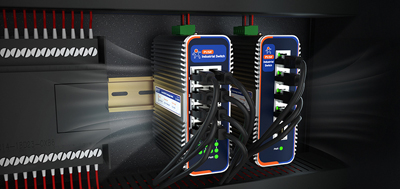
And the "central nervous system" of that network is theindustrial switch.
Most people's understanding of cold chain still stops at "refrigerated truck + cold storage."
But do you know how many temperature control nodes a box of vaccines goes through from factory to injection?
The answer: over 200.
From farm pre-cooling storage → refrigerated truck → transfer hub → city distribution station → community health center → vaccination point fridge — every single node has temperature sensors, humidity sensors, GPS modules, door-open sensors…
A mid-sized cold chain logistics company has 200 refrigerated trucks, 50 cold storages, 300 temperature-controlled containers, and thousands of sensors.
Number of nodes: tens of thousands.
These nodes are generating data every second. Temperature, humidity, location, door status, refrigeration equipment parameters… all need to be transmitted in real time to the central monitoring platform.
Here's the question: how do you connect ten thousand nodes into a network that doesn't break, doesn't lose data, and doesn't lag?
Use a regular switch?
Don't make me laugh.
A regular switch operates at 0°C–40°C. Throw it into a -25°C freezer truck and it quits on the spot. Throw it into an 85°C southern summer warehouse and it dies of heat.
Even if it survives the temperature, what about vibration? A refrigerated truck bounces on the road for eight hours — loose connections and lost data packets are routine.
Even if it survives vibration, what about electromagnetic interference? The compressors in cold storage and the generators in refrigerated trucks are all EMI sources. A regular switch's signal gets drowned out instantly.
So the core contradiction of cold chain logistics has never been "is it cold enough?" It's "can it stay connected?"
Ten thousand nodes. If any one disconnects, the whole chain can collapse.
Let me break the cold chain networking challenge into four layers, and you'll see.
Layer 1: Extreme temperatures kill equipment first
The temperature range in cold chain is -40°C to +35°C.
Regular switches can't handle below -25°C, which means the switch inside a freezer truck must be industrial-grade, supporting -40°C cold start.
Real-world data from a multinational cold chain company: under repeated switching between -25°C freezer trucks and 35°C outdoor environments, the failure rate of regular switches was8x higherthan industrial switches.
Layer 2: Nodes are moving — the network must "keep up"
Cold chain isn't static. Refrigerated trucks are moving. AGVs are carrying. Sorting robots are in motion.
High-frequency node movement means the network must support millisecond-level roaming handoff. If the handoff is slow, data is lost.
The industry benchmark is completing roaming handoff within20ms. Beyond that, real-time monitoring becomes "after-the-fact playback."
Layer 3: Data explosion — bandwidth can't clog
One refrigerated truck has 8 channels of 4K cameras + 100+ temperature/humidity sensors + GPS + door magnetic switches.
200 trucks means 1,600 video channels + 20,000+ sensor data streams, all needing real-time transmission.
Traditional 100Mbps network? Not enough. Must start at Gigabit, with 10-Gigabit at core nodes.
Layer 4: 7×24 non-stop — if it goes down, it's an incident
Cold chain can't break. Neither can the network.
If the network goes down, temperature data stops flowing back. You don't know if the cold storage is still cooling. By the time you find out, a whole warehouse of vaccines might already be ruined.
So dual power redundancy is mandatory, with automatic switchover on power loss — switchover time under50ms.
Put all four layers together, and that's what "lossless networking for tens of thousands of nodes" really means —
It's not just "can connect." It's that under any extreme condition, ten thousand nodes stay online simultaneously, not a single frame of data is lost, and latency is controlled at the millisecond level.
Now you understand — cold chain logistics doesn't need a switch. It needs a communication infrastructure designed for extreme environments.
What anindustrial switchdoes in cold chain, boiled down, is three things:
First, "stitch" ten thousand nodes into one network.
Through fiber optic ring + VLAN isolation + QoS priority, it strings together cold storages, refrigerated trucks, sorting centers, and distribution stations. Cold storage temperature data runs on one channel, video surveillance on another, management commands on a third — no interference, each runs its own lane.
Case from an international logistics company: after deploying industrial switches, 1,000+ cold chain containers achieved real-time temperature/humidity monitoring at 5 updates per second, instead of the original once every 30 minutes. Temperature monitoring error was compressed from ±1.2°C to ±0.3°C.
Second, "survive" in the harshest environments.
-40°C cold start, IP67 dust/waterproof, 4kV surge protection, fanless cooling design — these aren't specs on a datasheet. They're "survival permits" for cold chain sites.
Real-world data from a port: under 5G-level vibration conditions, the M12 interface connection stability of industrial switches was90% higherthan traditional solutions. After 2,000 hours of continuous AGV operation, the interface loosening rate was only 0.02‰.
Third, "self-heal" when broken.
RSTP/MSTP ring technology — if a fiber cable breaks, it automatically switches to the backup path within 50ms. ERPS ring self-healing can even achieve 20ms switchover.
What does that mean? It means even if a fiber cable gets dug up or an interface gets knocked loose, not a single frame of your temperature data will be lost.
A top cold chain company. Annual transported goods value: over 5 billion RMB.
Before deployment:
| Metric | Value |
|---|---|
| Ten-thousand-node online rate | 82% |
| Annual cargo loss rate | 8% |
| Annual cargo loss amount | 400 million RMB |
After deploying industrial switch networking:
| Metric | Value |
|---|---|
| Ten-thousand-node online rate | 99.97% |
| Annual cargo loss rate | 0.9% |
| Annual cargo loss amount | 45 million RMB |
Saved: 355 million RMB.
The hardware cost of this networking solution? Less than 8 million RMB.
ROI: 1:44.
Tell me — shouldn't this network be built?
Let's go back to that box of strawberries at the beginning.
Its 72 hours look like this:
| Time | Stage | Nodes | Data |
|---|---|---|---|
| 0h | Farm cold storage | Temp sensors ×20 | 2°C ±0.3°C |
| 6h | Loading | GPS + door sensor + temp ×8 | Location + door status + temp |
| 12h | Highway transport | Onboard switch aggregates 1,000+ sensors | Real-time transmission |
| 24h | Transfer hub | AGV + scanner + camera | Location + cargo + image |
| 48h | City delivery | Distribution station temp/humidity monitoring | 2°C–8°C |
| 72h | Supermarket shelf | Temp label + consumer scan | Full traceability |
6 stages. Tens of thousands of nodes. Not a single one can break.
If any one breaks, the data breaks. If the data breaks, you don't know what that box of strawberries went through. If you don't know what it went through, you don't dare put it on the shelf.
What theindustrial switchdoes is keep this network "unbroken."
Let the temperature from the farm reach the table. Let the scan at the table trace back to the farm.
Let government regulators see the full journey. Let consumer trust be backed by data.
There are quite a few industrial switches on the market that can achieve "lossless networking for tens of thousands of nodes." But the cold chain scenario has several hard thresholds:
Must support -40°C to 85°C wide temperature— cold chain doesn't pick seasons, and neither can the equipment.
Must be IP67 rated— cold storage frosts up, refrigerated trucks get rained on. The equipment must survive.
Must have ring self-healing under 50ms— when it breaks, it can't wait for a human to fix it. It must recover on its own.
Must support PoE— sensors and cameras don't need separate power cables. One Ethernet cable solves it all.
Must support Gigabit/10-Gigabit— tens of thousands of nodes. 100Mbps won't cut it.
Filter by these five rules, and the choices shrink quite a bit.
The one we use in our own projects is theUSR-ISG series by USR IoT. Wide temperature, IP40 protection, ring self-healing, PoE, Gigabit fiber ports — everything a cold chain scenario needs. Deployment is simple too — connect the sensors and cameras, configure the VLANs, power it on, and it runs.
But honestly, the product is just a tool.
What really lets that box of strawberries arrive at the table alive isn't any single switch. It's that you finally decided — to build this network.
Cold chain logistics, boiled down to one sentence:
From field to table, what's in between isn't distance. It's ten thousand nodes that could break at any moment.
You can choose to gamble — gamble that the temperature won't break, the data won't be lost, the alerts won't be late.
Or you can choose to build a network — let ten thousand nodes stay online simultaneously, let every degree of temperature be recorded, let every box of cargo be traceable.
The cost of gambling: hundreds of millions in cargo losses every year.
The cost of building the network: less than ten million.
You're Old Chen. Which do you choose?
(Your cold chain stays unbroken not because of luck, but because of a network that truly never breaks.)