Optimization of Smart Traffic Intersections: How IoT Gateway 5G+AI Resolve Urban "Traffic Gridlock"
In December 2025, a seemingly ordinary traffic accident occurred on a main road in Futian District, Shenzhen: a van overturned at an intersection, blocking three lanes. However, this incident triggered a domino effect—due to the inability of traditional traffic signals to dynamically adjust timing, the blocked traffic quickly spread to five adjacent intersections, ultimately paralyzing a surrounding area of 3 square kilometers and increasing average commuting time for citizens by 47 minutes.
This is not an isolated case. According to statistics, the annual economic losses caused by improper signal timing at intersections in China's first-tier cities exceed 200 billion yuan. More critically, with the number of new energy vehicles surpassing 100 million, the traditional model of "fixed timing + geomagnetic detection" for traffic signals can no longer adapt:
Delayed response: It takes 3-5 minutes from detecting congestion to adjusting signals, while the rapid acceleration/braking characteristics of new energy vehicles increase the speed of congestion propagation by 40%.
Data silos: Data sources such as cameras, geomagnetic sensors, and navigation apps operate independently, failing to form a holistic view.
Computing bottlenecks: The limited processing capacity of edge devices at intersections makes it difficult to support real-time AI analysis.
A logistics company executive once lamented, "Our trucks spend more time waiting at intersections than driving, increasing fuel costs by 23%, not to mention the losses from driver fatigue and delayed deliveries."
In Ma'anshan, Anhui Province, a quiet revolution is underway. The smart intersection system deployed by the local transportation department, through the combination of "USR-M300 IoT Gateway + 5G private network + AI algorithms," has achieved a leap from "second-level response" to "millisecond-level prediction" in signal timing:
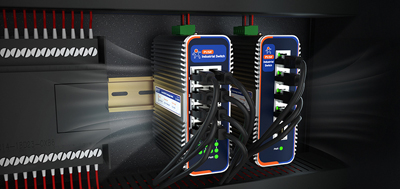
Traditional intersection devices are like "deaf-mutes"—cameras can only see, geomagnetic sensors can only sense, and navigation apps can only report, unable to communicate with each other. The USR-M300 IoT Gateway, with its powerful protocol conversion capabilities, serves as the key hub for data fusion:
Multi-protocol support: It simultaneously handles 12 industrial protocols such as Modbus, OPC UA, and MQTT, seamlessly connecting devices from different manufacturers.
Edge computing: Data cleaning and feature extraction are completed locally at the gateway, reducing invalid data uploads by 90%.
5G low latency: Data is transmitted back in 10ms via the 5G private network, 10 times faster than traditional fiber optics.
At a demonstration intersection in Ma'anshan, the system can process over 2,000 vehicle trajectory data points per second, identifying 18 typical scenarios such as "right-turn vehicle backlog" and "pedestrian crossing conflicts" with an accuracy rate of 98.7%.
The AI traffic signal control system jointly developed by Shenzhen Traffic Police and Huawei reveals the core logic of intelligent transportation:
Spatiotemporal prediction model: Based on LSTM neural networks, it can predict intersection traffic flow changes 15 minutes in advance with an error rate of less than 8%.
Reinforcement learning optimization: By simulating over 100,000 timing scenarios, it automatically generates optimal solutions, reducing average stopping times by 35%.
Priority for special vehicles: It reserves "green channels" for fire trucks and ambulances, compressing response times from minutes to within 15 seconds.
The director of the emergency center at a top-tier hospital commented, "Now, when ambulances approach intersections, the traffic signals turn green in advance, shortening dispatch times by 40%. Many critically ill patients have been saved as a result."
In the complex scenarios of smart transportation, the USR-M300 IoT Gateway demonstrates three unique advantages:
Environmental adaptability: It operates in a wide temperature range of -40°C to 85°C with an IP67 protection rating, capable of withstanding extreme weather conditions such as heavy rain and sandstorms.
Computing redundancy design: Equipped with a 1.2GHz quad-core processor and 4GB of memory, it supports running three AI models simultaneously.
Security protection: It features a built-in firewall and VPN encryption to prevent data tampering and signal hijacking.
During testing in the no-man's land of Golmud, Qinghai Province, the USR-M300 operated faultlessly for 180 consecutive days at -35°C, successfully supporting the traffic monitoring system along the Qinghai-Tibet Railway.
When technological breakthroughs encounter managerial inertia, the implementation of smart transportation often faces three major challenges:
A new first-tier city once planned to build a unified city-wide traffic brain but shelved the project due to inconsistent data formats among departments such as traffic police, urban management, and public transportation. The "data standardization" function of the USR-M300 became the key to breaking the deadlock:
Automatic mapping: It converts raw data from different manufacturers into a unified format.
Permission control: It achieves "usable but invisible" data through blockchain technology.
API openness: It provides standardized interfaces to support rapid integration by third-party applications.
The head of the city's transportation bureau stated, "Now, data from various departments can finally 'speak the same language,' improving cross-departmental collaboration efficiency by 60%."
Compared to traditional intelligent transportation systems costing tens of millions, the combination of 5G+AI+IoT Gateway offers significant cost advantages:
Modular design: The USR-M300 supports scalable IO interfaces, reducing initial investment.
Cloud-edge collaboration: It places 80% of computing tasks at the edge, reducing cloud computing demands.
Energy optimization: It consumes 55% less power than traditional industrial computers, saving over 10,000 yuan in annual electricity costs.
In a county-level city in Sichuan Province, the local government upgraded 20 key intersections using USR-M300 at a total investment equivalent to just one-third of traditional solutions, reducing congestion indices during peak hours by 22%.
A citizen once questioned, "How do we know if the AI is adjusting traffic signals randomly?" To address this, the system introduced "explainable AI" technology:
Decision visualization: Through an app, it shows drivers the reasons for signal adjustments (e.g., "Accident 300 meters ahead").
Public participation platform: It allows citizens to report abnormalities, which the system automatically verifies and incorporates into optimization models.
Performance evaluation reports: It publishes monthly data on intersection efficiency and emission reductions, accepting public supervision.
This "out-of-the-box" transparent mechanism increased public acceptance of smart transportation from 41% to 78%.
Looking back from the threshold of 2026, the evolutionary trajectory of smart transportation is clear: from "passive response" to "active prediction," from "single-point optimization" to "global collaboration," and from "mechanical control" to "organic life." In this transformation, IoT gateways are playing an increasingly vital role—not just as data connectors but also as intelligent carriers and security guardians.
As stated in the "2030 Global Traffic Trends Report" by an international think tank, "Future traffic intersections will no longer be cold steel jungles but 'urban cells' with perception, thinking, and evolutionary capabilities. The combination of 5G+AI+IoT Gateway is the key gene for constructing these cells."
For every urban manager eager to break free from traffic dilemmas, every ordinary citizen plagued by congestion, and every enterprise seeking balance between efficiency and safety, this revolution has arrived. It may not bring disruptive visual impacts but will quietly transform how we interact with cities every morning and evening—making travel smoother and life better.