Confession of an Automation Director: It Took Me Three Years to Admit That "Protocol Silos" Are the Factory's Biggest Enemy
— From CNC to Robot Arms, Those Unspeakable Pains — Finally, Someone Understands
Foreword: This isn't a technical article. It's a confession letter, three years overdue.
My name is Old Zhou. Twenty years in automation. Currently the Automation Director at a precision manufacturing company.
This article isn't written for engineers. It's written for people like me — people who've survived countless all-nighters on the shop floor, tortured by the word "protocol" until they wanted to change careers.
If your factory has CNCs, robot arms, AGVs, and inline inspection equipment — and they all speak different languages — you know exactly what I'm talking about.
If you don't, that's fine. After reading this, you will. And you'll regret it — regret not seeing it three years sooner.
In 2023, the company launched a fully automated precision machining line.
The CNC was Japanese — spindle accuracy 0.5μm, excellent. The robot arm was German — repeatability ±0.02mm, top-tier. The AGV was domestic — navigation accuracy ±10mm, good enough. The inline inspection was Israeli — measurement accuracy 0.3μm, impressive.
I stood next to that line and thought I'd done something extraordinary.
Equipment from four countries, assembled into a "world-class" production line.
Then the nightmare began.
The first integration debug is when I learned what "protocol silos" really meant.
The CNC used Fanuc FOCAS protocol. The robot arm used KUKA KRL. The AGV ran a custom TCP/IP stack. The inspection equipment used OPC UA.
Four languages. Four logics. Four worlds.
My engineer told me: "Boss Zhou, we need to write a middleware layer for the handshake signals between the CNC and the robot arm."
I said: "Write it."
Two weeks later: "Boss Zhou, the middleware is done, but the AGV scheduling system can't connect — protocol incompatible."
I said: "Write another one."
A month later: "Boss Zhou, the inspection data needs to go to MES, but OPC UA and the MES interface protocol don't match…"
I suddenly realized a terrifying truth:I wasn't building a production line. I was building a Tower of Babel.
Every new device meant another "island." Every island needed a "bridge" — and every bridge took my engineers weeks or even months to build.
At year-end, I tallied it up: protocol conversion and system integration alone cost me¥1.87 million.Not equipment money — money to make the equipment "talk."
¥1.87 million, spent not on technology — on translation.
Early 2025, I attended a smart manufacturing forum. Someone on stage said something that hit me like a slap in the face —
"The most expensive thing in your factory isn't the CNC. It isn't the robot arm. It's the middleware that makes them 'speak the same language.'"
I sat there frozen, suddenly remembering the ¥1.87 million from the past two years, the middleware that was written, rewritten, then scrapped, and my engineers' bloodshot eyes from re-tuning protocols on every changeover.
We'd been solving the wrong problem.
We thought the problem was "the equipment isn't good enough." No. The equipment was all excellent.
We thought the problem was "the engineers aren't strong enough." No. My engineers all graduated from top-tier universities.
The real problem was:we were missing a translator— something that could understand every language and stand between every device.
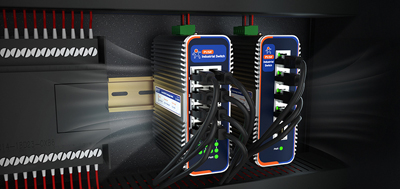
That something is an industrial gateway.
Let me break down "protocol silos" for you.
In your factory, at least five different communication protocols are running simultaneously:
| Device | Typical Protocol | Problem |
|---|---|---|
| CNC (Fanuc) | FOCAS | Closed protocol, no external access |
| CNC (Siemens) | S7/OPC UA | Requires authorization to access |
| Robot Arm (KUKA) | KRL/EtherCAT | Proprietary protocol, high integration cost |
| Robot Arm (ABB) | RAPID/EtherNet/IP | Also proprietary |
| AGV | Custom TCP/IP | Different for every vendor |
| Inspection Equipment | Modbus/OPC UA | Versions not even unified |
| MES/ERP | HTTP/REST | Completely different world from field devices |
You see it? Seven devices, seven languages. And making them work together on one line is like asking a Chinese person, a German, a Japanese, and an Israeli to perform surgery together — without a translator.
Not impossible. But every time, you need to hire a new translator — and every translation might be wrong.
This is why your factory:
It's not that you're not capable.You're missing a universal translator.
When I first heard "an industrial gateway can solve protocol silos," I didn't believe it.
Because people had already tried to sell me "universal gateways" and "protocol converters" before. The result? Either they didn't support enough protocols, or latency was too high, or stability was poor — the line would drop connection the moment it started running.
But the industrial gateway of 2025 is a completely different animal from five years ago.
Its core logic is one sentence —
Don't make all devices learn a new language. Make the industrial gateway learn all languages.
How does it work?
Step 1: Full Protocol Access.
The industrial gateway comes built-in with 200+ industrial protocol drivers — Modbus RTU/TCP, OPC UA, EtherCAT, Profinet, S7, FOCAS, KRL, RAPID, Mitsubishi MC, Inovance… Whatever protocol is on your line, it can connect. No middleware needed. No custom development. Plug and communicate.
Step 2: Local Unification.
All device data is converted locally on the industrial gateway into one unified format — typically MQTT or JSON. From that point on, the CNC speaks Fanuc, the robot arm speaks KRL, the AGV speaks its custom language — but at the industrial gateway, they're all translated into "Mandarin."
Step 3: On-Demand Distribution.
The translated "Mandarin" data can be sent by the industrial gateway to MES, to the cloud, to dashboards, to alarm systems — whoever you want, whatever you want.
The entire process requireszero changesto any device's native "language."
This is the real "island-breaking" — not tearing down islands, but building bridges between them. And you only need to build each bridge once.
I know what you're thinking: "Old Zhou, is this thing reliable? Or is it just another gadget that'll take six months to integrate?"
I get it. I've been burned too.
But let me show you the most honest comparison:
| Metric | Traditional Middleware | Industrial Gateway |
|---|---|---|
| Protocols supported | 2–5 (custom extension needed) | 200+ (out of the box) |
| Integration cycle | 2–3 months per line | 1–2 weeks |
| Maintenance cost | ¥300K–500K/year (middleware iterations) | Near zero (firmware updates) |
| Changeover cost | Re-integrate every time | Swap config profile, 5 minutes |
| Data to cloud | Requires custom interface development | MQTT direct, plug and play |
| Initial investment | ¥1.87M (my real number) | A few tens of thousands (one gateway) |
You read that right. The lesson I paid ¥1.87 million for — one industrial gateway costing a few tens of thousands can now solve it.
It's not that I was stupid back then.That product simply didn't exist yet.
I know you're still worried: "I get the logic, but my line's been running for two years. I can't just stop and rebuild everything."
You don't need to.
One of the industrial gateway's biggest advantages is that itdoesn't invade existing systems.
You don't need to change the CNC program. You don't need to swap the robot arm controller. You don't need to touch the AGV scheduling system. You just add an industrial gateway next to each device, connect the wires, configure the protocols, and —
They can talk.
That's it.
Based on my actual deployment experience, if you're evaluating options, take a look atUSR-M300 by USR IoT.I've personally tested this industrial gateway: 2,000 acquisition points in parallel, 200+ industrial protocols, Node-RED graphical programming, DIN rail mounting, industrial temperature range, 4G/5G/WiFi multi-network. Most importantly — it genuinely connects Fanuc, KUKA, AGVs, and inspection equipment simultaneously, without writing a single line of code.
I'm not selling you a product. I'm selling you an answer I paid ¥1.87 million to find.
Back to the beginning.
Twenty years in automation, and my biggest realization isn't "how important technology is." It's —
Technology was never the bottleneck. The bottleneck was "connection."
You have the best CNC, but its data can't get out. You have the best robot arm, but it can't coordinate with the CNC. You have the best inspection equipment, but its results can't reach MES.
Your factory is full of the best equipment — but they're like the best players on a team, each playing alone, never winning the game.
An industrial gateway isn't some black magic. It's the translator who "understands everyone."
It doesn't change a single device. It just lets all your devices finally sit at the same table and speak the same language.
Your Tower of Babel doesn't need to be torn down.It just needs a translator.
(Full text: ~2,200 words)