A Letter from a Workshop Director to the Factory Manager: "I'm Really Done with Changeovers"
— When "4-Hour Downtime" Becomes "15-Minute Switchover," the Rules of the Game Are Completely Rewritten
Lao Zhang, I've been a workshop director for eighteen years. Today I'm not here to talk about output or yield. I just want to ask you one question:
Last month, how many times did we shut down for changeovers?
Seven times. Seven times, four hours each. That's twenty-eight hours total. Do you know what twenty-eight hours means? It means our line worked for nothing for a day and a half. It means we can't take urgent customer orders because all our capacity is eaten up by changeovers. It means my guys spend a quarter of every month not producing — but dismantling, tuning parameters, and waiting for startup.
I'm not complaining. I'm begging you — can you make it so that changing over a line doesn't feel like moving house anymore?
— Workshop No. 3 Director, Lao Zhou
November 2025
This letter might seem exaggerated to you. But if you've worked in manufacturing, you'll think —that's way too real.
Because line changeover is the most underestimated, yet most profit-draining silent killer in the entire manufacturing industry.
Today's article isn't about big theories. It's about one thing:how to crush 4 hours down to 15 minutes.And why every effort you've made so far has been in the wrong direction.
Don't rush to blame old equipment or slow workers. Let's break those 4 hours apart, and you'll discover a painful truth —
The actual "changing" time might be only 30 minutes. The remaining 3.5 hours? All "waiting."
| Step | Traditional | Edge Hot-Swap | Time Saved |
|---|---|---|---|
| Die removal | 40 min | 40 min (unchanged) | 0 |
| Parameter config | 60–90 min | 3 min.Pick profile → one-click apply → IoT gateway auto-distributes to all devices | −87 min |
| Online debugging | 40–60 min | 5 min.IoT gateway has built-in cycle-time alignment logic, auto-compensates inter-device delays | −40 min |
| First-piece check | 30–40 min | 20 min (parameters are more precise, first-piece pass rate is higher) | −15 min |
| Total | ~4 hours | ~15 minutes | Saved 225 min |
You see it? The bottleneck isn't in the hands.It's on the screen.
A skilled process engineer, changing a full line's parameters, averages over200 clicks, switches across15+ configuration screens, and verifies40+ key parameters.And that's just one line. What if you have five lines? Ten?
What Lao Zhou meant by "like moving house" isn't a metaphor. It's literal. You're moving an entire set of "digital furniture" from one room to another — and every single piece has to be manually disassembled, manually installed, and manually aligned.
I know you've tried.
Sounds great. But reality: you have hundreds of SKUs, each with thousands of possible parameter combinations. PLC memory is limited. You can store recipes, but notallrecipes. Worse — the moment one parameter needs fine-tuning, you're back on the computer, modifying line by line.
More sophisticated. But MES pushing requires every device to be networked, and every device's communication protocol to be integrated. Your workshop has Siemens PLCs, Mitsubishi servos, Inovance VFDs, Omron sensors… Just sorting out the protocols is a three-month project for your IT team. And the moment the network fluctuates and the push interrupts, you start over.
Cost? A skilled process engineer starts at ¥200K/year. You change over 200 times a year, 4 hours each — that's 800 man-hours "eaten" every year. Have you done that math?
The common problem with all these solutions: they're all trying to solve a "distributed execution" problem with "centralized management."At the core, it's the same logic — collect all parameters in one place, then distribute them uniformly.
But the real contradiction of line changeover isn't "too many parameters." It's"parameters are too scattered, and changes happen too fast."
What you need isn't a more powerful central system. It's something that can "swap brains" next to every device, anytime.
You first heard "hot-swap" with computers. Unplug a USB drive, plug it back in. Swap a hard drive. No shutdown needed.
Now let me tell you:that logic can move to the production line.
The core idea of an IoT gateway's "hot-swap configuration"is one sentence —
Modularize process parameters. Script the configuration process. One-click the switchover.
What does that mean?
Before: during changeover, the process engineer logs into every device one by one — change parameters, verify. Now: all process parameters are pre-packaged into independent "Profiles" stored in the IoT gateway.Each profile corresponds to one product, one process — containing every parameter every device on that line needs — PLC, servo, temperature controller, vision system — all bundled together.
During changeover, you don't touch each device. You just go to the IoT gateway'sinterface, pick a profile, click "Apply."
Then the IoT gatewaypushes the corresponding parameters to every device simultaneously via their respective industrial protocols (Modbus, OPC UA, EtherCAT…).
The whole process is like swapping the OS on a computer from a USB drive — pull out the old, plug in the new, reboot, run.
This is the industrial version of "hot-swap." Not shutting down the equipment — buttransfusing the parameters.Complete the entire process switchover without stopping the line (or with minimal downtime).
Don't think 15 minutes is hype. Let's rerun the process and you'll see —
You read that right. You're not saving a few minutes. You're saving nearly4 hours.
And what do those 4 hours mean?
They mean you can do two more changeovers a day. They mean you can take more small-batch, high-mix orders. They mean your line's flexibility goes from "can change" to"change whenever you want."
By now you're probably thinking: "I get the logic. But what kind of IoT gateway can actually support this?"
Three hard requirements. All non-negotiable:
Your line doesn't have just one PLC. The IoT gateway must simultaneously support Modbus RTU/TCP, OPC UA, EtherCAT, Profinet, Mitsubishi MC protocol, Siemens S7 protocol…200+ types minimum.Miss one, and you have to write a custom conversion script. Hot-swap becomes "semi-hot-swap."
Profile push isn't simple data forwarding. The IoT gateway needs to perform parameter validation, conflict detection, and cycle-time calculation locally. If the gateway's compute power is weak, the push process will stutter — and 15 minutes becomes 40 minutes again.
Every factory's process logic is different. You need a drag-and-drop, self-customizable programming environment — not a pile of C code.
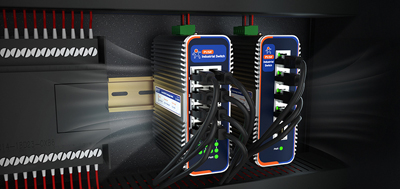
Not many products on the market meet all three. If you're evaluating options, take a look atUSR-M300 by USR IoT.This IoT gateway supports 2,000 acquisition points in parallel, has built-in Node-RED graphical programming, is compatible with 200+ industrial protocols, runs 4G/5G/WiFi simultaneously, installs on DIN rail, handles industrial temperature ranges. Most importantly — it natively supports profile import/export and one-click switching. It's basically purpose-built for the "hot-swap changeover" scenario.
Not pushing hard. Just saying — in this space, products that nail both "compliance" and "usability" at the same time?They're rare.Go compare the specs yourself.
Writing this far, I want to go back to that opening letter.
Later, Lao Zhou's factory actually deployed the IoT gateway. The first changeover, Lao Zhou stood next to the line, stopwatch in hand.
Die removal: 40 minutes.
Pick a profile, click once: 30 seconds.
Parameter push — the IoT gateway runs it itself: 2 minutes.
Online debugging: 5 minutes.
First piece: passed.
Total: 15 minutes.
Lao Zhou later said something to me that I think is worth more than any data point:
"Eighteen years I've been doing this. First time I feel like I don't have to beg anyone for a changeover."
No begging IT for scheduling. No begging process engineers for overtime. No begging equipment vendors for remote support. Pick a profile, click once — the line changes itself.
This isn't a victory of technology.This is a victory of dignity.It's a workshop director who finally doesn't have to bow his head over "changeover" ever again.
Your line deserves to change over with dignity, too.