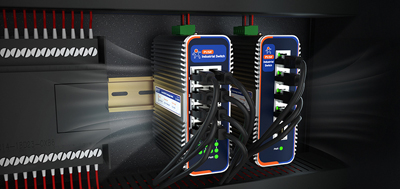
How Much Inspection Efficiency Is a Non-Crashing Cellular Router Saving You?
—That 4G cellular router in the substation that keeps crashing—how much of your inspection efficiency is it stealing?
—Distribution transformer area data upload failure rate: 8%. It's not the platform's fault. It's your cellular router.
"Engineer Zhang, 3 more meters in our transformer area aren't reporting data."
"The master station is pressing us—upload success rate is below 92%. They're asking if our platform is broken."
"We checked everything. Platform's fine. SIM cards are fine. Signal is fine. Turns out... that 4G cellular router crashed again."
This conversation came from a WeChat voice message sent by a distribution operations team leader in East China.
58 seconds long. Tired tone. The hum of a substation in the background.
What he doesn't know: his "8% upload failure rate" ranks in thetop 10 province-wide.
What hereallydoesn't know:that 8% isn't a meter problem. It isn't a SIM card problem.It's every substation, every distribution transformer area, and that "good enough" 4G cellular router—slowly eating his inspection efficiency, bite by bite.
This article won't throw specs at you. Won't pile up buzzwords. Just one question:
Why does your cellular router keep making you look bad in front of the master station?
Let's do the math. You might not sleep well after this.
One distribution team manages 120 transformer areas. Each area has an average of 48 smart meters. At an 8% upload failure rate:
| Metric | Number | In Plain English |
|---|---|---|
| Daily failed data records | 120 × 48 × 8% ≈461 records | 461 data points "disappear" every single day |
| Weekly manual re-reads | 461 × 7 ≈3,227 reads | Your people make 3,227 extra trips every week |
| Monthly extra ops hours | ≈38 hours | That's almost a full month of one person's workload |
| Annual assessment point deductions | Uncountable | The master station doesn't care why you couldn't upload |
And that's not even counting the hidden costs:
Perle wrote on its cellular router product page, translated:
"Even with 99.5% fixed-line availability, downtime costs for a small office, a branch, or a temporary site can exceed $1 million per year."
$1 million is a Western number. But in a Chinese distribution team,that "8%" is tens of thousands in lost labor hours, dozens of assessment penalties, and countless nights woken up by a phone call.
The problem isn't your people. It isn't your platform. It isn't your SIM card.
The problem is that cheap 4G cellular router you bought years ago—the one that crashes every day.
Anyone who works in distribution automation knows: the environment a 4G cellular router faces in a transformer area is far harsher than you imagine.
No theory. Just the real scenarios you deal with every day:
Outdoor cabinets under direct sunlight easily hit 60°C+ inside. Ordinary cellular router chips start throttling above 55°C and thermal-shutdown at 65°C. You think it's working. It's actually "heat-stroked"—you just don't notice until it reboots.
Direct lightning? You have lightning rods. Butindirect lightning?The ground potential rise from lightning current flowing through the grounding system surges along Ethernet cables and serial lines straight into your cellular router. Ordinary devices have no surge protection. One indirect strike is enough for "brain death."
Even sneakier: the temperature and humidity swing before and after storms causescabinet condensation. Moisture settles on PCBs, corroding solder joints day after day. Three months later, a joint goes cold—and data starts stuttering.
Substations have transformers, switchgear, reactive power compensation devices. All running. All generating EMI. Ordinary cellular router communication modules see their error rates spike. The result:full signal bars, but zero data transfer.
This is the most maddening one. The cellular router hasn't crashed. All LEDs are green. SIM is registered. But data isn't moving. You log in remotely: CPU at 100%, memory overflowed, processes frozen.
Reboot fixes it? Yes. For three days. Then it happens again.
Inseego wrote clearly in its tech blog:"Cellular routers offer advanced security features, including WPA2/3 encryption and VPN support, which keeps data and transactions secure. They offer several key features that make them a great option for mobile computing and communication: Gigabit-speed connectivity, Long battery life, Flexibility, Failover."
Notice the word"Failover."A real cellular router, when the primary link fails,automatically switches to the backup link.Not wait for you to wake up at 2 AM and manually reboot.
Does your "good enough" cellular router have that capability?
If you're responsible for distribution communication equipment selection—or you're being tortured by that 8% failure rate—I bet you have three things you want to say but won't:
The first thing you dare not say: "The budget leadership approved was tiny. I wanted to buy the good one too."
Communication equipment is a tiny slice of the entire distribution automation project budget. Leadership cares about the master station, the terminals, the primary equipment. The cellular router? "As long as it sends data." So you picked the cheapest one. 200 RMB. Free shipping.
The second thing you dare not say: "I don't actually know what makes a cellular router 'industrial grade.'"
Every vendor claims "industrial grade." IP67, wide temperature, anti-interference—all written the same on the spec sheet. But deploy it to the field and you realize:between the spec sheet and reality, there's a whole thunderstorm season.
The third thing you dare not say: "What I fear most isn't equipment failure. It's the 2 AM phone call."
Equipment can be replaced. But being woken up at 2 AM, driving through rain to a substation to reboot a cellular router—once is enough. You don't fear failure.You fear the uncertainty of never knowing when it'll happen.
The USR-G806w heard all three.
Before I recommend the product, let me tell you about a test detail.
Our test engineer was running the G806w at full load. He casually touched the heatsink on the enclosure—warm. You could rest your hand on it. Not hot.
What does that detail mean?
It means heat is being efficiently conducted away. The chip isn't "grinding through it." It means the passive cooling design is working—no fan, no noise.
That matters enormously in distribution scenarios. Substations already hum with transformer noise. Add a screaming fan on top of that, and every inspection visit becomes annoying. The G806w sits quietly in the cabinet like a veteran employee who never needs your attention.
Now let's see what it actually solves for you:
The G806w features deep EMC optimization for power environments, with built-in multi-stage surge protection. Thunderstorm season field tests: communication interfaces withstand surges of4kV and above.Not lab data—real substation performance.
Meanwhile, against the intense EMI from substation transformers and switchgear, the G806w's communication module maintains low error rates in harsh environments.Full signal bars AND data actually transferring—that's what "online" means.
Supports IEC 60870-5-104, IEC 61850, Modbus TCP/RTU, DNP3, and other mainstream power protocols. Compatible with the vast majority of SCADA systems and distribution master stations on the market.
No system changes. No re-debugging. No arguing with the master station vendor.Pull the old one out, install the G806w, import the config, go live. That's it.
Perle emphasizes in its product docs:"IRG routers can be easily configured as Router, Gateway, or Bridge."The G806w supports router, gateway, and bridge modes—flexibly fitting your network architecture.
Multiple sizes available, fitting any outdoor cabinet or indoor panel. Ethernet, serial, DI/DO, USB—everything you need in one box.
Before, you might have needed: a cellular router + a serial server + a protocol converter. Now,one G806w handles it all.Cabinet space saved. Failure points reduced.
Referencing Perle cellular router design standards (-40°C to +70°C, extremely high MTBF), the G806w is built to the same industrial-grade environmental specs. Summer distribution boxes, winter northern outdoor cabinets—stable operation, no compromise.
No fan. No noise. The heatsink is warm to the touch—heat is being dissipated in an orderly way, the chip is running at a comfortable temperature.
This means:no more 2 AM wake-up calls. No more quarterly "preventive reboots." No more adding "check if cellular router is dead" to your inspection checklist.
Ordinary cellular router: 200 RMB, replaced twice a year, plus labor, spare parts, assessment penalties—hidden cost per station per year exceeds 2,000 RMB.
G806w: higher unit price, butthree years without replacement, no field trips, no midnight phone calls.
Across 120 transformer areas, the ops savings in one year are enough to buy another batch of G806ws.
| Self-Check Item | If Yes, It's Time to Replace |
|---|---|
| Crashed/rebooted 3+ times in the past 3 months | Crashes aren't random—they're a design flaw |
| Upload failure rate spikes during thunderstorm season | No surge protection, no EMC design |
| Ops staff spend 4+ hours/month "rebooting the cellular router" | You're paying for unreliability |
| Data starts dropping when cabinet temp exceeds 55°C | Cooling is failing—chip is throttling |
| Master station complains data is intermittent, but on-site signal is full | "Fake alive"—CPU or memory can't cope |
If you checked 3 or more, stop hesitating. Your cellular router isn't transmitting data—it's stealing your efficiency.
Go back to that team leader's 58-second voice message.
The last thing he said:"Engineer Zhang, do you think this is just our fate?"
No.
It's not your fate. It's not your team's fate. It's not the 8% failure rate's fate.
It's that cellular router's fate.
Replace it with one that actually holds up—and the fate changes.
USR-G806w.Built for distribution automation. Stable performance, fast operation, rich form factors, complete interfaces, compatible with mainstream power systems, anti-interference, passive cooling, zero noise, cost-effective.
Bring your data upload success rate from 92% back to 99.9%.
Turn your ops staff from "rebooting cellular routers at midnight" into "clocking out on time."
If your transformer area has that "crashed again" cellular router, contact us for the USR-G806w's detailed specs and distribution industry deployment plan.
Don't let a cellular router steal your entire team's efficiency.