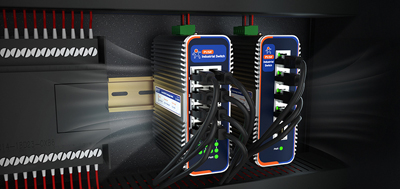
In almost all digitally transformed manufacturing workshops, smart water treatment stations, and oil-gas gathering and transmission control centers, you will always see dense Ethernet cables extending along the ports of industrial switches: a link runs out from the SCADA system cabinet and connects to PLCs, smart meters, frequency converters, visual inspection terminals... However, various cross-network failures break out from time to time: the local serial port debugging shows normal communication, but the remote end cannot find the device at all after accessing the Ethernet; when 5 new serial sensors are added to the workshop, the original system has no extra COM ports for allocation, and the host computer software directly reports an error and fails to recognize the devices; when the central control room is more than 1500 meters away from the on-site equipment, the traditional RS485 bus will experience large-scale packet loss at the far end, with data synchronization delay exceeding 3 seconds.
The first reaction of many engineers is to check the crystal heads of network cables, replace serial port adapters, and repeatedly calibrate the Modbus communication timing, but they cannot find the root cause after working half the night.
In fact, 90% of these "intractable cross-network problems" are precisely the natural barriers between traditional serial devices and modern industrial Ethernet: the traditional pure serial bus has an insufficient upper limit of transmission distance and cannot meet the requirements of remote centralized management and control; the serial devices from different manufacturers have incompatible protocols, making it difficult to directly access the unified SCADA platform; the serial devices scattered throughout the workshop do not have independent network identities, so cross-segment data interaction cannot be realized. A qualified industrial-grade serial to Ethernet converter is exactly the optimal solution that can complete the network upgrade of old serial devices at low cost without overturning the original on-site wiring.
Against the backdrop of Industry 4.0, the new demands for remote centralized management and control and multi-system data interconnection have created a huge gap with the native capabilities of traditional serial buses. The hidden bottlenecks from the physical layer to the application layer are the root cause of 90% of cross-network communication failures.
According to the standard specifications of RS232/RS485, the theoretical transmission distance of RS232 is only 15 meters, and the maximum transmission distance of RS485 bus at 9600bps baud rate is only 1200 meters. However, in scenarios such as large factories and long-distance pipelines, the central control room is often more than 2000 meters away from the farthest on-site equipment. The signal attenuation of the traditional serial bus will lead to errors in data identification at the far end, which cannot meet the remote transmission requirements at all.
At the same time, a single RS485 bus can connect up to 31 standard load slave stations. When a large number of new smart sensors and visual terminals are added to the workshop, the access capacity of the bus will be quickly exhausted. To expand the capacity, the only option is to rewire, resulting in extremely high transformation costs. A final assembly workshop for auto parts once fell into this pit: to connect 12 new serial terminals for tightening guns, engineers had to re-lay 3 RS485 buses, which took 3 days and directly caused a production line shutdown loss of over 180,000 yuan.
The vast majority of old industrial equipment that has been in service for more than 5 years only supports Modbus RTU and custom serial protocols, and has no native Ethernet interface, so it cannot directly access modern industrial Ethernet. However, most of the current mainstream SCADA systems and MES platforms are developed based on the TCP/IP architecture and only support Ethernet protocols such as Modbus TCP. Directly connecting to old serial devices will lead to a "language barrier" problem.
To realize data interconnection, many engineers have to develop additional customized drivers, which not only takes weeks of development time, but also requires repeated modification and adaptation during subsequent equipment iterations, resulting in high maintenance costs. In a central control system upgrade project of a food processing enterprise, nearly 100,000 yuan was spent only on customized driver development to connect 27 old serial temperature control instruments, and an additional 20,000 yuan was invested every year for compatibility maintenance.
Traditional serial devices must be directly connected to the COM port of the local industrial computer through physical cables. The devices themselves do not have independent IP addresses, so remote access across network segments cannot be realized. When the devices are distributed in different sections of the factory, engineers have to go to the site to debug parameters and read data, and cannot complete centralized operation and maintenance in the central control room.
At the same time, pure serial networking has no data encryption and permission control mechanisms. Illegal access from external networks can easily penetrate directly into the on-site control layer, posing serious industrial network security risks. An old workshop in a chemical industrial park once suffered an external network attack, which invaded the on-site PLC system through an unisolated serial link, causing abnormal production processes and triggering an emergency shutdown, resulting in a direct loss of over 300,000 yuan.
The most critical transformation of a serial to Ethernet converter is to endow traditional serial devices with independent network identities, seamlessly convert serial data that could only be transmitted locally over short distances into TCP/IP Ethernet data packets, and realize the network upgrade of serial devices. Without modifying the wiring and parameter configurations of the original on-site devices, it can directly solve all the above cross-network communication pain points.
Industrial-grade serial to Ethernet converters are equipped with a built-in hardware protocol parsing engine. Without additional driver development, they can automatically complete the bidirectional unpacking, reassembly and forwarding of Modbus RTU and Modbus TCP, directly encapsulate the messages of traditional serial devices into Ethernet data packets, and realize seamless docking with SCADA and MES systems.
Engineers do not need to modify the original host computer software. Through the virtual serial port function, they can directly generate COM ports in one-to-one correspondence with on-site devices in the central control room. The original software can directly access remote serial devices without secondary development. In the aforementioned food processing enterprise project, after adopting serial to Ethernet converters, 27 old temperature control instruments were connected to the network in only 1 day, directly saving the development cost of customized drivers.
The Ethernet side of a serial to Ethernet converter supports 10/100Mbps adaptive transmission. When paired with industrial switches, the data transmission distance can be extended to dozens of kilometers, fully covering the management and control requirements of large factories and long-distance pipelines. At the same time, a single multi-port serial to Ethernet converter can connect up to 16 RS232/RS485 serial devices. Through cascading expansion, centralized access to hundreds of serial devices can be easily realized, directly breaking the access limit of 31 slave stations of traditional RS485 buses.
At a long-distance oil-gas gathering and transmission station, on-site sensors are distributed in 3 pump stations 5 kilometers apart. The traditional RS485 bus cannot cover the entire link. After deploying multiple serial to Ethernet converters, the serial instrument data of all stations can be transmitted to the central control room in real time through the factory's optical fiber network, with data synchronization delay controlled within 100ms, fully meeting the real-time management and control requirements.
Each device connected to a serial to Ethernet converter can be assigned an independent IP address and supports cross-segment access. Engineers can remotely debug the parameters of on-site serial devices and read operating data in the central control room, without going to the site to operate each device one by one, improving operation and maintenance efficiency by more than 80%.
At the same time, industrial-grade serial to Ethernet converters have built-in firewalls, access permission control, and encrypted data transmission functions, which can safely isolate the on-site serial control layer from the upper office network and prevent illegal intrusion from external networks. After deploying serial to Ethernet converters in an automobile welding workshop, IP whitelists were configured to restrict access to on-site serial devices only to designated servers in the central control room. No illegal access incidents occurred during 3 consecutive years of operation, and the network security level was directly upgraded to meet the requirements of Level 2 Protection.
Many engineers report that after using serial to Ethernet converters, problems such as data packet loss and connection disconnection still occur. In fact, in most cases, the problem is not with the device itself, but because these hidden pitfalls were not avoided during deployment.
Many low-cost serial to Ethernet converters on the market only realize the most basic serial-to-Ethernet conversion function, without hardware protocol parsing, photoelectric isolation, and surge protection designs. Such devices may operate normally in a common office environment, but in the high-dust, strong electromagnetic interference environment of industrial sites, they are prone to crashes and disconnections, and may even directly burn out on-site serial devices due to voltage fluctuations.
When selecting models, be sure to identify industrial-grade products with a wide operating temperature range (-40℃~85℃), serial port isolation above 2kV, hardware Modbus protocol conversion, and offline data resume functions. Do not save a few hundred yuan to bury major failure risks for the production line.
Although serial to Ethernet converters support multi-device access, it is recommended to divide the serial to Ethernet converters into independent VLANs during deployment, and do not share the same network segment with on-site video surveillance and office networks. If a large number of data packets from serial devices are mixed with video data streams, broadcast storms are likely to occur, leading to a sharp increase in serial data transmission delay.
At the same time, it is recommended to configure a fixed IP address for each serial to Ethernet converter, instead of using DHCP dynamic address allocation, to avoid the situation that the host computer software cannot recognize the device after the network restarts and the device IP changes.
The metal casing of the serial to Ethernet converter must be reliably grounded. When wiring RS485, the A/B lines must be connected correspondingly, and the GND ground wire must be connected at the same time to ensure that the common ground potential of both communication parties is consistent. If on-site devices are distributed in different sections, make sure that the ground potential difference between different devices does not exceed the common-mode tolerance range of the serial to Ethernet converter. If necessary, add a signal isolator to eliminate the potential difference. At a water treatment station, when deploying serial to Ethernet converters, the RS485 GND ground wire was not properly connected. After the on-site ground resistance increased on rainy days, common-mode interference directly caused the data packet loss rate to soar to 25%. After the common ground wire was reconnected, the packet loss rate dropped directly to below 0.1%.
During deployment, it is recommended to divide ports according to the communication frequency of devices: assign separate ports to visual terminals and motion controllers that require high-frequency data collection, and assign other ports to smart meters and sensors with low communication frequency. Do not concentrate the serial data of hundreds of devices on a single low-performance serial to Ethernet converter, to avoid data congestion caused by insufficient port bandwidth.
For key production lines and unattended stations that require extremely high continuous operation, you can also use the advanced functions of serial to Ethernet converters to further maximize network reliability.
For central control systems adopting a redundant architecture, you can choose serial to Ethernet converters that support dual network port backup, and connect to two independent industrial switch links at the same time. When the main network link is interrupted, the system will automatically and seamlessly switch to the backup link, with a switching time of less than 10ms, which will not affect the continuous transmission of data at all.
For unattended field scenarios, you can choose smart serial to Ethernet converters that support edge computing. They can complete local data preprocessing and abnormal alarm judgment, and only upload key data to the cloud, greatly reducing network bandwidth occupation. At the same time, they support offline data resume function: when the network is temporarily interrupted, the device will store the collected data in the local Flash, and automatically retransmit the data after the network is restored, so no data loss will occur.
We can even integrate wired RS232/RS485 links, Wi-Fi, 4G/5G wireless links through cascading deployment of serial to Ethernet converters in traditional industrial networks. For mobile devices and scattered monitoring points that are difficult to wire, they can be connected to the central control platform through the wireless network without re-laying cables. At the same time, with the traffic monitoring function of serial to Ethernet converters, the communication status of each device can be counted in real time. Once the communication quality of a certain link deteriorates, the system will upload an alarm message to the SCADA system in advance. Engineers can troubleshoot hidden dangers in advance without going to the site, shifting from post-failure emergency repair to pre-emptive preventive maintenance.
Many people always think that to complete the industrial digital transformation, all old serial devices must be replaced with new devices with Ethernet interfaces to achieve a permanent solution. However, in more than 70% of the existing industrial scenarios, a large number of serial devices that can still operate stably are still in service. The transformation cost of replacing all of them is often hundreds of thousands or even millions of yuan, and there is also the risk of long-term production shutdown.
An industrial-grade serial to Ethernet converter costing less than 1,000 yuan can seamlessly connect traditional serial devices to modern industrial Ethernet without modifying any parameters of the original devices or re-wiring a large area. It directly opens up the data path from the on-site perception layer to the upper management layer, and is exactly the optimal solution that balances transformation cost and business continuity.
The implementation of industrial digitalization is never achieved by blindly stacking the latest technical concepts. The practical solutions that precisely fill the gaps for heterogeneous network barriers are often the ones that can truly solve the pain points of on-site engineers being called out for remote emergency repairs in the middle of the night.