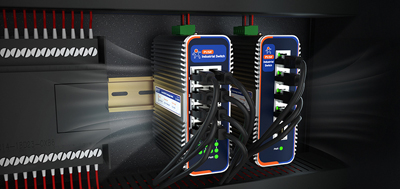
For remote factories, unmanned equipment rooms, outdoor control cabinets, and distributed industrial sites, a5G cellular routeris more than a device that provides network connectivity.
It often sits between industrial equipment and the public network.
PLCs, industrial PCs, cameras, sensors, and other devices may connect to the Internet through the router. If the router is poorly configured or insufficiently protected, the problem is not limited to the router itself. The industrial devices behind it may also be exposed to unnecessary risks.
So when choosing an industrial 5G cellular router, one important question is:
Can the router act as the first security boundary for the industrial network?
A typical remote industrial site may look like this:
5G Network → Industrial 5G Router → PLC / IPC / Camera / Sensor
The router is the first network device between the public network and the internal industrial devices.
This means PLCs, industrial PCs, and other devices should not be directly exposed to the public Internet whenever possible. Instead, the router should control how external traffic reaches the internal network.
For example, the PUSR USR-G816 supports 5G SA/NSA and provides multiple Gigabit Ethernet ports for connecting industrial devices. It also integrates functions such as firewall, NAT, DMZ, port forwarding, and access control.
The basic principle is simple:
Let the public network reach the router first, rather than exposing industrial devices directly.
When a router acts as a security gateway, the first step is usually not allowing more connections. It isreducing unnecessary access.
Consider a remote control cabinet containing:
A maintenance engineer may only need access to one of these devices.
Instead of allowing the entire LAN to be accessed remotely, configure firewall and access-control rules on the router to allow only the required IP addresses, ports, or devices.
The USR-G806w, for example, provides firewall, Anti-DoS, IP/domain/MAC filtering, port mapping, and access-control functions.
When configuring the router, ask three simple questions:
Which devices need to be accessed?
Where should the access come from?
Which ports actually need to be available?
Anything outside those requirements does not need to be exposed.
Remote maintenance is common in industrial environments.
For example, an engineer at headquarters may need to access a PLC or industrial PC at a remote factory.
One straightforward approach is to configure port forwarding on the router and access the device directly over the Internet.
However, this can expose services on internal devices to external networks.
A better approach in many deployments is to establish a VPN connection through the router.
For example, the USR-G816 supports VPN options including PPTP, L2TP, and OpenVPN. The USR-G806w also supports VPN technologies such as PPTP, L2TP, GRE, IPSec, and OpenVPN.
The network can then be structured like this:
Headquarters → VPN → 5G Router → PLC
rather than:
Public Internet → PLC
The remote engineer must first enter the controlled VPN network before accessing the industrial device.
Many industrial networks already use NAT.
NAT allows internal devices to use private IP addresses while the router handles external network communication.
This is useful because PLCs, HMIs, sensors, and other industrial devices do not need individual public IP addresses.
However, one point is easy to overlook:
NAT does not mean the network is automatically secure.
If the router has excessive port forwarding, DMZ settings, or overly permissive access rules, external access may still be possible.
A more practical approach is to combine:
NAT + Firewall + Access Control + VPN
rather than relying on NAT alone.
If the router is the security boundary of the industrial network, the router itself cannot become the weakest point.
When selecting a 5G industrial router, do not only look at 5G speed. Also check whether it provides:
For example, the USR-G806w supports remote management functions such as SSH, SNMP, and SMS, and can also work with the PUSR platform for remote monitoring, upgrades, and alerts.
This becomes particularly important when routers are deployed across multiple factories, warehouses, or outdoor sites.
The real challenge is often not configuring one router.
It is managing50, 100, or even more routersafter deployment.
If every problem requires an engineer to visit the site, maintenance costs can quickly increase.
In a real industrial network, security usually does not depend on a single feature.
A practical approach is to build several layers:
Layer 1: Firewall
Block unnecessary external connections.
Layer 2: NAT / Access Control
Reduce direct exposure of internal devices and control which devices can be accessed.
Layer 3: VPN
Allow remote maintenance through a controlled and encrypted connection.
Layer 4: Remote Management
Continuously manage the routers themselves, including configuration, firmware upgrades, and alerts.
This layered approach means that a problem with one configuration does not automatically remove all of the network's security boundaries.
If you are selecting a 5G cellular router for an industrial deployment, take this checklist into the evaluation process:
| Check | Questions to Ask |
|---|---|
| Firewall | Can unnecessary external access be blocked? |
| Access Control | Can access be restricted by IP, MAC, or device? |
| VPN | Does it support VPN technologies that fit the existing network? |
| NAT | Can internal PLCs and other devices avoid direct exposure? |
| Port Mapping | Can only the necessary ports be opened? |
| Remote Management | Can problems be handled remotely? |
| Firmware | Can firmware be upgraded remotely? |
| Industrial Reliability | Can the router remain stable during long-term deployment? |
For an industrial network,5G is only the connectivity method.
What matters is whether the router can also handlenetwork isolation, controlled remote access, and security boundary functions.
The PUSR USR-G816, for example, combines 5G connectivity, Gigabit Ethernet, firewall, NAT, access control, and VPN capabilities in an industrial-grade device. This makes it suitable for applications that require remote industrial connectivity while keeping the public network separated from the field network.
A good industrial 5G router should do more than connect equipment to a 5G network. It should serve as the first controllable security boundary before industrial devices reach the public network.