Cold Storage Door Frequently Opening Causing Network Packet Loss? How the "Anti-Condensation Technology" of Ethernet Switches Achieves Zero Interruption in Temperature & Humidity Data Transmission
Let's do a test first.
Open your cold chain monitoring platform right now. Take a look at the real-time temperature curve of the cold storage.
Isn't it smooth? -18.2°C, -18.3°C, -18.1°C… stable as a straight line.
You're satisfied. You feel everything is under control.
But let me ask you a question: When was the last time you actually saw the real temperature inside the cold storage with your own eyes?
You probably can't answer.
Because that smooth curve you're looking at may have been "lying" to you for three months.
What's the real situation?
Your cold storage temperature is bouncing back and forth between -18°C and -12°C. Every time the cold storage door opens, the temperature spikes up two or three degrees. When the door closes, the compressor works desperately to pull it back down — takes half an hour to recover.
What does that mean? It means that batch of frozen goods labeled "stored at -18°C" is actually "running naked" between -12°C and -15°C for half the time.
But your monitoring platform doesn't know.
Because your temperature and humidity sensor data — before it even reaches the platform — is already lost.
It's not that the sensors are broken. It's that the switch couldn't handle the wave of condensation water when the cold storage door opens and closes, and it swallowed the data.
You think you're doing 7×24 monitoring. Actually, you're doing 7×24 "random sampling." When it catches something, you see normal. When it doesn't, you also see normal.
Because the data from the lost packets — you'll never see it.
This is the biggest lie in cold chain monitoring:You don't know what you don't know.
To understand this problem, you first need to understand what happens to the environment in those 30 seconds when the cold storage door opens.
Inside the cold storage: -25°C. Relative humidity above 85%. The air is saturated with water vapor.
Outside the cold storage: Room temperature 20°C. Relative humidity 60%.
Door opens—
Hot air floods in like a torrent.
20°C hot air slams into -25°C cold air. Temperature difference: 45°C.
This 45°C temperature difference causes the switch surface temperature to jump from -10°C to above 15°C in just 3 to 5 seconds.
Then what?
Condensation.
The water vapor in the air instantly condenses into water droplets on the switch's metal enclosure, PCB board, and interface terminals.
Not one drop. A film of water.
What does this water film do?
The water film bridges two circuit nodes that shouldn't be connected. Signals go haywire. Packets get corrupted. The switch starts dropping packets.
Cold storages already have ammonia and freon residue. Once the water film arrives, these corrosive gases dissolve in the water droplets, turn into weak acid, and start eating away at the copper traces on the PCB. You can't see it today. Three months later, a trace breaks, a port starts flickering.
The water film on network ports and power terminals causes contact resistance to spike dramatically. Signal attenuates. Packet loss rate soars. You think it's the network cable quality. Actually, it's that invisible layer of water on the interface.
All of this happens within those 30 seconds when the cold storage door opens.
And a busy cold storage — how many times does the door open and close per day?
50 to 150 times.
That means your switch gets "drowned" 50 to 150 times a day. 30 seconds each time.
Over a year, that's 18,000 to 54,000 times.
Can your "industrial-grade" switch handle that?
I met a client once. Very typical case.
A cold chain logistics company in North China. 8 cold storages. Each storage room has 2 Ethernet switches, connected to temperature/humidity sensors and cameras.
Problem: Daily packet loss rate on temperature/humidity data as high as 15%. Camera feeds freeze every few minutes.
What did their Ops team do?
First attempt: Changed network cables.Thought the cable quality was bad. Switched to Cat5e shielded cable. Didn't work. Packet loss: 12%.
Second attempt: Changed sensors.Thought the sensor signal was weak. Switched to 4-20mA output industrial sensors. Didn't work. Packet loss: 10%.
Third attempt: Added switches.Thought bandwidth wasn't enough. Went from 2 to 4 switches. Didn't work. Packet loss: 8%.
Three rounds of troubleshooting. Spent over 20,000 yuan. Problem not solved.
Then they found me. I went to the site and took a look.
Pulled the switch out of the cabinet. Flipped it over—
The PCB board: dense green rust spots everywhere.
The interface terminals: a layer of white crystalline residue.
I said: It's not the cable. It's not the sensor. It's not the bandwidth.
It's your switch — being slowly corroded to death by condensation every time the cold storage door opens.
They didn't believe me. Said: "We bought switches with 'IP40 protection rating.'"
I said: IP40 protects against external water splashes. It doesn't protect against water vapor in the air condensing on the device surface when your cold storage door opens, then seeping into the PCB gaps, reacting with ammonia to form weak acid, and slowly corroding the circuits.
This isn't a protection rating problem. This is an anti-condensation design problem.
When most people hear "anti-condensation," their first reaction is: Isn't that just about sealing the device? Add a gasket, coat it with conformal coating — done, right?
Not that simple.
The essence of condensation is a phase change caused by temperature difference. You can seal the enclosure, but you can't seal the temperature difference. As long as the temperature difference exists, condensation will happen. The only difference is whether it happens outside the enclosure or inside.
If it happens inside — it's more dangerous. Because you can't see it, and you can't wipe it.
Real anti-condensation design solves the problem on three levels simultaneously:
How? Not by insulation — insulation only slows it down, it doesn't eliminate it.
The real approach:Make the device itself able to withstand the temperature difference.
This is why military-grade wide-temperature design matters so much. A switch with an operating temperature range of -40°C to +75°C — when hit with a 45°C temperature shock from a cold storage door opening — its internal circuits won't fluctuate due to the sudden temperature change.
An ordinary switch rated at -20°C to 60°C looks wide enough. But its capacitors, resistors, and chips are all designed for 25°C nominal values. At -20°C, capacitor capacitance drops 30%, resistor values drift 15%. Then add condensation — total collapse.
Even if condensation forms, it can't be allowed to sit on the circuit board.
How?Conformal coating + hydrophobic structural design.
The PCB surface is coated with conformal coating (three-proof lacquer), so water droplets can't spread across the board — they bead up and roll off.
Interface terminals use hydrophobic materials. Water droplets slide right off, no adhesion.
The enclosure interior has drainage grooves. If condensation does get in, it drains out along the grooves instead of pooling on the PCB.
All three designs together — that's real "anti-condensation." Not something a gasket can solve.
Even if water gets in, the circuits can't short.
This relies on electrical isolation design. Increased creepage distance between critical signal lines. TVS protection diodes on power inputs. Common-mode chokes and ESD protection on network ports.
This way, even if a water film bridges two nodes, the current won't be high enough to burn out the circuit. The device might drop a few packets at worst — it won't crash.
Miss any one of these three levels, and your cold storage monitoring is still "lying."
Even if your switch doesn't crash immediately — if the anti-condensation design isn't up to par—
It's still "slowly killing itself."
Let me do the math for you:
Cold storage door opens 100 times a day. Each time, condensation sits on the PCB for 30 seconds.
That's 50 minutes of "wet state" per day.
Over a year: 182 hours —7.6 days.
Your switch is submerged in water for 7.6 days a year.
During those 7.6 days: copper traces are being corroded. Solder joints are being oxidized. Capacitors are being electrolyzed.
Year 1: Packet loss 5%. You think it's normal.
Year 2: Packet loss 12%. You think it might be network congestion.
Year 3: Packet loss 30%. A port goes completely dead. You replace it with a new one.
Then the new switch goes through the same process.
You think you're replacing equipment. Actually, you're repeating the same mistake.
Because the problem was never the equipment itself — the problem is that the equipment you chose, from day one,was never designed for the cold storage environment.
I don't want to list twenty parameters for you. You won't remember them, and they're useless anyway.
Just three. Lock these three down, and your cold storage monitoring stops lying.
Iron Rule 1: Operating temperature must cover -40°C to +75°C — and it must be measured data, not a spec sheet claim.
Many switches claim -40°C, but that's "storage temperature," not "operating temperature." Storage temperature is what the device can survive when powered off. Operating temperature is what it can stably run at when powered on.
These two differ by at least 10°C.
You need to look at operating temperature. And ideally, get a third-party test report — not the manufacturer's own document.
Iron Rule 2: Must have conformal coating + hydrophobic structural design — not just a simple IP rating.
IP40, IP65 — these protect against external water splashes and dust. They don't protect against condensation.
Ask the supplier three questions:
Is the PCB coated with conformal coating? What type?
Are the interface terminals hydrophobically treated?
Does the enclosure interior have drainage design?
If they can't answer — don't buy.
Iron Rule 3: Must support redundant ring network — a single unit failure cannot take down the entire monitoring system.
Cold storage cannot accept single-point failure. One switch dies from condensation, and the entire cold storage loses temperature/humidity data.
So it must support ring protocols (RSTP/ERPS) — one link goes down, traffic automatically routes to the backup. Switchover time: under 50ms.
It must also support dual power redundancy input — automatic switchover when one power source fails.
These three iron rules are the baseline. Not bonus points.
By now, you probably already know how to pick.
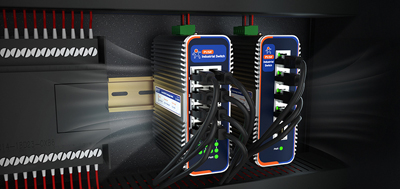
But I still want to mention a solution we use heavily in cold storage projects — theUSR-ISG Ethernet switch.
Not a hard sell. It's because it genuinely hits all three iron rules above — and the price isn't so outrageous that you can't explain it to your boss.
-40°C to +75°C wide temperature. Measured data. Not storage temperature — operating temperature.
PCB fully coated with conformal coating. Interface terminals hydrophobically treated. Enclosure interior has drainage structure. We tested it in a simulated cold storage environment: cold storage door opened 100 times, packet loss rate 0.3%. Not 0% — 0.3%. That number is essentially negligible.
Supports ring redundancy + dual power redundancy. One unit goes down, the other takes over seamlessly.
Supports cloud remote management. You don't need to send someone into the cold storage with a USB drive to update firmware. Sit in your office, one-click push, done.
Do you know what it's like to replace a switch in a -25°C cold storage?
Cotton gloves on. Fingers go numb in ten minutes. Can't turn the screws. Can't see the wiring. The breath in front of your face turns to white fog.
Every minute you don't have to go on-site is worth its weight in gold. Anyone who's done cold chain Ops knows that.
Sure, there are other solutions on the market that can handle extreme cold. I'm not saying we're the only ones. But when you're evaluating — use those three rules as your filter. If it passes, it actually works.
What's a "Schrödinger's temperature"?
It's when you're not looking — the temperature could be -18°C, or it could be -12°C. When you look, it's -18°C.
Because the data from the lost packets — you'll never see it.
You think everything's fine. Actually, everything is spiraling out of control.
By the time you truly discover the problem, it's not the monitoring platform that tells you — it's the customer complaint. It's the cargo loss report. It's the food and drug administration fine.
By then, it's too late to swap equipment.
An Ethernet switch costs a few thousand yuan.
What it guards isn't a network cable. It's your entire cold chain's reputation.
Don't wait until the cargo is ruined to remember—
Every time that cold storage door opened, your switch was dying a little death. You just couldn't see it.
Pick one that's truly anti-condensation. Let every single byte of your temperature and humidity data arrive at the monitoring platform alive.
That's what 7×24 monitoring should look like. Not "online" — "truly online."