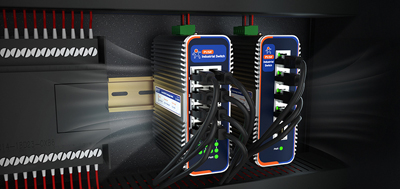
Welding Shop Dust Explosion Risk: How the "Intrinsically Safe Design" of RS485 to Ethernet Converters Passes ATEX Zone 2 Certification
You probably saw that news.
A car parts factory in Jiangsu. Welding shop. A dull boom. Six people injured. Investigation conclusion: aluminum dust concentration exceeded limits, ignited by electrical sparks from equipment.
You closed the app. Glanced at your own shop.
Sparks flying, smoke everywhere. Dust on the floor—your shoes leave clear footprints. In the corner, the RS485 to Ethernet converter's LED blinks steadily. Next to it sits your eight-year-old PLC, cables exposed, tape at the connectors already black.
You know in your gut—that dust, once it reaches concentration, any spark could be the last match.
But you also know something else: the line can't stop. That RS485 to Ethernet converter is on the welding robot's RS485 bus. Cut it off, the whole line's data collection goes dark. Yield reports don't generate. Tomorrow's client audit—what do you show?
So you didn't replace it. Every day you walk past, you whisper "it should be fine," then keep working.
This article isn't here to scare you. It's here to tell you—that "should be fine" can actually become "it is fine."
People who manage welding shops never fear the risk itself.
Risk can be quantified. What you fear is—you don't know if your equipment is truly safe, and you can't stop to check.
Specifically, you're probably being tortured by these three questions:
First: Can your RS485 to Ethernet converter actually be used in a dust environment?
When you bought it, the supplier said "industrial grade." But those three words mean nothing in front of ATEX standards. Ordinary industrial equipment's IP65 rating keeps water and dust out—but it doesn't prevent internal sparks from igniting external dust. Aluminum and iron powder in a welding shop, particles as small as tens of microns, suspended in air. A relay contact bounce inside an ordinary device—0.1 millijoules of energy is enough. How many such contacts are inside your RS485 to Ethernet converter?
Second: You want ATEX certification, but you don't know where to start.
ATEX Zone 2 means the equipment must operate safely in explosive gas or dust atmospheres. The full certification process involves design, material selection, testing, documentation—long cycles, high costs. You're a workshop director or an automation engineer. You don't have the energy to chew through IEC 60079 standards. You just want to know: what's the minimum-cost fix for my existing line?
Third: You're afraid you'll spend the money and still fail the safety inspection.
Safety inspections are getting stricter. Last month the factory next door got fined 120,000 RMB—reason: "electrical equipment selection doesn't meet explosion-proof zone requirements." You look at that row of RS485 to Ethernet converters in your shop, stomach turning—what if they come for me? What do I say? The words "I didn't know" are worth nothing in front of a safety accident.
Get the concepts clear first—then the solution will make sense.
ATEX Directive 114 divides explosive atmospheres into zones:
Zone 0 / Zone 20: Explosive atmosphere present continuously or for long periods. Your welding shop during normal production—dust everywhere—falls here.
Zone 1 / Zone 21: Not likely during normal operation, but if it occurs, it persists for a while. Like when you shut down for cleaning and residual dust gets stirred up.
Zone 2 / Zone 22: Won't occur during normal operation; even if it does, it's brief. Like a tiny leak at an equipment seal.
Most electrical equipment in welding shops is classified as Zone 2.
What does that mean? It means you don't need that bulky flameproof equipment (Ex d)—you don't need to lock the whole device in a metal box. What you need is intrinsically safe (Ex i) design—limit energy at the circuit source, so even if a spark occurs inside, the energy is too low to ignite dust.
That's the core logic of intrinsically safe design: don't contain the spark—make the spark incapable of igniting.
Plenty of RS485 to Ethernet converters on the market claim "explosion-proof." But a genuine ATEX Zone 2 intrinsically safe product follows a completely different design logic.
Let's break down what's happening inside a qualified unit—things you can't see:
First: Energy-limiting circuits.
This is the soul of intrinsic safety. Every circuit node inside—voltage, current, capacitance, inductance—is strictly limited. RS485 bus output energy is suppressed to microjoule levels. Even in a short circuit, the spark energy is far below aluminum dust's minimum ignition energy (~10 millijoules). When you plug or unplug the device, electrostatic discharge at the interface is absorbed by TVS diodes and current-limiting resistors.
Second: Isolation design.
Between the intrinsic safety side and the non-intrinsic safety side, there must be galvanic isolation—optocoupler or magnetic isolation. This ensures that any fault in the high-energy circuit on the non-IS side (like the power supply) never conducts energy to the RS485 bus on the IS side. That isolation wall is your safety floor.
Third: Passive components preferred.
Intrinsically safe designs minimize relays, mechanical switches—anything with contacts. They use solid-state relays, optocoupler switches instead. Because mechanical contact bounce is the most uncontrollable spark source. That "click-click" relay inside your old RS485 to Ethernet converter? In an IS design, it simply shouldn't exist.
Fourth: Enclosure and sealing.
While IS design doesn't rely on a flameproof enclosure, dust protection for Zone 2 is still required. IP65 or higher sealing ensures external dust can't get inside and accumulate on the PCB—accumulated dust is itself a hazard. If any non-IS heat dissipates nearby, that dust pile could ignite.
Fifth: Certification and documentation.
A truly ATEX Zone 2 certified device comes with complete technical documentation: risk assessment, circuit schematics, component list, test reports, Declaration of Conformity (DoC). When the safety inspector comes, you hand over the folder—crystal clear.
Most people hear ATEX and picture: shut down the line, rewire everything, bring in experts.
Not needed.
The deployment logic for an intrinsically safe RS485 to Ethernet converter is almost identical to your current one. DIN rail mount. RS485/RS232 wiring. Ethernet cable up to the network. The only difference—swap out the old unit for the ATEX Zone 2 certified model, update the equipment register with the new explosion-proof rating, let the safety officer check the box.
That's it.
Line keeps running. Data never stops. Safety compliant.
That's what you actually need—not a safety theory, but an action you can take tomorrow morning.
Go back to that opening scene.
2 a.m. The phone rings. Not because the line exploded—but because the system pushed an alert: Welding Robot No. 3 current curve anomaly, maintenance ticket auto-generated. You glance at your phone. Data normal. Line running. You roll over and go back to sleep.
That's not a fantasy.
When your RS485 to Ethernet converter is ATEX Zone 2 intrinsically safe certified, when every node on your RS485 bus is protected by energy limiting, when every device in your safety register has complete compliance documentation—that "should be fine" in your gut really becomes "it is fine."
If you want to look at specific product selection, there are mature solutions on the market. For example, the USR-TCP232-304 RS485 to Ethernet converter—metal housing, wide temperature design, supports RS485/RS232, strong industrial environment adaptability. When planning your retrofit, pay close attention to whether its explosion-proof certification matches your zone classification. The sooner you start selection, the sooner you put that stone down in your chest.
You're responsible for dozens of people's safety. Tens of millions in production lines.
You deserve a good night's sleep.