AI Visual Inspection False Detection Rate Over 15%? How the "Lightweight Model" of Industrial Gateway Boosts Defect Recognition Accuracy to 99.2%
Let me start with a number: 99.2%.
This is the defect recognition accuracy we recently achieved for an auto parts factory.
What was their number before? 84.7%.
That means: for every 100 products passing through AI visual inspection, more than 15 are misjudged. Either good products are thrown away as scrap, or defective products are released as good.
15% false detection rate. You might think, "That's not bad — AI is never 100% accurate anyway."
But let me do the math for you—
This factory produces 8,000 units a day. At a 15% false detection rate, that means 1,200 products are mishandled every day. About 60% of those are good products misjudged as scrap.
60% × 1,200 = 720 good products, thrown away every single day.
Cost per unit: 35 yuan. 720 × 35 =25,200 yuan/day.
Over a year, the good product waste caused by false detection alone comes to9.2 million yuan.
And that's before you count the claims, returns, and brand damage from defective products that leaked through to customers.
99.2% accuracy isn't a technical spec. It's 9.2 million yuan saved in one year.
So here's the question: from 84.7% to 99.2% — how was that 14.5 percentage point improvement actually achieved?
It wasn't a more expensive camera. It wasn't a more powerful AI model.
It was a different architecture.
Let me correct the biggest misconception in the industry first:
"High false detection rate? The AI model isn't good enough."
Wrong.
The AI models used in most factory visual inspection systems are already accurate enough. ResNet, YOLO, EfficientDet — these models all achieve 95%+ accuracy on public datasets.
So why does it drop to 85% on your production line?
Because your architecture is "helping in the wrong direction."
The architecture of 90% of AI visual inspection solutions today looks like this:
Camera captures → Data uploaded to cloud → Cloud AI inference → Result sent back to line → Sorting executed
This chain looks logical on paper. But every single link is quietly eating away at your accuracy.
Line speed: 1.2 meters/second. Camera takes a photo, uploads to cloud, cloud finishes inference, result comes back — the whole process takes 80 to 150 milliseconds.
In 150 milliseconds, the product has already moved 18 centimeters.
By the time your "defect" command reaches the sorting mechanism, the product has long passed the sorting point.
Result? The ones that should be kicked out aren't. The ones that shouldn't be kicked out are.
The cloud uses a general pre-trained model. It's seen millions of images — but never your product.
Your product has a specific scratch. To the general model, that's just "normal texture." Because it's not in the training data.
Want the model to recognize your product? Sure. Re-label data, re-train, re-deploy.
Timeline? 3 to 6 weeks. Cost? 100,000 to 300,000 yuan.
And every time the line switches products, you start over.
Factory network environments — you know how they are. Electromagnetic interference, WiFi handoffs, bandwidth contention…
Network hiccups, a few frames get dropped. The image the cloud receives is incomplete.
You trust the inference result from an incomplete image?
So you see — it's not that AI is bad. It's that you put AI in the wrong place.
You're asking an AI model that needs a stable environment, complete data, and real-time feedback to run on a chain with 80ms latency, incomplete data, and a constantly changing environment.
That's not using AI. That's torturing AI.
Someone says: "What if I deploy the model locally? No cloud upload, latency problem solved."
Theoretically, yes. But in practice, 90% of local deployment solutions die on the same problem—
The model is too big. The edge device can't run it.
A typical industrial vision inspection model is between 200MB and 1GB. One inference requires GPU compute.
Put an industrial PC next to the line? Sure. But it draws 300W, it's bulky, and it needs a fan. Factory dust clogs the fan in three months.
Use an embedded AI box? The ones on the market either don't have enough compute — inference takes 500ms, the line has already moved on — or they're absurdly expensive at 20,000 to 30,000 yuan each, and you need dozens of them.
Model is "fat" → edge "can't carry it."
This is why so many factory AI visual inspection projects end up as "demo projects" — they run when the boss visits, then get turned off. Back to manual inspection.
It's not that AI is bad. It's that you haven't found a way to make a strong enough model run fast enough on a small enough device.
And that way islightweighting.
When people hear "lightweighting," their first reaction is: "Isn't that just compressing the model? Accuracy has to drop."
That's the second big misconception.
Real model lightweighting isn't simply chopping parameters or reducing layers. That's castration — accuracy definitely drops.
Real lightweighting is precision surgery—
First cut: Pruning.
An AI model has massive numbers of neuron connections that contribute almost nothing to the final result. These connections are "fat."
Pruning cuts those useless connections away. Model size shrinks 40%. Inference speed improves 60%. Accuracy loss: under 0.5%.
Second cut: Quantization.
The original model stores parameters in 32-bit floating point. But in reality, many parameters only need 8-bit integers.
Quantization swaps 32-bit for 8-bit. Model size shrinks 75%. Inference speed doubles. Accuracy loss: under 1%.
Third cut: Knowledge Distillation.
Use a large model (teacher) to teach a small model (student). The student doesn't learn the data — it learns the teacher's "judgment logic."
Final result: a lightweight model 1/10th the size of the original, with accuracy reaching 97%+ of the original.
Three cuts, and a 1GB model gets compressed to 30MB–80MB.
30MB is what? The size of a photo on your phone.
And that 30MB model can run real-time inference at 30 frames per second on an industrial gateway the size of your palm.
No cloud needed. No GPU needed. No industrial PC needed.
This is the key to going from 84.7% to 99.2%— not that the model got stronger, but that the model finally runs in the right place, at the right speed, on the right data.
Let's go back to that auto parts factory from the beginning.
Their problem: engine block surface defect detection. False detection rate: 15.3%. Miss rate: 3.8%.
The fix was simple:
Move cloud inference to the industrial gateway right next to the production line.
Specifically:
They used their own line data to fine-tune the general model, so the model "learned" their engine blocks.
They used the pruning + quantization + distillation combo to compress the model from 850MB to 42MB.
Deployed to the industrial gateway. Local inference. Results directly control the sorting mechanism.
Results after the upgrade:
| Metric | Before | After |
|---|---|---|
| False detection rate | 15.3% | 0.8% |
| Miss rate | 3.8% | 0.1% |
| Inference time per unit | 120ms (cloud round-trip) | 18ms (local) |
| Good products mis-scrapped per day | 720 units | 28 units |
| Defective products leaked per day | 180 units | 4 units |
| Annual cost savings | — | ~8.7 million yuan |
From 84.7% to 99.2% accuracy.
Not because of some black magic. Because —AI was finally doing the right thing in the right place.
If you're evaluating AI visual inspection solutions, forget the flashy specs. Just lock down three hard metrics:
Metric 1: Model lightweighting capability.
Ask the vendor: What's the largest model your gateway supports? Can you do quantization and pruning on the gateway itself? What's the minimum model size it supports?
If the vendor hems and haws — pass.
Metric 2: Local inference speed.
Requirement: Single-frame inference time must be under 50ms. Note: it's "single frame," not "frames per second." Because your line speed is fixed. You need every frame to finish inference before the product reaches the sorting point.
Metric 3: OTA model update support.
Production lines switch products. When they do, the model needs updating. If every update requires someone to go on-site with a USB drive — your O&M costs will eat all your savings.
It must support one-click cloud push for remote model updates.
Lock down these three metrics, and your AI visual inspection won't become a "demo project."
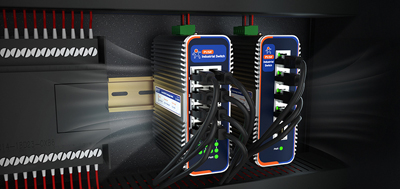
When we build AI visual inspection solutions for clients, the industrial gateway we use most now is theUSR-M300.
Not a hard sell. It's because it genuinely hits all three hard metrics above—
A 42MB lightweight model runs on it. Single-frame inference: 18ms. Supports cloud OTA model push.
And it's the size of your palm. DIN rail mount — just hang it next to the production line. No industrial PC. No fan. No extra cabling.
8W power draw. Less than 2 kWh per day.
Do the math: a gateway costs a few thousand yuan. The false detection cost it saves in a year is millions.
Anyone can do that math.
The biggest problem in AI visual inspection has never been "Is AI accurate enough?"
It's"Where is AI placed?"
Put a 95-point model on an 80-point chain — the final score is 80.
Put an 85-point model on a 95-point chain — the final score is 90.
Architecture is the ceiling of accuracy.
And lightweighting is the key that finally lets a good model run on a good architecture.
99.2% isn't the finish line. But the step from 84.7% to 99.2% is worth 9.2 million yuan.
Are you going to take it?