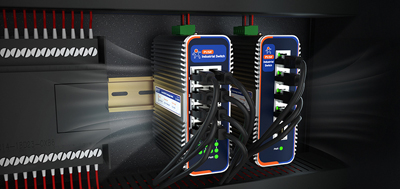
There's been a lot of discussion lately about a new wave of industrial network gear: a fanless industrial gateway, a rugged access point with adjustable reflector antennas, and a few stackable switches. The hardware itself is nothing exotic, but the direction is clear — network equipment is finally taking construction sites seriously. Dust, heat, vibration, unstable power: problems that barely exist in an office are an everyday reality on a job site. This article breaks the approach down into four steps: connectivity, coverage, cameras, and maintenance.
An office-grade router on a construction site typically runs into two problems first:
①Dust kills fans.In a fan-cooled device, dust kills the fan first, cooling fails, and then come the reboots and dropouts.
②Temperature and power.A container trailer can pass 40°C in summer and drop below freezing in winter; surges from generator start/stop cycles can damage the power supply.
So when choosing equipment, look at three things: whether it is fanless (or uses passive metal cooling), its operating temperature range, and whether it has surge/EFT protection.
Construction sites rarely have wired broadband ready to use. Cellular is the most practical option: internet from day one, and the SIM card goes with the team when the job ends.
Both models support link failover: when the primary link drops, the router switches to the backup automatically.
Job sites are open with few obstructions, but they are large. Wi-Fi is not a "put one in the middle" proposition. Directional coverage is already being discussed in the industry — a rugged AP with adjustable reflector antennas was recently shown, using reflector panels to shape the signal toward a specific work zone. The idea is worth borrowing: map out the work zones, the office area, and the storage area first, then decide whether each zone needs omni-directional or directional coverage.
The G806w ships with 2.4GHz Wi-Fi, dual 5dBi high-gain antennas with FEM amplifiers, and a wireless rate of up to 300Mbps — more than enough for a container office. On larger sites, use the router as the gateway and extend with additional APs.
Streaming site cameras over the public internet without encryption is neither secure nor stable. The G816, G806w, and G809s all support OpenVPN, IPsec, PPTP, L2TP, and GRE, so an encrypted tunnel can be built back to the head office and footage checked from a phone at any time.
The G809s is the edge router of the lineup: 1 WAN + 4 LAN ports, RS232/RS485 serial ports, 2× DI/DO digital I/O, dual-SIM backup, IP30 metal housing, and DIN-rail mounting. It suits network segmentation in the equipment room — cameras on one subnet, office traffic on another, without interference. The serial and digital I/O ports can also hook up site sensors, gates, and similar equipment.
The worst failure on a site network is the one nobody notices. Two things matter when choosing equipment:
①Hardware watchdog:automatic reboot after a crash, no site visit required.
②Remote management and alerts:the PUSR cloud platform handles remote configuration, reboot, and firmware upgrades; device offline, weak signal, and traffic overrun all trigger real-time alerts pushed by email and SMS.
Deployment checklist:put a 5G or 4G industrial router on the primary link with VPN and cloud management; mount it on a DIN rail inside the equipment room or container to resist vibration and dust; connect cameras to the router's LAN ports (add a PoE switch when multiple devices need power), then access them remotely over VPN. Get these four steps done on day one, and the network basically runs itself from then on.