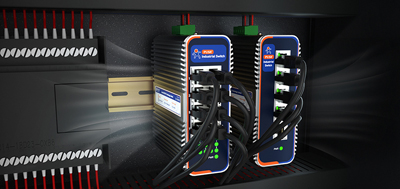
Garages, outdoor camera mounts, production-line control cabinets—the industrial Ethernet switches installed in these locations do not receive power over Ethernet. They connect to an external power supply instead. But different models have very different requirements for external power: some only accept a fixed voltage, while others with a wide input range can work with various DC power sources on site. Pick the wrong one, and the device either won't boot or the power module will burn out.
When faced with a stack of datasheets, how do you quickly tell whether an independently powered industrial switch fits the site? Focus on three things.
DC 12V, 24V, and 48V are common power sources on industrial sites, and some sites even have a 60V DC bus. If a switch has a narrow input range—for example, only 24V ±5%—it may not operate correctly when the on-site power fluctuates even slightly.
Choosing a model with a wide voltage input range is more reliable. The PUSR USR-ISG series, for instance, accepts DC input from 9.6V to 60V, so 12V, 24V, and 48V DC power supplies can all be connected directly without adjusting the site's power configuration to match a new switch.
Industrial environments experience significant voltage fluctuations. Lightning strikes, motor start-stop cycles, and loose wiring can all cause momentary power interruptions. A single-power-supply switch goes completely offline the moment its power circuit fails, taking every connected camera and AP down with it.
Redundant dual power supply design allows two independent power sources to be connected to the two power ports—one active, the other on hot standby. When the primary supply drops or voltage goes abnormal, the backup takes over seamlessly and the device keeps running. This matters most for unattended outdoor cabinets and parking-lot camera points.
The USR-ISG series supports dual power input and includes multiple layers of protection: polarity reversal protection, 6KV lightning surge protection, and short-circuit protection. The power circuit can handle common industrial-site disturbances.
Switches are rarely mounted in air-conditioned server rooms. They hang on garage walls, outdoor DIN rails, and control cabinets beside production lines. Protection rating and operating temperature range directly determine how long the equipment lasts.
Certifications: 3C, CE, and FCC are baseline requirements for the Chinese, European, and North American markets respectively. ROHS indicates the materials meet environmental standards. An IP40 rating protects against dust and falling objects. The -40°C to +85°C operating range covers extreme hot and cold conditions. For cooling, an aluminum housing with fanless design dissipates heat effectively without a fan—quieter operation and fewer failure points.
All of these specifications are available on the USR-ISG series: 3C, CE, FCC, and ROHS certified, IP40 protection, -40°C to +85°C wide-temperature operation, and fanless aluminum housing cooling.
Summarizing the three points above, here is a checklist for evaluating independently powered industrial switches:
For an independently powered industrial Ethernet switch, the core question is not "can it accept a power supply?" but "what kind of power supply, and under what conditions will it run stably?" Wide voltage input, redundant dual power supply, and complete certifications with protection features are the three indicators that need to be confirmed first during selection. Equipment that meets these three requirements runs reliably in garages, camera mounts, and production-line control cabinets, reducing long-term maintenance costs.