On an industrial site, the worst outcome isn't paying more — it's buying a converter that fails on the job. Serial-to-Ethernet converter on the market look similar on spec sheets, yet prices can differ several times over, and real-world performance varies even more. No fluff here: let's break down, one by one, the reliability indicators that decide whether a device can run for years on site without giving you trouble. Every point can be checked directly against the datasheet.
Don't just check "it works right now". The main chip determines protocol conversion capability (such as a Modbus RTU/TCP gateway or multi-host polling), data processing speed, and long-term stability. Devices with weak chipsets tend to lose packets or drop connections when baud rates change, multiple hosts poll at the same time, or data volumes grow — and troubleshooting that in the field is painful.
The USR-TCP232-410s and the N5X0 series use a Cortex-M7 core running at 400 MHz, precisely so that protocol conversion and multi-host polling don't stumble.
Before selecting, take stock of the field devices: meters, sensors, and VFDs are mostly RS485; older instruments and some controllers are RS232. A converter labeled RS232-only cannot talk to RS485 — you would need an extra RS232-to-RS422/485 adapter board. The more cables you add to the chain, the more failure points you create.
If the cabinet has both types, pick a dual-serial-port model: the USR-TCP232-410s runs RS232 and RS485 simultaneously. If you only have RS485 meters, a single-port USR-N510 is enough — don't pay extra for interfaces you'll never use.
The biggest difference between an industrial site and an office is that the environment doesn't negotiate: in summer, temperatures inside a cabinet easily exceed 60°C, supply voltage can fluctuate, and a VFD starting up is a burst of interference.
The USR-TCP232-410s operates from -40°C to +85°C, accepts 9-36V DC with reverse polarity protection, carries 1.5KV galvanic isolation on the Ethernet port, and its metal housing helps dissipate heat. The USR-N510 likewise accepts 5-36V DC input. These specs look dry on paper, but after three to five years in a cabinet, they're what decide whether a device is "still online" or "acting up every other week".
A USB-to-serial adapter plugged into a laptop can be yanked out and re-plugged if it dies. But a Serial-to-Ethernet Converter runs on the device side, powered 24/7. If it hangs at midnight, the line stops — and you only find out the next morning, after the damage is done.
Reliability has to mean "recovers by itself": both the USR-TCP232-410s and the USR-DR132/134 carry hardware + software dual watchdog, so a crashed program auto-resets and restarts. The DR132/134 also supports automatic reconnection — if the link drops, it restores itself without a site visit.
Port count isn't just about whether today is covered. The USR-N510 has 1 port, the USR-N520 has 2, and the USR-N540 has 4. RS485 can daisy-chain multiple devices on one bus, but the more devices you hang on it, the longer polling takes and the worse real-time data collection gets. Replacing the converter when you actually add devices means rewiring and reconfiguring everything. Leaving headroom for the next three to five years is cheaper than rework later.
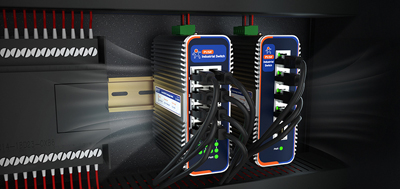
Cabinet space is always tight. The USR-DR132/134 is "lipstick"-sized, snaps directly onto a DIN rail, and uses push-in terminal blocks — no screwdriver needed — which makes it perfect for small cabinets and enclosures. The USR-TCP232-410s is wall-mountable, suited to the inside wall of a cabinet. Confirm the mounting method at selection time, so field installation doesn't get awkward.
Whether a device runs for years without trouble is not luck — it's the result of nailing down these indicators one by one: a reliable chipset, the right interface, wide temperature and voltage tolerance, self-recovery, and port-count headroom. When you choose a Serial-to-Ethernet Converter, run this checklist against the datasheet item by item, and you basically can't go wrong.