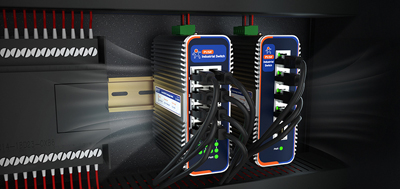
When selecting an industrial computer for the first time, many equipment manufacturers tend to ask first: "Which offers better performance, ARM or X86?"
Actually, this question should come later.
A more practical approach is to answer four key questions first: Where will the device be installed? What software will it run? Which field devices need to be connected? How much computing and network capacity is required? Once these four aspects are clear, choosing the right industrial computer becomes much easier.
Commercial computers are not completely unsuitable for industrial projects.
If the computer will be placed in an air-conditioned control room with stable ambient temperature, minimal dust, vibration, and power fluctuations, and if maintenance can be easily performed after equipment shutdown, then a standard commercial computer can often get the job done.
However, if the computer is to be directly installed inside machinery, electrical cabinets, energy storage cabinets, or on the production line itself, an industrial computer should be the primary consideration.
The reason is practical: industrial environments are not office spaces. For example, PUSR's USR-EG528 adopts a fanless industrial design, supports a DC 9–36V power supply, and operates within a temperature range of -25 to 75°C. The X86-based USR-EC series features a fully enclosed all-aluminum body with fanless cooling; when paired with a wide-temperature SSD, its operating temperature range can reach -20 to 60°C.
Therefore, the first selection principle is simple:
If the device goes into a control room, you can compare the costs of commercial computers and industrial computers. If it goes into machines, cabinets, or production sites, prioritize industrial computers.
Don't just compare purchase prices; also factor in the costs of on-site replacements, system reinstallation, and downtime for maintenance.
Next comes the question many people struggle with: ARM or X86?
The simplest method is not to compare CPU benchmark scores, but to first look at the software you plan to run.
If your primary tasks involve connecting to PLCs, instruments, sensors, BMS, serial devices, performing protocol conversion for Modbus, OPC UA, IEC104, IEC61850, BACnet, MQTT, etc., and uploading data to servers or cloud platforms, ARM is usually more suitable.
For instance, the USR-EG528 is equipped with a quad-core Cortex-A53 processor, 4GB RAM, and 32GB eMMC, runs Ubuntu 24.04, has Node-RED built-in, supports Docker installation, and provides 4 serial ports, dual Ethernet ports, as well as Wi-Fi and 4G connectivity. For most device networking, edge data acquisition, and protocol gateway projects, this configuration offers a balanced solution.
For tighter budgets, consider the USR-EG228. It features a Cortex-A7 processor, 512MB RAM, 8GB eMMC, dual Ethernet ports, 2 RS485 ports, and 2 CAN FD ports, and also supports Ubuntu, Node-RED, and various industrial protocols. It's more suitable for data acquisition, protocol conversion, and lightweight edge logic, rather than running large PC-based HMI software.
If the existing software is a Windows application, or if the project already uses a significant amount of SCADA, databases, middleware, or industry-specific software developed for the X86 environment, there's no need to adapt the software for ARM.
In such cases, choosing X86 directly usually presents lower project risk.
The PUSR USR-EC series supports both Windows and Linux. The EC100 comes standard with an Intel Celeron J6412 and offers dual Gigabit Ethernet ports. The EC300 utilizes a Core i5 platform, providing more USB and serial port resources. The EC500 further offers 5 Gigabit Ethernet ports along with a large number of serial and USB ports. For projects requiring multiple PC software applications, connecting numerous peripherals, or needing multiple network ports for network isolation, X86 is more appropriate.
Remember this principle:
The software determines the architecture; performance is a secondary consideration.
These two requirements are often confused.
If you only need to read data from PLC like Siemens, Mitsubishi, Omron, Modbus, etc., ARM-based industrial computers like the EG228 or EG528 are already capable of handling PLC data acquisition and protocol conversion tasks.
However, if you want the industrial computer itself to run control logic, then you need to consider PLC Runtime.
For example, the USR-EG628 comes with OpenPLC built-in, is compatible with IEC 61131-3, and supports five PLC programming languages: LD, FBD, SFC, IL, and ST. This means it can not only "read PLC data" but also take on some of the functions of an edge controller.
This is important for equipment manufacturers: if the original solution required an industrial gateway, a simple PLC, a protocol converter, and an edge computer, consider whether these functions can be integrated into a single device instead of adding more hardware to the cabinet.
If the requirement is only for on-site data display and simple control, installing a full-fledged, large SCADA system might not be necessary.
The USR-EG528 itself provides local SCADA/HMI capabilities for on-site data monitoring and control. If an on-site touchscreen is also needed, the USR-SH800 can be chosen, which integrates a 10.1-inch touchscreen, Ubuntu, Node-RED, Docker, and edge computing functions.
If deploying Ignition, it's recommended to check software and module compatibility rather than focusing solely on CPU architecture. The official Ignition 8.3 Docker image currently supports linux/amd64, linux/arm64, and linux/arm/v7, so ARM is not inherently incompatible with running Ignition. However, specific PLC Drivers, third-party modules, and the existing project environment still need to be verified item by item. When there are already many Windows applications and traditional modules, choosing an X86 model from the EC series often saves migration effort.
Another common issue for manufacturers is: the CPU seems sufficient, but as more devices are added, data traffic begins to congest.
At this point, what you should really look at are the number of network ports, network port speeds, and on-site interfaces.
For example, ordinary device data acquisition might choose the EG528. If more control functions, CAN, serial ports, and edge capabilities are needed simultaneously, consider the EG628. For energy projects requiring connections to many devices within cabinets, the EG828-EMS directly provides 4 Gigabit Ethernet ports, 8 isolated RS485 ports, 16 isolated inputs, 6 relays, 2 isolated CAN ports, and 4 analog inputs.
For multi-network, high-bandwidth X86 applications, the EC500 offers 5 Gigabit Ethernet ports. If the project involves video analysis and edge AI, the EG928A provides 3 Gigabit Ethernet ports, 8GB RAM, 128GB eMMC, and an NPU with up to 6 TOPS, making it more suitable for visual analysis and AI inference.
Therefore, for network selection, don't just ask "does it have network ports?" Instead, tally: the number of field devices, data volume per device, whether video is involved, whether internal and external network isolation is needed, and whether local control is required after network disconnection.
6. You Can Choose Directly Using This Table
| Requirement | Priority Consideration |
| Low-cost data acquisition | EG228 |
| General-purpose ARM industrial computer | EG528 |
| PLC Runtime / OpenPLC | EG628 |
| Protocol conversion, edge computing | EG528 / EG628 / EG828 |
| Node-RED / Docker | EG528 / EG628 / EG828-GL / EG828-EMS |
| IoT secondary development | EG118 / EG628 |
| Energy storage EMS | EG828-EMS |
| Edge AI | EG928A |
| Windows / X86 software | EC100 / EC300 / EC500 |
| High-performance, multi-interface X86 | EC300 / EC500 |
| Multi-network port projects | EC500 |
| Industrial touchscreen | SH800 |
In a photovoltaic power station project case provided on the PUSR website, the EG628 directly converted inverter DL/T 645 data to MQTT and uploaded it to the cloud platform, eliminating the need for an additional protocol gateway. The project result mentioned in the material was a 60% reduction in deployment time and a 45% reduction in operational costs.
In another case involving a remote island microgrid using the EG828-EMS, the site originally faced issues like frequent diesel generator start/stops, photovoltaic curtailment, and manual battery status checks multiple times a day. What such projects truly need is not a "computer with higher benchmark scores," but an industrial computing platform capable of simultaneously connecting to PCS, BMS, PV inverters, diesel generators, and field I/O, and performing local data processing and control.
This is the most important point to consider when choosing an industrial computer: Don't buy for performance first and then figure out how to use it. First, list out the software, devices, interfaces, and network requirements, then select a model that precisely meets those needs.
If you're only collecting data from a few dozen devices, there's no need for a high-performance X86 system. If you've already decided to run Windows SCADA and a lot of legacy software, there's no need to force a switch to ARM for lower power consumption.
For most manufacturers, the truly cost-effective industrial computer is not the one with the highest specifications, but the one that can reduce the need for additional gateways, switching equipment, PLCs, and maintenance work, while leaving an appropriate margin for future expansion.