Factory garages exceeding 45℃ in summer, equipment rooms with humidity reaching 95% after doors and windows are closed, outdoor surveillance enclosures with internal temperatures far above outdoor readings under direct sunlight. These are not edge cases but daily operating conditions for many manufacturers.
Placing a standard switch in such environments causes frequent disconnections or, in severe cases, motherboard corrosion and failure. When selecting an industrial Ethernet switch, ambient temperature, humidity, chassis cooling, and installation conditions must be evaluated together rather than focusing solely on port count and transfer speed.
Switches generate heat from their chips and power circuits during operation. This heat must dissipate through the chassis. Enclosed equipment cabinets typically run 10℃ to 15℃ higher than ambient outdoor temperatures, and the difference widens further when cabinets receive direct sunlight. Fanless designs rely on natural heat dissipation through the chassis, which does not mean placing switches adjacent to heat sources is acceptable, nor does it guarantee temperature stability in sealed enclosures.
USR-ISG employs a -40℃ to +85℃ wide-temperature design, covering peak summer temperatures across most industrial districts in China. When selecting a switch, actual temperature at the installation location should serve as the reference point, and local meteorological data can only establish a baseline rather than substitute for estimates of cabinet-internal temperatures.
High humidity alone is not the primary concern; condensation is. When moist air contacts a cold surface, water vapor condenses into droplets. Equipment transported from a cold warehouse to a warm site in winter can develop internal condensation before power-on, potentially causing short circuits or corrosion. Sealed cabinets similarly experience internal condensation during nighttime cooling, and sealing alone cannot prevent this.
While a product specification states "5% to 95% relative humidity," the non-condensation requirement must also be confirmed. USR-ISG operates within 5% to 95% RH without requiring special anti-moisture coatings. During installation, sufficient air circulation space should be maintained between the device and cabinet walls to prevent surface temperature drops during cold startups that could trigger condensation.
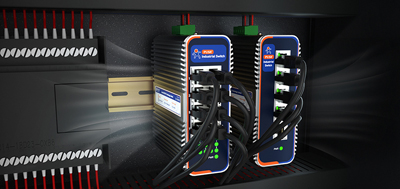
Aluminum alloy housings offer higher thermal conductivity than standard steel plates, and fanless cooling proves more reliable in continuous high-temperature environments—there are no fan bearing wear issues and no periodic dust cleaning required. USR-ISG's aluminum body combined with fanless design reduces failure points in high-humidity, dust-prone environments.
The compact form factor with DIN-Rail mounting saves space within equipment cabinets. DIN-Rail mounting is the most common fixing method in industrial settings, allowing faster installation and removal compared to screw mounting.
Fourth, ingress protection rating and lightning protection capability cannot be overlooked in harsh environments.
IP40 protection prevents solid foreign objects larger than 1mm from entering and blocks finger contact with internal components. For garage or equipment room environments not exposed to direct rain, IP40 is sufficient; outdoor installations require higher protection enclosures.
Lightning surges and power fluctuations are routine in industrial sites. USR-ISG provides 6KV lightning protection on both power and network ports, supports DC 9.6V to 60V wide-voltage input, and features dual power redundancy. When one power supply fails, the other seamlessly takes over, ensuring uninterrupted operation.
Selecting an industrial Ethernet switch for high-temperature, high-humidity environments boils down to four points: a wide temperature range covering actual cabinet temperatures, humidity specifications with non-condensation conditions, aluminum chassis with fanless cooling to reduce failure points, and ingress protection and lightning ratings matching the deployment location. Only devices meeting these criteria maintain network stability under sustained high-temperature, high-humidity conditions.
USR-ISG carries 3C, CE, FCC, and ROHS certifications, operates from -40℃ to +85℃, offers IP40 protection, aluminum fanless chassis, 6KV lightning protection, and DIN-Rail mounting, covering most of the key considerations outlined above.