In industrial automation circles, you keep hearing the same question: "I need to connect a PLC, HMI, servo drives, and a host computer on this line — which switch should I buy? 5 ports or 8? Gigabit or fast Ethernet? Do I need an SFP optical port?"
Different people give different answers to the same question. Some recommend managed switches, others unmanaged; some emphasize the brand, others the price. But when you break it down, most "I don't know which one fits" situations are not caused by a lack of information — they come from not turning the requirement into a few specific, answerable questions.
Choosing an Industrial Ethernet Switch is essentially a constraint problem: find the one that best matches the site within hard limits — port count, speed, temperature, power supply, protection, and mounting.
When you receive a project requirement, work through the five questions below in order. Each has a clear answer, not a "something close enough."
First, count the devices that will plug into the switch once powered on: PLC, HMI, servo drives, sensor gateways, IP cameras, APs, host computers… For each device type, add a port, then leave 1–2 spare ports as redundancy and for expansion.
On speed:
This is often overlooked, yet it's a major source of on-site failures.
The temperature inside a control cabinet is usually higher than ambient — especially in sealed enclosures. A quick field check: close the cabinet and press the back of your hand against the panel. If it's clearly too hot to hold, the air inside is likely 10–20 °C above the outside reading.
So when selecting, don't just read the "ambient temperature" spec — look at theoperating temperature range:
If the project involves outdoor enclosures, high-temperature workshops, or cabinets that stay sealed without ventilation, go straight to a wide-temperature model. Don't save on this one.
A 24 V supply on the industrial floor is not the same as a lab bench supply. Motor starts and stops create surges, wiring can be reversed, and the supply circuit can dip briefly.
A few points to confirm:
This is the most over-specced item. An unmanaged switch is plug-and-play, with no configuration interface and therefore no chance of a misconfiguration taking the network down. In these cases an unmanaged model is enough:
The signals that genuinely call for a managed switch are: a large network, ring self-healing requirements, business segments that must be isolated, or remote troubleshooting across distributed equipment — none of which shows up often in small or mid-sized projects. If the project doesn't meet those conditions, paying the managed premium means most features go unused.
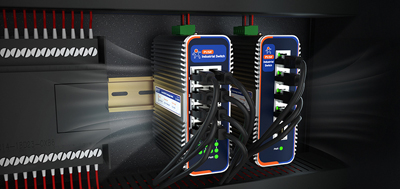
PUSR's USR-ISG series is built along exactly these five points:
Unmanaged, plug-and-play, with no management features stacked on that will rarely be used. For small and mid-sized automation projects, the reliability budget should go into hardware protection, not into configuration interfaces that sit unused.
To choose an Industrial Ethernet Switch, answer five questions first: how many ports, at what speed, where it goes, what the temperature is, and whether the power supply is stable. Once the hard conditions are answered, the choice narrows naturally. No need for brand leaderboards, no need to wrestle with "is managed more advanced," and no need to pay a premium for features that won't be used.
Put the budget into temperature, power, and protection — the three things that actually affect the failure rate — and the selection will rarely go wrong.