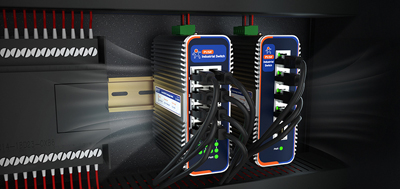
A control cabinet is not a server room. Heat, dust, vibration, 24 VDC power and no space to spare — a gateway that lives there has to be chosen differently. Here is the checklist, and the concrete way to wire PLC / Modbus devices up to the cloud.
Earlier this year, Ubiquiti shipped the first product of its new UniFi Industrial line — the Cloud Gateway Industrial. The r/Ubiquiti thread announcing it filled up fast, and most people noticed the same thing: the box looks nothing like the sleek white hardware they were used to. It is roughly 2.4 kg (5.3 lb) of extruded aluminum with big heatsink fins. It is fanless. It draws about 28 W and dissipates all of it passively. It even ships with a DIN-rail mounting kit.
Why would a company known for clean home-networking gear build that? Because the people buying these boxes told them why: a gateway sitting inside a control cabinet is not in a server room. It is in a metal box next to contactors and motor drives, breathing dust, vibrating with every machine cycle, expected to run 24/7 without anyone coming back to touch it. Fans are the first thing that die in that environment — they clog, they whine, they stop. The "industrial" version is the industry admitting that ordinary network gear simply was not built for this.
But there is a catch most buyers miss. A gateway thatsurvivesa control cabinet is not the same as a gateway thatdoes the jobin one. The device in your cabinet is rarely there to route Wi-Fi. It is usually there to talk to a PLC or a Modbus meter and get that data somewhere useful. Those are two different products. This article is about telling them apart — and about the checklist I would run through before spending money on either.
Four things are different inside a cabinet, and each one is a failure mode:
None of this is exotic. It is the reality of a machine cabinet — which is why "industrial design" is not a marketing adjective here. It is a checklist.
Before evaluating any product, run it through these five points. I will use PUSR's USR-M300 as a concrete example because it is the device I know best — but the checklist applies to any candidate.
The USR-M300 supports both DIN-rail and wall mounting, with an ABS housing rated IP30, and it is compact — 79.6 × 58 × 110 mm, roughly the size of a small modem. It takes one rail slot and does not crowd the terminals next to it.
A wide input range matters more than people think. 9–36 V covers 12 V and 24 V cabinets, and tolerates the dips and spikes that happen when big loads switch. If a device needs exactly 24 V, it is already a compromise.
A workshop cabinet that is not air-conditioned gets hot in summer and freezing in winter. The M300's -25~75 °C rating means it keeps working through both. And note: an internal fan would be a liability here, not a feature — the M300 is fanless, fully passive.
The M300 carries Level 3 protection across the key tests — ESD (IEC 61000-4-2, contact 6 kV / air 8 kV), surge (IEC 61000-4-5), and electrical fast transients (IEC 61000-4-4). These are the tests that simulate real cabinet noise. If a product does not list EMC levels, ask why.
Industrial buyers increasingly need proof, not promises. The M300 holds approvals including 3C, CE, FCC, RoHS, WEEE, CTA, ANATEL, ECAS RoHS, MTC, NBTC, RCM, SRRC, and TDRA — and PUSR devices have also met the EU's EN 18031 cybersecurity standard (the RED cybersecurity requirement). Whatever you pick, check the cert list against where the cabinet will be installed.
This is where most selection goes wrong. A "gateway" in an industrial cabinet can mean two completely different things:
They look similar from the outside and are completely different inside. The UCG-Industrial has no RS232/RS485 ports and speaks no Modbus — you would never wire it to a PLC. The USR-M300 is the opposite: it is built around data acquisition — serial ports, digital and analog I/O, protocol conversion, up to 2,000 data points — and its networking features (VPN, firewall, MQTT) exist to carry that data somewhere.
So the first question is never "which gateway is better." It is "which job is mine?" If you are connecting machines to a data platform, you need the second kind. If you are extending a network into a harsh environment, you need the first. Some sites need both — and they are separate purchases.
Here is the concrete method, using the USR-M300 as the working example.
Connect Modbus RTU devices to the gateway's two serial ports (one RS232/RS485, one RS485 — for multi-drop RS485 use A/B wiring on the RS485 port). Power meters, drives, and many PLCs expose Modbus RTU over RS485, so one port can poll a chain of devices.
The M300 actively polls devices: it reads registers from serial devices and converts Modbus RTU to Modbus TCP (and back), so equipment that only speaks serial becomes reachable over the network. It also supports common PLC protocols and power-meter protocols such as DLT645, and can convert data into standard formats like OPC UA, Modbus, JSON, or BACnet if a downstream system needs them.
The M300 runs a dual-core 1.2 GHz processor on Linux and supports Node-RED graphical programming. You build the data handling right there: filter noisy readings, average values, buffer data when the network drops, and set alarms. The "2,000 data points" figure is headroom; what you will actually use is the ability to process data before it leaves the cabinet.
The M300 has 2×DI, 2×DO (relay, rated up to 10 A), and 2×AI (4–20 mA). A DI can count pulses from a flow meter, an AI reads a 4–20 mA sensor, and a DO can trip a relay locally when an alarm condition is met — a DI or AI triggers the DO with no cloud in the loop. That is a local control loop living inside the gateway, which matters exactly when the network drops.
Data leaves the cabinet over Ethernet or 4G (LTE Cat-4, global bands, one micro-SIM slot) using standard MQTT, TCP, or HTTP with custom JSON reporting templates — which makes the format side painless when your server team has its own schema. The M300 connects out of the box to PUSR Cloud, Alibaba Cloud, AWS, Azure, and ThingsBoard. For remote maintenance it supports VPN (PPTP, L2TP, OpenVPN), so you can reach the cabinet network securely without opening inbound ports.
Machine data → industrial IoT edge gateway. Network edge → network gateway. Do not conflate the two.
Check rail mounting, power range, temperature rating, and EMC levels against the cabinet you know — not the one in the brochure.
Fanless design, remote management, VPN access, and certifications all decide whether "install once" really means install once — or climb back up in six months.
The hardware that started the discussion : even consumer-focused vendors now know a cabinet is not a closet, and that a fan is the enemy of a 24/7 device. Choosing an industrial gateway is the same argument applied to your own spec sheet. Pick the box that matches the cabinet, and that speaks the language of the machines inside it — and the data will take care of itself.