Solar farms and small hydro stations usually run two systems on one network: IP cameras for video surveillance, and SCADA for data acquisition and remote control. Cameras emit a continuous stream once powered on; SCADA traffic is small in volume but demands low latency and loss-free delivery. When both share the same 4G uplink, a poorly designed setup does more than stutter video — telemetry squeezed out of the pipe is the real cost. In technical communities, the question of which router suits a small industrial network keeps coming up. Stripped to its core, it asks whether a single industrial router can carry both CCTV and SCADA. Worked through step by step, it is not a hard problem.
The usable uplink bandwidth of 4G is what it is, so the first step is to quantify the demand rather than pick hardware.
Multiply the number of cameras by their bitrate. Four 1080P cameras with a 4 Mbps main stream add up to roughly 16 Mbps of uplink. Add one SCADA link: its packets total tens of kbps at most, yet it is far more sensitive to latency and stability. Video is what consumes the bandwidth; SCADA is the small share that cannot wait.
Two rules of thumb settle most cases. When the aggregate camera bitrate stays well below the usable uplink, a standard 4G industrial router is enough. When several HD streams run flat out and approach the ceiling, the answer is to reduce the bitrate, rethink the storage strategy, or move to a wider link. Traffic requirements should drive the router choice — not the other way around.
How the devices are connected determines whether video and SCADA travel on independent paths or interfere with each other.
Cameras should be wired wherever possible: aggregated by an NVR or a PoE switch, then uplinked to a LAN port of the router. This is far more stable than cameras hanging on WiFi. SCADA controllers, PLCs, and remote terminal units go on a separate path — ideally a dedicated Ethernet port, or an RS232/RS485 serial connection. Serial is particularly friendly to legacy devices, because no protocol change is required.
For a site with few devices, a compact router with a modest port count is enough: NVR and SCADA each take one port and never contend. The USR-G806w, a 4G industrial router with three Ethernet ports plus WiFi, fits this pattern. For sites with more gear, existing fiber runs, or serial-based legacy equipment, a gigabit multi-port edge router works better. The USR-G809s offers two SFP fiber ports plus eight gigabit copper ports, and two serial interfaces: fiber reaches a remote switch or long-distance links, copper serves the NVR and field devices, and RS485 picks up meters, protection relays, and other serial terminals. A single box covers the whole on-site access layer.
Controlling 4G usage depends less on router-side rate limiting than on changing how video is transported.
The common pattern is local recording of the main stream. The NVR or the camera's SD card records the full HD stream continuously, while remote viewers watch the sub-stream or replay footage on demand, pulling a live feed only when a scene must be checked. The 4G link then carries traffic only during those moments and stays idle the rest of the time, which lets SCADA data travel more smoothly. For spots that need alarm linkage, event-triggered upload is an option: no video is transmitted during normal operation; when motion or an alarm occurs, a short clip is pushed. That costs an order of magnitude less traffic than a 24/7 live feed.
Router traffic alarms deserve to be enabled as well. Industrial routers can set usage thresholds and notify operators by email or SMS when they are crossed; offline events and weak signals trigger alerts in the same way. With many sites to look after, proactive notification beats waiting for complaints and troubleshooting afterwards.
Lost video can be reviewed from recordings; a SCADA outage affects live monitoring and remote operation. This traffic deserves a dedicated reliability design.
At the link level, pick a router with link backup: when the cellular connection fails, traffic switches to a standby link automatically so the SCADA session is not dropped. At the remote access level, the operations channel should enter through an encrypted VPN tunnel — OpenVPN, IPSec, and L2TP are standard on industrial routers — instead of exposing device ports to the public internet. Remote maintenance of a SCADA site goes through the tunnel, which covers both security and stability.
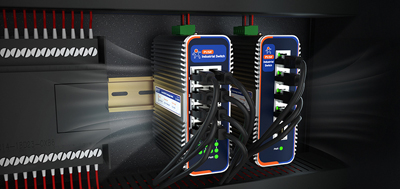
At the environment level, most of these sites live in outdoor cabinets and switchgear rooms, so the equipment must tolerate temperature swings and unstable power. Wide-temperature rating, wide-range DC input, a metal enclosure, and DIN-rail mounting are baseline requirements in these scenes. A hardware watchdog reboots the device automatically after a fault and reduces trips to the site.
Match the requirement to the model:
Back to the opening question: can one industrial router carry both cameras and SCADA? Yes — provided the steps above are followed in order: size the traffic, separate the wiring, keep recordings local, and give SCADA its own reliability design. The industrial router puts both services safely on