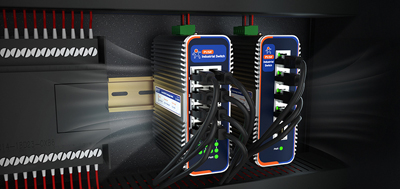
Two years after handover, the router in the cabinet carries seven or eight rules: three from the factory, two added with new equipment, and the rest that nobody can explain. Whoever added them has moved on, and the person who inherited the machine will not delete them, or answer customer IT's question about what that line was for.
Care is not the issue. Building stability on the assumption that whoever configures the device will not make mistakes hands the safety net back to a person. When industrial router options are compared, what decides the network's state three years later is whether rules can be locked down, whether a bad change can be rolled back, and whether changes leave a trace.
One entry point is the default state. Factory communication rules ship with a single LAN-to-WAN forwarding rule that nobody touches, leaving the device open on the internal side. That is usually what "the firewall was never enabled" describes.
Another is drift from hand-configuring each unit. Across a batch of fifty entered one at a time, unit fifty gets a target address one digit short or a port reversed, and catching it depends on checking every unit by hand.
A third is context lost at handover: the rule's author moves on, and the successor faces an unannotated table, able only to add, never to remove.
None of the three shows up at the moment of failure; each is buried in an earlier routine operation.
The first layer is direction: deny by default, allow on demand. On the menu it comes down to a few fixed actions.
In the firewall's communication rules, build one forwarding rule per device that needs outbound access: source zone lan, source address the device IP. MAC matching also works, but the two are mutually exclusive, so source IP stays empty when matching on MAC. Some firmware splits the destination zone into wan, wan_wired and wan_4g; ticking one leaves the rule uncovered after a link switch, so select all forwarding zones. Fill in destination address, protocol and port, set the action to accept, and apply.
After the allow rules, add one catch-all: source and destination both all, action deny, last in the list. Rules match top-down, so a wrong order means the rule may as well not exist. The change takes effect only after a reboot from the system menu, the step most often skipped and often mistaken for missing support.
Acceptance needs no extra preparation: listed devices can reach out, unlisted ones cannot. Where the target is a domain rather than a fixed IP, use the domain whitelist under access restriction. Know the default: whitelist mode with no entries blocks every domain.
The second layer is undoing a bad change. Getting it right in one pass is luck, so the way back is prepared in advance.
The backup and upgrade page exports the current configuration as an archive; other machines in the batch import the same file and reboot. The practical pattern: clean the factory configuration, export it as a template, then change only the target address and port on site. When flashing firmware, tick Keep settings so rules are not wiped with it.
Rollback to factory settings has two routes: hold the Reload button on the chassis, or run restore-to-factory and reboot on one gateway from the remote platform. The first means standing at the cabinet, the second needs the device online. Put both in the handover document.
Export a copy before every change and archive it by date; it looks like nothing until the day it matters most.
The third layer is permissions. The built-in web page ships with the same default username and password, admin and admin in most cases. Changing that is the first task at handover, and the new credentials go into the handover document, not onto the cabinet door.
When several people share one administrator account, nobody can be traced if something goes wrong. Without fine-grained role separation, split passwords by machine batch, one per batch, rotated when staff changes.
An outside team arriving for commissioning does not need the whole network opened; an encrypted tunnel fits better. The VPN suite covers PPTP, L2TP, IPSec, enhanced OpenVPN and GRE. Enhanced OpenVPN works as a client to an external server and as a server itself, with one-click import of .ovpn profiles and PKCS#12 certificates. A tunnel scoped to one device passes customer IT review more easily than an open subnet, and deleting the tunnel or replacing the certificate takes the access back.
Rule names carry audit value too: include the device name and date of change, so each register line maps to one entry on the device and nobody has to guess during an audit.
The fourth layer is visibility. Batch management pushes parameters and firmware to several gateways at once, so identical models need no individual logins. Remote login opens the built-in web page without a site visit. Status monitoring shows online state and signal quality, and the platform gives each gateway 50M of VPN bandwidth.
Three alert types cover the usual ground: device offline, weak signal, traffic over limit. Email and SMS delivery is supported, and alerts can be pushed repeatedly, so a single notification does not get buried.
A monthly check catches most drift: the online list on the platform, the rule count on the device, the date of the last export. When the three do not line up, someone changed something without recording it.
When rules must live on one device inside a tight cabinet, USR-G806w covers it: communication rules, access restriction and rate limiting in the firewall, configuration export as a reusable template, power from either a 2-pin terminal or the DC jack for redundancy, a 104×102×28mm housing, dual software and hardware watchdogs, and a -20 to 70°C range.
Where machines ship into varied environments and the uplink may lack a cable, USR-G816 fits: automatic backup between cellular and wired links, a metal housing and wide-voltage terminal with reverse polarity protection, a -35 to 75°C range, and an RS232/RS485 port for field devices.
Where a site holds many devices and needs one aggregation point, USR-G809s carries it: 2×WAN/LAN plus 6×LAN plus 2×SFP optical ports, DC 9-60V with reverse polarity protection, -25 to 75°C, Reset held 5-15 seconds for factory reset, a short press switching display pages, and a USB flash drive plus SD card for storage expansion.
Fail-safe does not mean keeping people out of the loop. It means assuming someone will eventually make a mistake, then writing the safety net into the configuration. Rule ordering, template export, access retrieval and alerts: asking those four questions up front costs less than adding one more rule after an incident. The value of an industrial router rarely shows in the first lines of a datasheet; it shows in whether that rule table still makes sense three years later.
1. When is an industrial router needed instead of a standard enterprise router?
Look at installation location and service life. Cabinet temperature, condensation, vibration and supply fluctuation raise the failure rate of standard equipment noticeably. The differences in industrial models are wide-voltage input, wide temperature range, terminal-block power, DIN-rail mounting and ingress protection, not port count. When machines ship out with a system and are expected to run for five years or more, starting from an industrial model usually saves trouble.
2. Which part of fail-safe configuration pays off first?
Start with the default direction: add a catch-all deny after the factory LAN-to-WAN allow rule, then allow devices one by one. This step needs no extra budget, the change is limited in scope, and the result can be verified on the spot.
3. Why does traffic still pass after the rules were changed?
The most common reason is that no reboot was run from the system menu. Next is rule order: the catch-all deny has to sit after the allow rules. A less obvious case is filling in both source IP and source MAC, since the source IP must be left empty when matching on MAC.
4. What if the target is not a fixed IP address?
Switch to the domain whitelist and add domains one by one under access restriction. Watch the default: enabling whitelist mode with no entries blocks all domain access, so add each entry before applying.
5. How can a batch of machines share one configuration baseline?
Configure rules, naming and alerts on one unit and export the file, then import the same file on the rest and change only the target address and port. Combined with batch management on the remote platform, later parameter additions do not require individual logins.
6. How should temporary access be granted to an outside technician?
Do not grant network-wide access; open one encrypted tunnel to the target device. Write down the tunnel account, certificate and scope of access in one place, and retrieve it as soon as the person leaves. If the model supports acting as a VPN server, an outside party can connect inward instead of the internal network being exposed outward.
7. Does remote troubleshooting require exposing a port to the public internet?
No. With VPN or SD-VPN networking, the device initiates the connection to the management platform and maintenance staff join from their own computers, so no inbound port has to be opened. This is also the only arrangement most customer IT teams accept.
8. Where are configurations stored, and what if one is lost?
Archive the exported file with the handover documents, named with the batch and date. There is a second layer: while the device is online, log in to its built-in web page through the remote management platform and export the current configuration again.
9. If the device itself locks up, is that a configuration problem?
No, but the fallback still belongs in the plan. Dual software and hardware watchdogs handle automatic recovery. Add one habit as well: export an archive before every change, and when the device behaves inexplicably, restore factory settings and import the previous configuration, which is far quicker