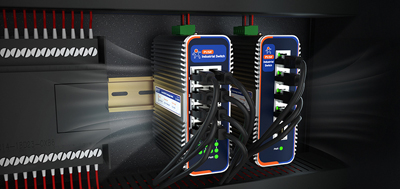
What worries people at industrial sites most is not a lack of features, but failures that start showing up after installation. When an Embedded industrial PC goes down, the cost is a trip to the site at best, and interrupted production or site data at worst. The good news is that whether a machine will keep running reliably over the long term can be judged before ordering — a datasheet plus a few questions is enough. The method below is arranged in check order, and can be applied to candidate models one by one.
Start by writing down the operating environment. Five items:
① ambient temperature range and swings at the installation point;
② dust, oil mist and humidity on site;
③ power quality (voltage stability, grounding);
④ whether the site is unattended (can anyone get there quickly after a fault);
⑤ what the machine will run (data acquisition, protocol conversion, or local applications). Different environments demand different levels of reliability, and every spec below should be checked back against this environment list.
For equipment installed in cabinets or on dusty factory floors, the most common failure path is the fan. A fan is one of the few moving parts in the whole unit. As dust builds up, speed drops, noise grows, and eventually the fan seizes, causing overheating or an outright shutdown. Industrial sites cannot be cleaned frequently, which is why "fanless design + one-piece aluminum housing for passive cooling" has become the mainstream approach for embedded industrial computers.
Take the USR-EG228 as an example: fully fanless, with the aluminum housing acting as the heat sink. There is no air intake, so dust cannot reach the internals, and a major mechanical failure point is removed. With wear parts like fans eliminated, the industry expectation for unit lifespan is generally five years or more. Fanless designs should be preferred unless the computing demand is genuinely high enough to require active cooling.
Site power is not as clean as laboratory power. Voltage fluctuation, reversed wiring, and lightning-induced surges can all damage equipment. Check three things:
The USR-EG228 is rated for DC 9-36V input, with reverse-polarity protection and a high EMC protection level. Parameters like these should go into the comparison table rather than being judged only by the number of ports.
Do not look only at whether the unit "boots up" — the question is whether it stays stable at extreme temperatures over long periods. Wide-temperature models are rated from -25°C to +75°C, covering non-air-conditioned cabinets and outdoor enclosures.
More important than temperature is self-recovery. When an unattended unit hangs and no one is there to restart it, the downtime multiplies. A hardware + software dual watchdog can reset the system automatically when it locks up — this is the key design behind "recovers on its own". The USR-EG228 comes with a dual watchdog built in. Confirm two points when purchasing: whether a watchdog is included, and whether both hardware and software mechanisms are in place.
Main controllers fall into two categories — decide the architecture first, then compare details:
To judge "industrial grade", do not rely on marketing language: check whether the chip is an industrial-grade part (such as the RK3562J), the rated temperature range of the whole unit, and whether EMC test results are documented in the datasheet.
Interface needs are dictated by the field devices: the number of serial ports (RS485/RS232), CAN, Ethernet ports and DI/DO should each be counted against the device list. Protocol compatibility matters just as much: whether the unit can talk to the existing PLCs and data terminals on site decides if extra converters are needed during commissioning. The USR-EG828-EMS provides 4×ETH, 8×RS485, 2×CAN, 16×DI and 16×DO for I/O-heavy scenarios such as energy management; coverage of common power and industrial protocols (IEC 61850, IEC 104, DLT645, DNP3, BacNet) should also be confirmed item by item.
Certifications are issued per model. CE, FCC, RCM, 3C, ANATEL, MTC, NBTC, RoHS, WEEE and cybersecurity-related certifications correspond to different sales regions and bidding requirements. Check the certificate of the exact model intended for purchase against the target market.
Long-term support comes down to three things: whether the operating system is mainstream (e.g. Ubuntu 22.04); whether applications can be extended in standard ways such as Docker; and whether firmware updates and remote management (e.g. the WukongEdge remote backend) are available. These decide whether the unit can be kept alive across its five-to-seven-year life cycle.