TSN Time-Sensitive Networking + Edge Computing: How to Redefine Real-Time Control Architecture in Precision Machining
Let me ask you a question first.
Your CNC spindle is cutting at high speed. Suddenly, it receives a "STOP!" command — from the moment the sensor detects an anomaly to the moment the command reaches the spindle braking system, how many milliseconds does it take?
If your answer is "tens of milliseconds," you've already lost.
In aerospace-grade precision machining, that number must be compressed to under 1 millisecond. Miss by 1 millisecond, and the tool may travel an extra 0.02mm on the workpiece. 0.02mm means nothing in consumer electronics. For an aero-engine blade — it means scrap.
But what's the reality?
In your workshop, sensor data first goes through the PLC, then SCADA, then uploads to the MES. The MES analyzes and issues a command. The command goes through the gateway, the switch, and back to the PLC —
This path takes a dozen hops and 50–200 milliseconds.
Your 5-axis machining center has 0.001mm precision, 12,000 RPM spindle speed, tool life accurate to 0.1 seconds — but your control architecture is stuck in the last century.
The equipment waits for the command. The command waits for the network. The network waits for analysis. The analysis waits for the upload.
This isn't precision machining. This is precision waiting.
To understand why TSN matters, you first need to understand the "original sin" of traditional industrial Ethernet.
What was traditional Ethernet designed for?Maximum throughput.
First come, first served. Can't send it? Queue it. Can't queue it? Drop it. Simple, efficient, cheap.
This logic works perfectly for office networks, for video transmission.
But for real-time control in precision machining — it's a disaster.
Imagine this: In your workshop, 5 CNCs, 10 sensors, and 3 AGVs are all running simultaneously. A traditional switch receives a data packet, finds the port busy — what does it do? Drop it. Send another — busy again — drop it.
5% packet loss? In an office network, users wouldn't even notice.
But in your workshop, 5% packet loss means: out of every 100 control commands, 5 vanish.
And one of those 5 might be "spindle emergency brake."
You say you're using QoS? Priority scheduling?
It helps. But QoS is "best effort" priority. When all ports are running at full load, QoS can only guarantee "relative fairness," not "absolute punctuality."
In the world of precision machining, "relative fairness" equals "unfair."
This is the original sin of traditional industrial Ethernet:it was never designed for real-time control. It was designed to "transmit as much data as fast as possible."
What your workshop needs is the exact opposite — not as much as possible, but every single packet must arrive on time. Not one can be missing.
What is TSN (Time Sensitive Networking)?
One sentence:Give traditional Ethernet a clock accurate to the microsecond, so every data packet has a "reserved seat."
Traditional Ethernet is "whoever arrives first sits down." TSN is "you arrive at exactly this hour, this minute, this second — you sit in seat number X. One microsecond late? Don't come in."
This isn't a metaphor. These are mechanisms explicitly defined in the IEEE 802.1 standard:
Time-Aware Shaper (TAS): Time is sliced into fixed-length time slots. Each slot only allows a specific type of traffic to pass. Control commands go in the control slot, video surveillance in the video slot, data acquisition in the acquisition slot — no interference, no preemption.
Frame Preemption: A high-priority control frame is being transmitted, and suddenly an even higher-priority emergency brake command arrives? Traditional Ethernet has to wait for the current frame to finish. TSN can literally "cut" the current frame in half — send the emergency command first, then fill in the rest.
Clock Synchronization (802.1AS): The clock error across all network devices is controlled within 1 microsecond. All devices run on the same "time reference." There's no "I think it's 10:00:00.001, you think it's 10:00:00.005" chaos.
What does this mean?
It means every control command your CNC spindle receives can arrive in a deterministic, predictable time. Not "about 50 milliseconds" —"exactly 4.7 milliseconds."
For aero-blade machining, that 4.7 milliseconds of determinism is the dividing line between yield and scrap.
If TSN solves the problem of "no traffic jams on the road," then edge computing solves the problem of "you don't need to drive every car to downtown before deciding where to go."
Traditional architecture looks like this:
Sensor → PLC → Gateway → Switch → MES Server (Cloud/Server Room) → Analysis → Issue Command → Switch → Gateway → PLC → Actuator
Data has to make a round trip, passing through a dozen hops, taking tens to hundreds of milliseconds.
TSN can make the road traffic-free, but the road is still too long.
The logic of edge computing:Analysis isn't done in the cloud. It's done on the roadside. Commands aren't issued from the server room. They're issued on the shop floor.
Specifically:
Sensor → PLC → IoT Gateway Device (Local Analysis + Local Decision) → TSN Network → Actuator
Data makes only one hop. Analysis is done locally. Commands are generated locally. TSN guarantees the command arrives on time within 1 millisecond.
From detection to execution: no more than 5 milliseconds.
This is the real-time control architecture precision machining needs — not "fast," but"deterministically fast."
You might ask: Is the IoT gateway device's computing power enough? Can it handle real-time analysis?
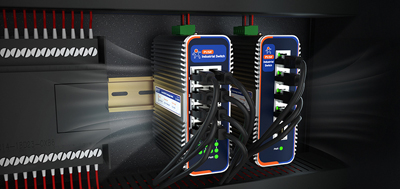
That's exactly why we need IoT gateway devices specifically designed for industrial scenarios — like the USR-M300. It's not an ordinary industrial PC. It's an edge computing device with built-in TSN switching capability, local AI inference support, capable of completing the full "detect-analyze-decide-issue" chain in 5 milliseconds.
No need to change your MES system. No need to re-cable. It connects to your existing industrial Ethernet, enables TSN mode, and upgrades your workshop from "best effort" to "precise control."
Let me show you with three real scenarios what TSN + edge computing actually changes:
The five axes of a 5-axis machining center must be strictly synchronized. Under traditional architecture, the five axes' control commands are issued from the same PLC but travel different network paths — arrival times may differ by 5–10 milliseconds.
A 10-millisecond difference at 12,000 RPM means the tool path deviates by 0.01–0.02mm.
Under TSN + edge computing, all five commands are issued in the same time slot, switched through TSN, arrive simultaneously — error < 1 microsecond.
Path accuracy improves from 0.02mm to under 0.001mm. This isn't parameter optimization — it's a physics-level upgrade from an architecture change.
You have 5 AGVs running in your workshop. Under traditional architecture, AGV obstacle-avoidance commands are issued from the central dispatch system, passing through the gateway and switch to the AGV controller — 100–200 milliseconds.
In 200 milliseconds, the AGV has already moved 30cm. If an obstacle suddenly appears ahead, by the time the command arrives — it's already crashed.
Under TSN + edge computing, obstacle avoidance is computed locally at the edge gateway, and the command is issued through TSN in 1 millisecond.
The AGV receives the "STOP" command in 1 millisecond and has only moved 1.5mm. Zero collision.
Under traditional architecture, finished workpieces are sent to the QC area. QC data uploads to the MES. The MES analyzes and feeds back to the line for parameter adjustment — this cycle takes 30 seconds to 2 minutes.
During those 30 seconds to 2 minutes, the line is still machining with old parameters. Every extra part machined is one more scrap.
Under TSN + edge computing, QC camera data is analyzed locally at the edge gateway. Pass/fail is determined in 10 milliseconds. Parameter adjustment commands are issued in 5 milliseconds.
From machining to feedback: no more than 50 milliseconds.
You're not doing "after-the-fact inspection." You're doing "real-time correction." Yield jumps from 95% straight to 99.5%.
At this point, you might ask: If TSN + edge computing is so good, why haven't most precision machining shops adopted it yet?
The answer is simple:not that they don't want to — they don't dare to.
Afraid the retrofit cost is too high.Do you have to tear down the entire traditional architecture? Replace switches? Replace gateways? Replace PLCs? The whole package costs hundreds of thousands, and the line has to shut down for days.
Afraid the compatibility is too poor.TSN is a new standard. What if old equipment doesn't support it? What if the MES system isn't compatible?
Afraid the risk is too big.Precision machining fears uncertainty above all. What if you switch to an unproven architecture and a batch of aero parts gets scrapped? Who takes responsibility?
All these fears are completely reasonable.
But the real advantage of TSN + edge computing is exactly this:it doesn't require you to tear down your existing architecture. It adds a layer on top of it.
Your PLC doesn't need to change. Your sensors don't need to change. Your MES doesn't need to change.
You just need to add a TSN-capable IoT gateway device at key nodes — like the USR-M300. It connects to your existing industrial Ethernet, enables TSN time-slot scheduling, and handles real-time analysis and decisions locally.
No production line changes. No equipment shutdowns. No system modifications. But your real-time control capability jumps directly from "hundreds of milliseconds" to "milliseconds."
This isn't a revolution. This is evolution.
The precision machining industry is entering a new era.
Over the past decade, everyone competed on equipment precision — whose CNC is more accurate, whose spindle is faster.
Over the next decade, everyone will compete on control architecture — whose commands are more punctual, whose feedback is more real-time, whose data loop is shorter.
The competition in equipment precision has hit the ceiling. The competition in control architecture has just begun.
TSN + edge computing isn't a technology trend. It's the watershed moment for precision machining — from "can do it" to "do it right."
You can keep using traditional architecture, keep enduring 50–200 milliseconds of control latency, keep letting every batch of aero parts risk being scrapped under "best effort" commands.
Or, you can use an IoT gateway device to install a clock accurate to the microsecond in your workshop.
Let every command arrive on time. Let every part be worthy of the effort.
If your precision machining line is considering upgrading from "traditional industrial Ethernet" to a "TSN + edge computing" architecture, contact us for the USR-M300's detailed specs and TSN deployment plan.
Your precision is already high enough. Now, make your control worthy of your precision.