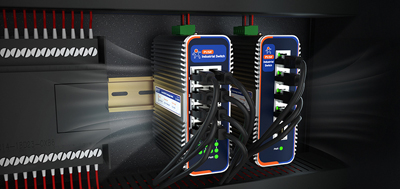
Once a serial device is connected to Ethernet, engineers usually gain a very convenient feature: enter the device IP address in a browser, open the Web management interface, and configure serial parameters, network settings, or operating modes remotely.
That convenience is useful, but it also introduces an important security question:
Just because serial data needs network access does not mean the Web management interface should be accessible from every network.
For a serial to ethernet adapter deployed in a factory, equipment room, water station, or remote industrial site, the goal should not be to eliminate remote management. The goal is to clearly controlwho can reach the management interface and from where.
Recent security research involving serial-to-Ethernet devices illustrates why this matters. Researchers identified vulnerabilities in some products involving authentication bypass, remote code execution, and configuration manipulation, with several issues directly related to Web management interfaces. The research also found nearly 20,000 such devices reachable from the public Internet.
If you are evaluating or deploying a serial device server, the following steps provide a practical place to start.
A common request during deployment sounds like this:
“We may need to change the configuration remotely later, so let’s just forward the management port.”
It is convenient for maintenance, but it also means anyone who can reach the public IP address may be able to discover and probe that management service.
A safer architecture is:
Engineer PC → VPN or dedicated maintenance network → Industrial site network → Serial device server
The Web interface should only be reachable from trusted management networks.
Consider a serial device server installed in a remote pumping station. A SCADA server may need continuous access to RS485 meter data, while only two or three maintenance engineers actually need permission to change baud rates, IP addresses, or operating modes.
There is little reason for the entire office network—let alone the public Internet—to reach the device configuration page.
Security guidance for serial-to-IP devices similarly recommends avoiding direct Internet exposure and using VLANs, dedicated subnets, and access-control rules to isolate management interfaces.
In many industrial projects, the problem is not that the device has no password.
The problem is that dozens of devices are installed and continue using the same initial credentials used during commissioning.
If those credentials are exposed on one device, the same credentials may provide access to many others.
Changing management credentials should therefore be part of the normal deployment process for every serial to ethernet adapter:
Power on → Configure IP address → Change management credentials → Configure serial settings → Configure network services → Connect to the production network
For example, the PUSR USR-TCP232-410s supports parameter configuration through its Web Server and allows the Web login username and password to be configured.
The important question is not simply:
“Does the device support password authentication?”
The more useful question is:
“Were the default or commissioning credentials actually changed before deployment?”
This is one of the most common sources of confusion in real deployments.
A serial device server may have several different types of network traffic at the same time, such as:
Allowing a business application port does not mean the Web management interface must also be reachable from the same networks.
For example, if PLC data is transmitted to a supervisory computer through TCP, the firewall may only need to allow:
Device IP → Specified server IP + specified service port
The Web management interface can be restricted separately:
Maintenance VLAN → Device management IP
This way, other hosts on the production network cannot automatically access the device configuration interface.
This separation is simple, but it significantly reduces unnecessary exposure.
There is another detail worth checking when selecting a device:
“Supports SSL/TLS” does not automatically mean “the Web management page uses HTTPS.”
These are two different security functions.
For example, the USR-TCP232-410s supports SSL/TLS for data communication in operating modes such as TCP Client, HTTP Client, and MQTT, and it also supports certificate-based authentication.
These capabilities help protect application data in transit.
The security of the Web Management Interface, however, should be evaluated separately. Depending on the model and firmware version, you should confirm whether the management page supports HTTPS, what authentication mechanism it uses, and how management access can be restricted.
Even when the serial data channel is encrypted, the management interface should still be protected through controls such as:
VPN access, VLAN isolation, firewall ACLs, or trusted management hosts.
Data encryption protects the communication channel.
Network segmentation protects the configuration interface.
Both matter.
A real incident provides a useful example.
In late 2025, attacks against wind and solar facilities in Poland involved configuration resets on serial device servers after attackers first gained access through VPN infrastructure.
The important point is that the serial device servers were not necessarily exposed directly to the public Internet.
The attackers first entered the internal environment and then targeted devices inside it.
This highlights an important lesson:
No public IP does not automatically mean the management interface is safe.
If an attacker, contractor laptop, compromised workstation, or unauthorized device gains access to the internal industrial network, an unrestricted Web management interface may still become a target.
For remote industrial sites, it is better to enforce two levels of access control:
First: Who is allowed to enter the site network?
Second: Once inside, who is allowed to access the serial device server management interface?
These should be treated as separate security decisions.
Before putting a serial device server into production, engineers usually verify whether the serial communication works.
It is worth adding a few management-security checks to the same commissioning process:
Has the Web management password been changed?
Can the Web interface only be reached from the maintenance network?
Are any temporary Internet port-forwarding rules still enabled after commissioning?
Are application servers allowed to access only the ports they actually require?
Is the deployed firmware version the one approved for the project?
Does remote maintenance enter the site through a VPN or another controlled management network?
These checks usually add very little time to commissioning, but they can significantly reduce the device's exposed attack surface.
For manufacturers and system integrators evaluating a serial to ethernet adapter, the purchasing decision should therefore go beyond RS232/RS485 port counts, baud rates, and protocol-conversion capabilities.
The device may remain connected to a production network for many years.
So another question is equally important:
“How should I securely manage the Web Management Interface of this device?”
A device such as the PUSR USR-TCP232-410s can provide RS232/RS485-to-Ethernet connectivity, Web-based configuration, Modbus gateway functionality, and SSL/TLS-supported data communication.
When these capabilities are combined with a dedicated management network, controlled remote access, appropriate firewall rules, and disciplined credential management, manufacturers can keep the convenience of remote maintenance without unnecessarily exposing the device configuration interface.