In-depth Analysis of Processor Performance in Integrated IoT Screens: A Selection Guide for ARM Cortex-A53 vs. A72
In the wave of transformation toward Industrial Internet of Things (IIoT) and smart factories, integrated IoT screens serve as the "digital nerve center" connecting the device layer with the management layer. The performance of their core processors directly determines the efficiency of data acquisition, edge computing, and visual display. Currently, mainstream ARM Cortex-A53 and A72 processors have become key choices in industrial scenarios due to their respective advantages in energy efficiency, computational performance, and ecosystem compatibility. This article provides a comparative analysis from three dimensions—architecture characteristics, application scenarios, and real-world performance testing—and offers a selection plan for enterprises based on the USR-SH800 integrated IoT screen.
As ARM's first 64-bit low-power core based on the ARMv8-A architecture, the Cortex-A53 employs an 8-stage sequential execution pipeline design, reducing power consumption by simplifying instruction scheduling logic. Its core advantages include:
Dual Execution State Compatibility: Supports switching between AArch32 (32-bit) and AArch64 (64-bit) modes, enabling seamless operation of legacy industrial protocol stacks (e.g., Modbus RTU) and new 64-bit applications.
High-Density Computing Optimization: At 28nm process technology, single-core power consumption can be as low as 0.13W, with a quad-core cluster consuming less than 1W, making it suitable for battery-powered mobile inspection terminals.
Limited Out-of-Order Execution: By improving branch prediction and instruction prefetch units, it enhances single-thread IPC (instructions per cycle) while maintaining low power consumption, achieving a 20% improvement in SPECint2000 scores over Cortex-A9.
Typical application scenarios include: smart meter data acquisition terminals, AGV (Automated Guided Vehicle) navigation controllers, and environmental monitoring sensor gateways—edge devices sensitive to power consumption.
As the flagship core of the ARMv8-A architecture, the Cortex-A72 features a 15-stage superscalar out-of-order execution pipeline supporting 3-way instruction parallel processing. Its technological breakthroughs include:
Process Technology Advantages: At 16nm FinFET process technology, it can reach a clock speed of 2.5GHz, delivering 1.8x performance improvement and 20% power reduction over its predecessor, the A57.
Multi-Core Scalability: Through the AMBA 5 CHI coherent bus interface, it can scale up to a 16-core cluster, meeting parallel computing demands for industrial vision inspection.
Hardware Acceleration Units: Integrated with NEON SIMD engines and dual-precision floating-point units, it supports OpenCL 1.2, accelerating PLC data parsing and AI model inference.
Typical application scenarios include: 5G base station signal processing units, automotive ADAS (Advanced Driver Assistance Systems) domain controllers, and high-end CNC machine tool HMIs (Human-Machine Interfaces)—complex systems requiring real-time responsiveness.
In a welding production line renovation project at an automotive parts factory, temperature and pressure parameters from 200 welding robots needed to be collected. Testing revealed:
Power Consumption Comparison: The A53 quad-core cluster (1.2GHz) consumed only 1.8W under full load, a 43.75% reduction compared to the A72 dual-core (1.5GHz) at 3.2W.
Latency Performance: The A53, with hardware-accelerated Modbus TCP protocol stack, controlled data acquisition latency within 50ms, meeting PLC closed-loop control requirements.
Cost-Effectiveness: The A53 solution reduced the BOM (Bill of Materials) cost per device by 35%, suitable for large-scale deployment.
In a photovoltaic power plant's inverter cluster monitoring project, real-time power analysis and fault prediction for 500 devices were required. Testing data showed:
AI Inference Performance: The A72, equipped with a 1.0TOPS NPU (Neural Processing Unit), could process 8 camera video streams in parallel, achieving a 98.7% accuracy rate in photovoltaic panel defect detection.
Multi-Task Handling: The A72 quad-core cluster, running Linux + Docker containerized applications, maintained CPU utilization below 60%, improving concurrent capability by 40% over the A53 solution.
Scalability Verification: Through the CCN-504 interconnect architecture, the A72 could scale up to a 16-core cluster, supporting future expansion for an additional 200 devices.
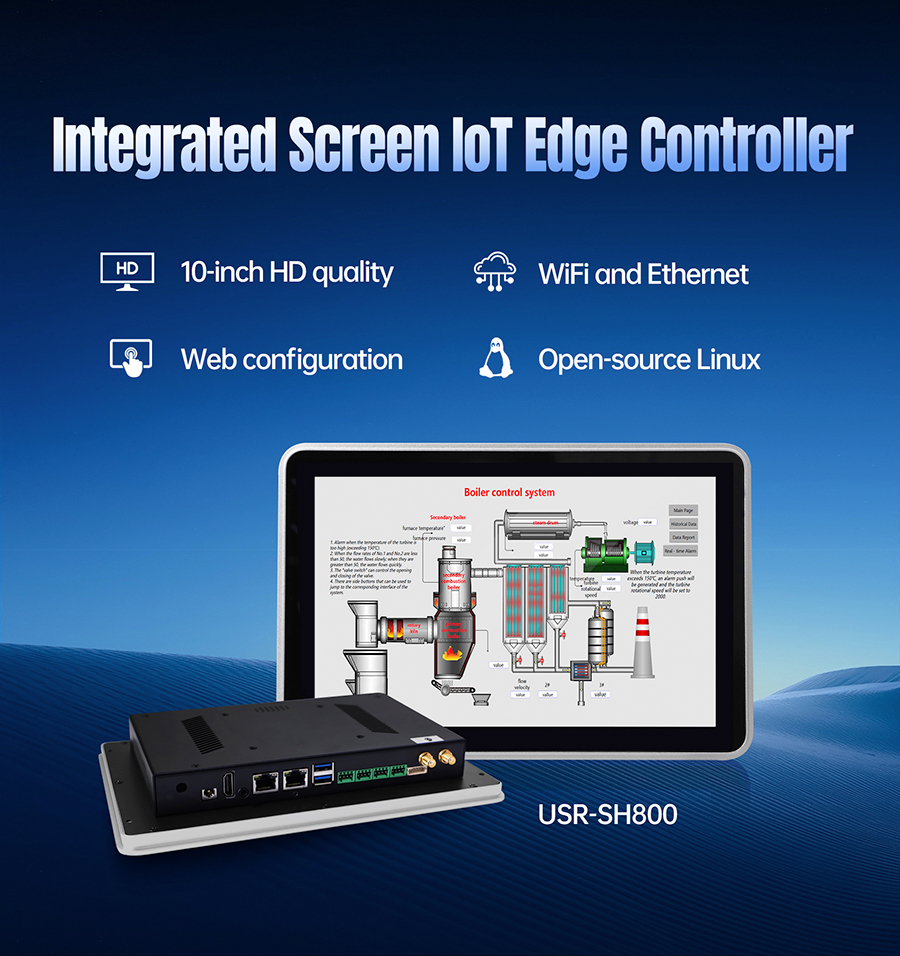
Addressing the cost-performance balance needs of small and medium-sized enterprises in smart factory transformation, the USR-SH800 integrated IoT screen offers an all-in-one solution:
Processor Configuration: Equipped with the RK3568 chip (4-core Cortex-A55 + 1.0TOPS NPU), its performance lies between A53 and A72, balancing energy efficiency and computational demands.
Industrial Protocol Support: Built-in with 200+ protocol libraries, it can directly connect to devices such as Siemens S7-1200 PLCs and Mitsubishi FX series without additional gateways.
Local Configuration Functionality: Through drag-and-drop WEB configuration tools, production line dashboards can be developed in 10 minutes, supporting dynamic data binding and alarm linkage.
Extreme Environment Adaptation: Operating in a wide temperature range of -20°C to 70°C, with an IP65 protection rating and 12V DC power supply, it meets the demands of harsh environments like welding workshops.
Typical Application Case:
In a 3C electronic assembly plant, the USR-SH800 achieved the following functions:
Real-Time Monitoring: Collecting status from 60 placement machines, improving OEE (Overall Equipment Effectiveness) by 15%.
Quality Traceability: Through AI vision inspection modules, reducing product defect rates from 0.8% to 0.2%.
Remote Maintenance: Engineers remotely debugging devices via 4G modules, reducing annual business trips by 70%.
Power-Sensitive Scenarios: Choose A53 or A55 cores to prioritize battery life or thermal constraints.
Compute-Intensive Scenarios: Select A72 or A73 cores to support AI inference and multi-task parallelism.
Cost-Oriented Scenarios: Opt for highly integrated SoC solutions (e.g., USR-SH800) to reduce peripheral circuit complexity.
| Metric | A53/A55 Solution | A72 Solution |
| Single-Core Performance | Suitable for lightweight tasks | Suitable for complex algorithm processing |
| Multi-Core Scalability | Up to 8-core clusters | Supports 16+ core clusters |
| Development Cycle | 1-2 weeks (standard protocol stacks) | 3-4 weeks (requires custom drivers) |
| Lifecycle Cost | 40% reduction in 5-year TCO (Total Cost of Ownership) | Suitable for high-value-added equipment |
To assist enterprises in precise selection, we offer the following services:
Online Diagnostic Tool: Fill out the "Industrial Scenario Requirements Questionnaire" to automatically generate a processor selection report.
Visit our official website, fill out the inquiry form, and our technical experts will contact you within 24 working hours.
Sample Testing Service: Submit application requirements to obtain sample trial opportunities and verify device performance in real-world environments.
Customized Development: Support Linux/Android system customization, providing SDK development kits and technical support.
Act Now: Scan the QR code below, submit your equipment list and scenario descriptions, and receive the "IoT Integrated Screen Performance Evaluation White Paper" and a tailored transformation plan!
In the Industrial 4.0 era, integrated IoT screens have evolved from mere display terminals into intelligent decision-making nodes. Whether it's the Cortex-A53 pursuing ultimate energy efficiency, the Cortex-A72 focusing on high-performance computing, or the balanced USR-SH800 solution, their core value lies in breaking down data silos and achieving a value (closed loop) between the device layer and the management layer. Choosing the right processor architecture is not just a technical decision but a strategic investment in an enterprise's digital transformation. Act now to make every bit of data a driving force for intelligent manufacturing!!


















