From "Manual Patrol" to "Unmanned Operation" — What Substations Really Lack Isn't Equipment, It's a Reliable Communication Network
——Two Real Station Stories That Reveal the True Threshold of Unmanned Operation
In 2023, in East China, two 110kV substations launched smart retrofits almost simultaneously.
Let's call them Station A and Station B.
Station A had a generous budget. They went all-in — smart patrol robots, online monitoring devices, AI visual analysis systems, digital twin platforms… The equipment list stretched to three full pages. When the leadership came to inspect, they pointed at that row of brand-new screens and said: "Nowthat'swhat smart transformation looks like."
Station B had only half the budget of Station A. Not many devices — just a few sets of online monitoring, one environmental sensing system, one remote video setup. It looked "shabby" — the leadership barely wanted to talk about it when they visited.
One year later, the results came in.
Station Astill relied on human patrols. The patrol robot "lost connection" every other day. Online monitoring data frequently failed to upload. The AI analysis false alarm rate was shockingly high. O&M staff still had to run to the site every day — "I don't feel right not going."
Station Btruly achieved unmanned operation. The monitoring backend updated data in real time. Anomalies triggered automatic alarms. 90% of daily O&M could be done remotely. Last month, it just passed the provincial company's unmanned operation acceptance review.
Same starting line. Same goal. So why such a huge gap?
The answer isn't in the equipment list. The answer is in that communication network you probably never gave a second look.
Station A's problem wasn't the equipment. It was the "connection."
Let's start with the patrol robot. Station A bought the hottest model on the market — LiDAR, infrared thermal imaging, AI recognition, fully loaded. But by the third day after installation, it broke down — the robot walked to a corner inside the station, the Wi-Fi signal dropped, and it just "died on the spot." O&M staff rushed over and found that the spot was right behind a high-voltage switchgear cabinet, where electromagnetic interference was off the charts. Ordinary Wi-Fi simply couldn't hold up.
They later added shielding measures, and it barely worked. But two weeks later, the robot "lost connection" again — this time because the 4G signal inside the station was too weak. Data couldn't get out, and the backend couldn't see the live feed.
A robot that cost tens of thousands of yuan became the station's most expensive "ornament" — all because of an unreliable network.
Now the online monitoring. Station A installed over a dozen monitoring devices on transformers, switchgear, and lightning arresters — theoretically, they could track equipment status in real time. But in practice, the data was constantly "on and off" — sometimes reporting once an hour, sometimes silent for half a day. O&M staff didn't trust the data, so they kept doing manual temperature checks and manual readings.
Why? Because those monitoring devices ran on the station's LAN, and the station's switch was a decade-old device — not enough ports, not enough bandwidth, severe packet loss. Data crammed together, "fighting" each other, and in the end, nothing got through smoothly.
A dozen-plus monitoring devices, all discounted because of a network that couldn't hold up.
The most frustrating part was the AI visual analysis. Station A installed eight cameras in the main control room, claiming they could automatically recognize meter readings, switch status, and personnel intrusion. But in the first week, the false alarm rate hit 60% — light changes, shadow movement, even a flying bug could trigger an alarm.
O&M staff had no choice but to turn off the AI and go back to watching screens manually.
The AI they spent a fortune on couldn't be "smart" at all — because of network latency and poor data quality.
Look — every single device at Station A, taken individually, was good. But the "conversation" between them was broken. Data didn't transmit stably, signals kept dropping, latency swung wildly — no matter how good the equipment, it was just a pile of哑巴 iron.
Station A's leader later said something to me that I still remember:
"We spent two million on equipment, only to find that the real bottleneck was that network nobody paid attention to."
Station B's approach, you might not believe this — they spent 60% of their budget on the communication network.
The equipment really wasn't much. Online monitoring only at key nodes. Video only covering main corridors. Inspection relied on fixed cameras + scheduled snapshots. No robot at all.
But they did one thing right:they built the network first, then hung the devices on it.
Station B's network architecture looked like this:
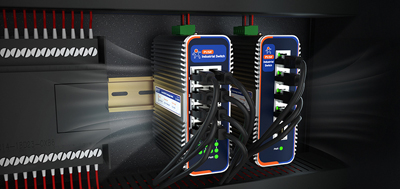
Inside the station, an industrial-grade switch built a dedicated communication network — physically isolated from the station control system, no bandwidth competition, no mutual interference. Key nodes were connected via direct fiber optic links, guaranteeing low latency and high reliability.
For the external exit, they didn't rely on the station's spotty 4G signal. Instead, they deployed a dedicated industrial 4G router— 4G/3G/2G full-network compatible, automatically switching from wired to wireless when the wired link drops, and from the primary carrier to a backup carrier when wireless gets weak.
This router was the "last line of defense" for Station B's entire communication network.
As it turns out, they used the USR-G806w from USR IoT. Not some sky-high-priced device either. But this little thing solved a big problem — no matter what happened inside the station, the data could always stably "get out."
One time, Station B's internal switch failed, and the entire station control network went down. But O&M staff at the backend could still see the online monitoring data — because that industrial 4G router was running on an independent link, completely unaffected.
That one detail alone is what let Station B truly achieve "unmanned yet fully monitored" during that failure.
Later, Station B's O&M manager said to me:
"We have fewer devices, but every single data point is accurate, every single alarm is real. O&M staff dare not go to the site — not because they're bold, but because they know: what the backend seesisthe real situation on-site."
That's the confidence to "let go." And that confidence didn't come from the equipment. It came from the network.
The stories of Station A and Station B aren't isolated cases. Over the years, I've visited hundreds of station retrofit projects, and I've found a pattern —
Most people's understanding of "unmanned operation" is off from the very first step.
Off how? Off in three myths.
This is the most common thinking. The boss says unmanned operation — the first reaction is: add devices. Robots, AI, digital twins, edge computing… The more devices, the more "smart."
But the truth is: devices are just terminals. The network is the lifeline.
You buy 100 smart devices. If the communication between them is unstable, data can't get through, commands can't get delivered — then what you have isn't 100 smart devices. It's 100 "information islands."
The prerequisite for unmanned operation isn't enough devices. It's data that actually flows.
Many people think: isn't a communication network just a matter of pulling a cable and setting up a switch? How hard can it be?
Too naive.
The communication environment in a substation is the "hell version" of a civilian network. Intense electromagnetic interference, extreme temperatures, humidity and condensation, cramped spaces, no air conditioning… Ordinary commercial equipment in this environment crashes every other day and dies every five days.
A network that tested perfectly in the office can behave completely differently on-site. Fiber optic bends too much and attenuates. Cable connector oxidation causes packet loss. Switch port aging causes latency — every detail you think is "insignificant" can bring the entire network down.
So a communication network isn't about "pulling a cable." It's a systematic engineering project of choosing the right equipment, surviving the environment, and building redundancy.
This is the most dangerous myth.
Many projects work perfectly when the network is first built. But after six months of operation, problems start cropping up — a switch port fails and nobody notices, the 4G signal weakens and nobody switches, the router crashes and nobody reboots it.
A communication network isn't infrastructure you "build and forget." It's a "lifeline" that needs continuous O&M.
What you need isn't just a good network. You need a network that can "handle things on its own" — self-heal when it breaks, auto-switch when it weakens, auto-reboot when it crashes.
That's the communication network unmanned operation truly needs: not a network that "never has problems," but a network where"problems don't take down the business."
By now, you should see it clearly —
From "manual patrol" to "unmanned operation," what's missing in between isn't equipment, isn't software, isn't AI. It's a reliable communication network.
This network needs to solve three problems:
First, inside the station, it must connect.All smart device data must stably converge onto one platform. This requires industrial-grade switches, a rational network architecture, and physically isolated communication channels.
Second, outside the station, it must connect.Data from inside must reach the backend in real time. Commands from the backend must reach inside in real time. This requires a reliable remote communication link — 4G/5G, fiber, satellite, or even multi-network backup.
Third, it must always connect.No matter what happens inside the station — switch failure, fiber cut, power outage — the communication link must not break. This requires equipment with built-in fault self-healing and automatic switching capabilities.
Solve these three problems, and your devices can truly "come alive." Your O&M staff can truly "let go." Your unmanned operation can shift from "unmanned on paper" to "unmanned in reality."
And solving these three problems doesn't require you to tear the whole station apart. You don't need to touch the secondary circuits. You don't need to modify protection devices. You don't need a single power outage.
You just need to place the right communication devices at the right key nodes.
Like thatindustrial 4G router at the station's external exit — it doesn't replace any of your smart devices. It just lets the data from all your devices get out, steadily and reliably. Some people use the USR-G806w from USR IoT — wide-temperature operation, automatic multi-network switching, built-in eSIM so no card needed. Drop it in the communication cabinet and basically forget about it.
It's not the star of the show. But without it, the star has nothing to perform on.
Let's go back to those two stations from the opening.
Station A spent two million, bought a pile of great equipment, and still relies on human patrols.
Station B spent half the money, didn't have many devices, but had a solid communication network — and truly achieved unmanned operation.
Where's the gap? Not in the equipment list. In that communication network you can't see but that works every single day.
If you're pushing unmanned operation, please — when you're building your plan, raise the communication network's budget and priority to the same level as your smart devices.
Not because the network is expensive. Because when the network goes down,everythingis expensive.
On the road to unmanned operation, devices are the legs, software is the brain — but the communication network is the bloodstream.
If the blood doesn't flow, no amount of legs will get you anywhere.
Lay that network down first. Only then has your unmanned operation truly taken its first real step.