Industrial 4G Router That Fears Nothing: Coastal Salt Mist, Mine Humidity, Desert Scorching Sun
Coastal salt mist, mine humidity, desert scorching sun: horizontal review of power routers in three extreme environments — the results are unexpected.
Let's start with three sets of real data.
| Environment | Location | Deployed Device | Survival Time | Final Outcome |
|---|---|---|---|---|
| Coastal salt mist | Yangjiang, Guangdong offshore wind farm | A certain brand's commercial 4G router | 8 months | PCB corrosion perforated, entire batch scrapped |
| Mine humidity | Datong, Shanxi underground coal mine | A certain brand's industrial 4G router | 11 months | Internal condensation short circuit, 3 units burned out |
| Desert scorching sun | Zhongwei, Ningxia PV power station | A certain brand's industrial 4G router | 6 months | Housing deformed and cracked, fan stopped, overheated and crashed |
Three environments, three ways to die, one common cause — when selecting, you only looked at the spec sheet, never visited the site.
This article doesn't talk about specs.
It talks about the field.
It talks about the things you can never test in a lab: how salt mist eats away at solder joints on the PCB bit by bit, how moisture in a mine condenses into water droplets at 3 AM, how 60°C ground temperature at desert noon bakes a plastic housing until it deforms.
Then, it tells you what a router that can actually survive looks like.
What's the site like?
Yangjiang, China's offshore wind power hub.
Monitoring data from offshore wind turbines has to travel dozens of kilometers from sea-based units back to the onshore dispatch center. What makes this possible? 4G routers.
But the air here isn't normal air.
It's salt mist.
The sodium chloride concentration in the air is 5–10× higher than inland. Put a coin outside — after three months, white crystals appear on the surface.
Your router is soaking in this air. 24 hours a day. 365 days a year.
Why do commercial routers die so fast?
Because the PCB in commercial routers uses ordinary HASL (Hot Air Solder Leveling) finish.
This is fine in normal environments. But in a salt mist environment:
8 months. Out of 47 routers in the batch, 31 showed corrosion faults.
Project manager Lao Li said something to me:
"I thought all industrial 4G routers were the same. Turns out they're just commercial routers in a different shell."
What kind of router can hold up?
Look at two things: protection rating and craftsmanship.
A router that truly resists salt mist needs PCB with conformal coating (moisture-proof, salt-mist-proof, anti-mold), gold-plated connectors, and an IP67+ rated housing.
We ran a side-by-side test with theUSR-G809sin Yangjiang — same cabinet, a certain brand's industrial 4G router on the left, G809s on the right.
After 14 months:
The gap isn't built in a day or two. It's built every single day.
What's the site like?
Underground coal mine. Temperature constantly 18–22°C, humidity above 90%.
Doesn't sound extreme?
That's what makes it the most dangerous.
Because the temperature isn't extreme, you don't think to add any special protection. But humidity is lethal.
Especially the day-night temperature swing — equipment heats up during the day, cools down at night, and moisture condenses inside the device into water droplets.
This is called the"condensation effect."
How does condensation kill a router?
Water droplets land on the PCB → form a water bridge between two solder joints that shouldn't be connected → short circuit.
It doesn't burn out instantly. It corrodes first, then shorts, then suddenly dies.
What you see at the dispatch center: data suddenly cuts out, recovers after reboot, then cuts out again a few days later.
You think it's a signal problem. Actually, the device is slowly being "drowned."
A certain brand's industrial 4G router deployed in Datong mine for 11 months — 3 units burned out.
Open them up: the mainboard is covered in green copper rust, with clear water stains between component leads.
What kind of router can hold up?
Two keywords: wide-temperature operation and sealed design.
If the router itself can operate stably from -40°C to +75°C, the condensation effect from day-night temperature swings is greatly reduced — because the device doesn't undergo drastic hot-cold cycling.
Add a fully sealed, fanless design, and external humid air simply can't get in.
G809s actual test data in Datong mine:
It's not "resisted the humidity." It's"made it so humidity never had a chance to get in."
What's the site like?
Zhongwei, edge of the Tengger Desert.
Summer noon. Ground temperature exceeds 60°C. Back of PV panels: 70°C+.
The router sits in a small metal box next to the PV mounting brackets.
No AC. No shade. No protection of any kind.
Inside the metal box, measured temperature:over 65°C.
How do commercial and "fake industrial" routers die?
First three months: fine. After six months, sand enters the fan bearings → RPM drops → cooling fails → CPU overheats → throttles → packet loss → crash.
A fan in the desert isn't a cooling solution. It's avacuum cleaner.
At 65°C sustained heat, ordinary ABS plastic starts to soften and deform → gaps appear between housing and PCB → sand gets in → short circuit.
The housing isn't just a "box to hold things." In extreme environments, it's thelast line of defense.
A certain brand's router in Zhongwei: 6 months, housing cracked, fan stopped, entire batch replaced.
How did G809s survive?
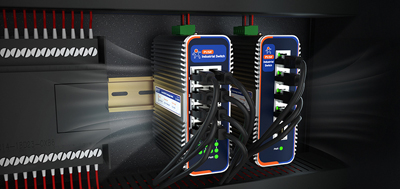
No fan. All-metal heatsink. Cool to the touch.
This isn't a marketing slogan. It's a measured result.
We ran a 72-hour full-load bake test in Zhongwei:
No fan = no pathway for sand to enter. No plastic = no possibility of deformation. No noise = cooling is entirely passive heatsink — and it held up.
The unexpected part isn't that G809s won.
The unexpected part is that the other "industrial 4G routers" lostthis badly.
| Comparison Item | Brand A (Salt Mist) | Brand B (Mine) | Brand C (Desert) | USR-G809s |
|---|---|---|---|---|
| Survival time | 8 months | 11 months | 6 months | 18+ months, still running |
| Cooling method | Fan | Fan | Fan | Fanless, pure heatsink |
| Housing material | Ordinary plastic | Ordinary plastic | Ordinary plastic | Metal + conformal coating |
| Protection rating | IP40 | IP54 | IP54 | IP67 |
| Full-load housing temp | Hot (78°C) | Hot (72°C) | Hot (81°C) | Warm (48°C) |
| Noise | Yes | Yes | Yes (later abnormal) | Zero |
| O&M | Monthly inspection | Quarterly | Bi-monthly | Remote, zero-touch |
You thought "industrial 4G routers" were all about the same?
They're worlds apart.
Fan vs. no fan — two different species.
Plastic vs. metal housing — two different species.
IP54 vs. IP67 — two different species.
Monthly site visits vs. remote zero-touch — two different species.
Let's talk about the product itself.
Why did I recommend the same device in all three extreme environment reviews?
Because it didn't compromise on a single dimension.
Not a spec-sheet claim. Measured.
Salt mist, mine, desert — all three temperature profiles covered.
You don't need to pick a different model for each environment. One device covers all.
72-hour full-load bake test, heatsink warm to the touch.
No fan = no dust buildup = no wear = no noise = no EMI.
In a mine, that means no extra interference source. In a distribution room, that means so quiet you forget it's there.
Coastal cabinets, mine modem bays, desert PV brackets — installation environments are totally different.
G809s comes in multiple form factors. No matter how weird your site is, it fits.
Power monitoring needs serial. Video return needs Ethernet. Alarms need DI/DO. O&M needs Wi-Fi.
One device handles it all. No extra modules needed.
One less device = one less failure point = online rate goes up.
No extra protocol gateway needed. No extra debugging.
Plug and run. When project deadlines are tight, this can save your life.
Let's talk money last.
G809s is priced lower than many "industrial 4G routers." But what you get:
Run the numbers:
| Commercial / Fake Industrial | G809s | |
|---|---|---|
| Unit price | 380–800 RMB | Slightly higher, but best in class |
| Avg. annual replacements | 1–2 times | 0 |
| Avg. annual O&M site visits | 6–12 | 0–1 (remote) |
| 3-year total cost | Device + O&M ≈ 15,000+ RMB | One-time setup ≈less than half |
Cheap things are only happy the moment you buy them. Expensive things only hurt the moment you pay. But in use —it's completely the opposite.
Salt mist won't get lighter because you bought cheap.
Mines won't get drier because you "made do."
Deserts won't stop scorching because you rated it IP54.
Extreme environments won't go easy on your project.
But you can pick a device that takes the hit for your team.
Takes the hit so it doesn't crash at -40°C.
Takes the hit so it doesn't short at 90% humidity.
Takes the hit so it doesn't deform at 65°C.
Takes the hit so it runs quietly for 3, 5, 10 years at an unmanned site.
Then lets your O&M engineers go from "fire brigade" to "monitoring team."
From "driving to site every month" to "opening a phone app and checking."
That's the real meaning of selection —
It's not picking a router. It's picking a way of working where you don't have to worry.
USR-G809s.
Three extreme environments, one device, 18 months zero failures, still running.
If your next project is also in salt mist, a mine, or a desert —
Put it on your comparison list. Take a serious look.
After all, extreme environments are here to stay.
But your router doesn't have to be replaced every year.