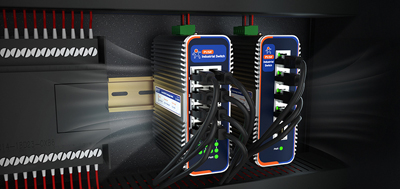
As the core computational carrier of industrial automation systems, the evolution of industrial computers (industrial computer) has been deeply intertwined with the digital transformation of global manufacturing. From an early stage of heavy reliance on imported technology to today’s era of comprehensive breakthroughs in domestic innovation, industrial computers have, over nearly half a century of iterative advancement, underpinned the 7×24-hour continuous operation of the global industrial infrastructure.
1. Comprehensive Timeline of Technological Evolution
1.1 1970–1980: Early Stage of Foreign Technology Import
In the 1970s, as global industrial automation surged, overseas manufacturers such as Siemens and Rockwell Automation introduced the first-generation industrial control devices. During this phase, China’s industrial computer market was almost entirely dependent on imports, with core technologies and supply chains controlled by foreign firms. Equipment procurement was costly, and maintenance and spare-part replacement cycles were extremely long, limiting deployment to only a few large-scale projects in steel, chemical, and automotive manufacturing. Industrial computers had not yet standardized; most were custom-built, application-specific control units with poor generality.
1.2 1980–1990: Emergence of Domestic Single-Board Computer Development
In the 1980s, China’s industrial sector began exploring self-reliant control technologies. The first-generation domestic industrial computers, centered on single-board computers, became mainstream. Domestic research teams and enterprises developed minimal industrial control units using general-purpose processors, integrating CPU, memory, and basic I/O interfaces onto a single circuit board, paired with simple assembly-level control programs to replace imported proprietary systems. Though limited in computing power and functionality, these systems broke foreign monopolies and laid the technical foundation for future domestic development, widely used in basic logic control on small production lines.
1.3 1990–2000: Industry Formation Through Functional Expansion
With the rapid growth of the PC industry in the 1990s, industrial computers adopted consumer PC architectural concepts, forming standardized product families. Rack-mounted, box-type, and panel-type industrial computers emerged, alongside standardized expansion buses like PCI and ISA, enabling flexible integration of data acquisition, motion control, and image capture cards. Numerous domestic industrial control manufacturers arose, and the supporting supply chain matured, leading to widespread adoption of domestic industrial computers across China’s manufacturing sector.
1.4 2000–2015: Rapid Growth Through Industrial-IT Convergence
After the millennium, internet technologies penetrated industrial domains, making “industrialization and informatization integration” a core direction. Industrial computers evolved beyond local logic control, integrating Ethernet and industrial fieldbus protocols to enable multi-device coordination over industrial LANs. The rise of machine vision, data acquisition, and MES deployments drove significant gains in computing power and expandability. Standard 4U rack-mounted industrial computers became dominant, supporting 7–14 mixed expansion slots and multiple image capture or GPU acceleration cards to meet complex computational demands.
1.5 2015–Present: New Era of Modularity, Miniaturization, Intelligence, Networking, and Security
Over the past decade, edge computing and AI have propelled industrial computers into a new phase. Fanless embedded and compact industrial panel PCs have emerged, enabling integration into tight control cabinets, AGVs, and smart terminals. Design has shifted toward modular, “plug-and-play” architectures, allowing users to freely combine components and drastically reduce customization costs. AI acceleration units now enable local edge inference, eliminating the need to upload data to the cloud for real-time analysis. Network capabilities now fully support
5G and TSN for millisecond-level low-latency communication. Simultaneously, rising cybersecurity demands have led domestic industrial computers to integrate domestically developed secure chips and China National Cryptographic Algorithms, building end-to-end data protection systems.
2. Cognitive Evolution: From Consumer PC Modifications to Professional Industrial PCs
In the early days of industrial computers, many vendors and users attempted to retrofit consumer PCs for industrial use—but critical flaws emerged:
Consumer motherboards are designed for mild home/office environments, prioritizing performance iteration and cost-efficiency, with product lifecycles of only 1–2 years. Rapid platform obsolescence and frequent interface/driver changes often caused hardware-software incompatibilities during industrial project expansion, delaying timelines by months.
Consumer PCs lack optimization for harsh industrial conditions—high temperature, dust, vibration, and electromagnetic interference—leading to overheating, loose connectors, and hardware failure in steel plants, lithium battery lines, or woodworking facilities, making them incapable of sustaining 7×24-hour operation.
After decades of evolution, modern professional industrial PCs have established a mature, distinct design paradigm:
Full-steel sealed enclosures effectively block dust and moisture while offering superior shock and vibration resistance, ensuring stable operation even on moving equipment like AGVs.
Passive backplane architecture replaces traditional consumer motherboards, decoupling core computing modules (CPU, memory) from expansion interfaces—enhancing stability and enabling hardware upgrades without replacing the entire baseboard, significantly extending device lifespan.
Distributed functional modules use modular designs, allowing independent plug-and-play replacement of communication, acquisition, and computation units—reducing on-site maintenance costs by eliminating full-system disassembly.
Industrial-grade wide-input power supplies (9V–36V) with comprehensive EMC protection withstand electromagnetic interference from inverters and high-power motors, preventing unexpected shutdowns due to voltage fluctuations.
High-end industrial computers now employ industrial-grade wide-temperature components, long-lifecycle processors, and shock-absorbing memory/storage packaging. Each unit undergoes over 100 rigorous tests—including thermal cycling, humidity, vibration, and drop tests—to ensure reliable operation in extreme environments from -20°C to 60°C.
3. Future Development Trends (2026–2035)
Over the next 5–10 years, as global manufacturing transitions toward intelligent production, industrial computers will undergo a new technological revolution, characterized by five core trends:
3.1 Full-Stack Self-Reliance
The maturation of domestic processors, operating systems, and industrial software will enable end-to-end autonomy in industrial computers—eliminating dependence on foreign technology ecosystems and achieving 100% domestic coverage in critical sectors such as new energy, semiconductors, and rail transit.
3.2 Native Edge Intelligence Integration
Future industrial computers will no longer be mere computational platforms but will natively integrate large-model edge inference units, enabling on-site execution of complex tasks—predictive equipment maintenance, intelligent quality inspection, and autonomous production parameter optimization—without cloud dependency, achieving true local autonomous decision-making.
3.3 Extreme Standardization of Modular Design
The industry will unify module interface standards, enabling cross-brand interoperability of compute, expansion, and communication modules. Users will no longer be locked into proprietary ecosystems, allowing on-demand assembly of customized control systems—further reducing customization costs and operational barriers.
3.4 Enhanced Adaptability to Extreme Environments
Industrial computers will expand into extreme domains—deep-sea exploration, space missions, and polar research—developing specialized units capable of stable operation under ultra-wide temperature ranges (-40°C to 85°C), intense radiation, and ultra-high dust conditions, supporting frontier industrial applications.
3.5 Intrinsic Security as Standard
Next-generation industrial computers will natively embed China National Cryptographic Algorithms, intrusion detection, and security auditing at the hardware level—not as add-on software—building end-to-end security from the silicon layer to application software, fully defending against industrial cyberattacks and ensuring the stability of critical infrastructure.
From dependence on foreign imports to leading global edge intelligence transformation, every technological iteration of the industrial computer industry has injected foundational momentum into the digital transformation of global manufacturing. With continued breakthroughs, industrial computers will evolve from traditional control devices into the edge intelligence gateway of the entire digital industrial ecosystem, enabling the interconnected, intelligent manufacturing era.