In a popular discussion on an overseas industrial maintenance community, an operation and maintenance engineer from an auto parts factory left such a question: "We have 30 CNC lathes and 20 welding robots in our workshop, but now we can't even collect all the data. We want to implement edge computing for quality inspection and predictive maintenance. After switching to several solutions, either the system stops working once the network is disconnected, or data is lost halfway through transmission. What kind of industrial tablet/industrial computer can withstand the oil stains, vibrations and complex electromagnetic environment in the workshop?"
This is not an isolated case. In an automobile chassis production workshop in Jinan, Shandong, China, the operation and maintenance team also encountered exactly the same problem: previously, ordinary commercial routers paired with common industrial computers were used, but the visual quality inspection data in the final assembly workshop often stalled on the way to the cloud, resulting in a 2-second delay in the AI detection screen of the gluing station, which directly slowed down the rhythm of the entire production line; as for the predictive maintenance model in the stamping workshop, once the factory optical fiber was temporarily interrupted, all local data would be lost completely, making real-time analysis impossible.
These problems are almost pitfalls that all manufacturing enterprises will step on when promoting digital intelligence: they want to collect equipment data, but cannot even achieve the most basic stable network connection; they want to implement edge AI applications, only to find that equipment computing power and network capabilities are completely disconnected, and eventually the edge project becomes a decoration that "works well during demonstrations but fails once launched".
The failure of many manufacturing enterprises' edge projects is essentially not due to insufficient computing power, but due to the forced separation of the two links of "computing power" and "networking". The root causes are concentrated in three core contradictions:
First, the contradiction between the scenario environment and consumer-grade hardware. The workshop is constantly filled with metal dust, equipment vibrations and wide temperature fluctuations. Ordinary commercial routers and household industrial computers simply cannot withstand such conditions. In summer, when the workshop temperature exceeds 40°C, they crash directly, let alone cope with the strong electromagnetic interference brought by welding equipment.
Second, the timing contradiction between data transmission and computing processing. Many enterprises divide data collection and edge computing into two independent projects. First, the router sends all data back to the cloud, and then the cloud distributes the data to the industrial computer for processing. This not only causes a sharp increase in latency, but also completely breaks the entire data link once the network is disconnected, bringing edge applications to a full stop.
Third, the contradiction between multi-protocol devices and unified access. The CNC systems, sensors and PLCs in the workshop come from more than a dozen different manufacturers with different protocols. Ordinary routers have no protocol parsing capability, and common industrial computers do not have stable wide-area network access capability. Used alone, neither of them can complete the full closed loop of "collecting data from equipment, processing it locally, and transmitting it to the cloud as needed".
Faced with these problems, most factories first try three types of conventional solutions:
The first one is to directly use commercial household routers paired with ordinary desktops. The cost is extremely low, but the hardware is not durable at all. In less than 3 months of use in the workshop, frequent network disconnections occur, and the data packet loss rate exceeds 15%, which cannot support production-level applications at all.
The second one is to separately purchase high-priced industrial-grade edge gateways, which are only responsible for data collection and networking. Without sufficient local computing power, they can only perform simple data forwarding and cannot run complex models such as AI visual inspection and predictive maintenance at all.
The third one is to separately purchase high-performance industrial computers, which are directly connected through the factory's wired network. Once the optical fiber fails, the connection is completely cut off. There is no redundant backup through mobile networks, and data synchronization across factories and workshops is not guaranteed at all.
Even if these three types of solutions are combined, they cannot avoid four fatal shortcomings:
First, the reliability shortcoming. Without full industrial-grade hardware protection, their capabilities in wide temperature resistance, vibration resistance and interference resistance are insufficient. In harsh workshop environments such as stamping and welding, the average annual downtime exceeds 72 hours.
Second, the architecture shortcoming. Computing power and network are completely separated. Data has to go through multiple forwards before processing, resulting in an end-to-end latency of more than 100ms, which cannot meet the requirements of scenarios requiring millisecond-level response such as robotic arm closed-loop control.
Third, the security shortcoming. Most ordinary commercial devices do not have complete network security certifications, and data transmission is not encrypted, which poses a high risk of process parameter leakage and industrial control system intrusion.
Fourth, the scalability shortcoming. A standalone gateway has insufficient computing power, and a standalone industrial computer has a single network access method. When new production lines and new AI models need to be added later, the hardware cannot be smoothly expanded at all and can only be replaced as a whole, resulting in a total waste of previous investments.
The solution that can truly solve these pain points is a complete edge solution that deeply integrates "local computing power" and "industrial networking" — using an industrial computer to carry edge computing capabilities and an industrial router to build a solid data transmission channel. The two work together to form a full closed loop from end-side collection, local processing to cloud synchronization.
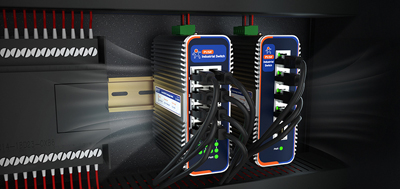
In this combination, different hardware can be flexibly matched for different scenarios:For small production lines and remote operation and maintenance stations in the workshop, the fanless industrial computer USR-EG228 is the preferred choice. It adopts a fully enclosed fanless design, supports wide-temperature operation, and has maximum vibration and interference resistance. It can stably run lightweight predictive maintenance models and small visual quality inspection programs. Paired with the 4G industrial router USR-G806w — which has more than ten authoritative certifications such as 3C, CE and SRRC, and supports dual backup of 4G full-network access and wired networks — even if the factory optical fiber is disconnected, it can immediately switch to the mobile network to ensure uninterrupted equipment data, fully meeting the basic edge requirements of a single production line.
For core scenarios with high computing power and high reliability such as automobile final assembly and battery workshops, the high-performance industrial computer USR-EG628 can be used. It is equipped with a high-performance processor and has sufficient computing power interfaces, which can simultaneously run AI visual inspection models for multiple devices and digital twin data synchronization programs. A single device can cover the edge computing requirements of an entire workshop. Paired with the 5G industrial router USR-G816, which supports 5G full-network access and low-latency transmission with an end-to-end latency as low as 20ms, it also has complete network security protection capabilities, fully complying with industrial data compliance requirements. Even for a large digital intelligent factory with 12,000 devices connected to the network at the same time, it can ensure stable data transmission without packet loss.
The core advantage of this combination lies in the native adaptation of the two links of "computing power" and "networking": the industrial computer is responsible for cleaning, analyzing and reasoning the multi-source heterogeneous data in the workshop locally, without sending all data back to the cloud; the industrial router is responsible for synchronizing the processed valid data to the cloud as needed through an encrypted industrial-grade network, which not only reduces bandwidth consumption, but also avoids business shutdowns caused by network disconnections, truly realizing the edge value of "key calculations done locally, important data transmitted as needed".
This solution does not require complex transformations. Factories can quickly implement it in 6 steps without affecting normal production at all:
First sort out the equipment types, number of protocols, computing power requirements and network environment in the workshop. Select the USR-EG228 + USR-G806w combination for small production lines, and the USR-EG628 + USR-G816 combination for core large workshops. Confirm the temperature, humidity and electromagnetic interference level of the installation location in advance.
Install the industrial computer in the industrial cabinet next to the production line, deploy the industrial router nearby on the outer side of the cabinet, complete the power wiring and equipment serial port/network port wiring respectively, and do a good job in dustproof and wear protection for the lines.
Import the protocol drivers of the corresponding devices into the industrial computer, complete the docking configuration of CNC systems, PLCs and sensors, set the data collection frequency and filtering rules, and directly filter out invalid redundant data locally.
Configure the dual-link backup of wired + 4G/5G in the industrial router, enable data transmission encryption and firewall access control, complete the network security policy configuration, and prevent unauthorized devices from accessing the workshop network.
Deploy pre-trained edge models such as predictive maintenance and visual quality inspection to the industrial computer, complete the closed-loop control joint debugging of local devices, set the rule of resuming transmission after network disconnection, and ensure that all data during the network interruption period is cached locally and automatically retransmitted after the network is restored.
First run a trial operation on a single production line for 72 hours. After verifying that the data collection accuracy, model reasoning success rate and network connectivity rate all meet the production requirements, launch it in full. In the subsequent stage, you can remotely manage all industrial computers and routers in the workshops through the remote operation and maintenance platform, without frequent on-site debugging.
In the auto parts processing workshop, this USR-EG228 + USR-G806w combination shortens the processing cycle of a single machine tool from 8 minutes to 7 minutes, generating an additional income of more than 5,000 yuan per month for a single machine tool, and reducing unplanned equipment downtime by 30%.
In the fully automatic gluing station of automobile final assembly, the 5G edge combination of USR-EG628 + USR-G816 controls the end-to-end latency of AI visual inspection within 20ms, and the recognition accuracy of gluing defects reaches 99.7%. At the same time, the full traceability of all assembly data is realized, fully meeting the quality control requirements of complete vehicle factories.
For manufacturing enterprises, edge solutions are never the more expensive the better. What matters is to make computing power and networks truly adapt to the real environment of the workshop. The combination of industrial computer + industrial router turns complex edge technologies into practical tools that factories can implement, save costs and achieve tangible results.