A photo that has circulated in woodworking communities shows a workshop wall completely covered with trim routers and plunge routers, machines lined up one after another. An automated machining shop tells a similar story: CNC machines, industrial PC, PLCs, cameras, and sensors spread across different stations, all needing to exchange data. An ordinary consumer switch or router rarely holds up for long in that kind of environment.
An Industrial Ethernet Switch is built for exactly this situation—a hardened networking device that links machines, controllers, and sensors on the same local network while surviving dust, vibration, and temperature swings that would shut down office-grade hardware. The question is not whether one is "better," but whether a given workshop actually needs it.
Whether an Industrial Ethernet Switch is needed comes down to a few practical checks:
① Devices are scattered and must talk to each other. When a CNC machine needs to push its status to an industrial PC, a PLC needs to read sensors, and camera feeds have to consolidate at a central controller, the setup is no longer "one computer getting online." Multiple devices must communicate reliably on the same local network, often across a shop floor that is larger than a single desk.
② The environment is harsher than an office. Workshops carry wood dust, metal shavings, equipment vibration, and electrical noise from motors starting and stopping; summer can push temperatures up as well. A standard plastic-cased consumer switch has no dustproofing or wide-temperature design, and a fan choked with dust easily stalls. In a cabinet next to a running machine, that failure shows up as dropped connections at the worst moment.
③ A network outage stops the line. Most consumer devices have no redundant power, so a single point of failure takes down the whole communication segment. For a small shop running to order, a few minutes of downtime is real delay with a real cost.
④ Cameras and AP are awkward to wire. A switch with PoE can power an IP camera or wireless AP through the same cable that carries data, removing one power line and making station changes more flexible. In a workshop where stations move as jobs change, that simplicity matters.
Some early signs point to consumer gear already struggling: devices drop off the network at random, the switch runs hot to the touch, or a reboot is needed every few days to restore communication. None of these are acceptable once production depends on the link.
Run those checks against the shop. If there are many devices, a messy environment, and a high cost to stopping, an industrial switch earns a place on the purchase list. A single climate-controlled room with one or two devices and no production impact can still get by with consumer hardware—the line is drawn where downtime starts to cost money.
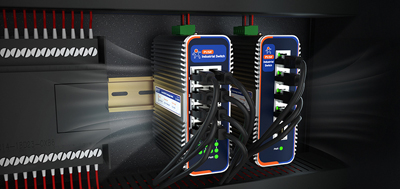
Take the PUSR USR-ISG series gigabit Industrial Ethernet Switch as an example. It ships as 5-port or 8-port 100/1000M unmanaged models that work as plug-and-play, with an aluminum fanless housing, DIN-rail mounting, a wide operating temperature of -40°C to +85°C, redundant dual-power input (DC 9.6–60V), 6KV lightning protection, and IP40 dustproofing. Some models support PoE under IEEE 802.3af/at (up to 30W per port) to power IP cameras and APs directly. For scenarios needing higher reliability, ring-network models with ERPS-based self-healing are available, restoring the link quickly when a cable fails. The series is certified to 3C, CE, FCC, and RoHS, suited to long-term use in dusty, vibrating, temperature-swung workshops such as automated manufacturing, energy storage, and traffic monitoring.
A practical way to select: first count the devices that need networking and where they sit, marking which require PoE; then choose port count and whether to use fiber based on the distance between stations; finally mount the switch in a cabinet or on a rail, away from direct splashing and sustained heat. A small shop does not need to go all-in at once—starting with a single 5-port unmanaged model often resolves more than 90% of the communication-stability problems, and extra ports or a ring model can be added later as the line grows.