Your Spindle Bearing Is Writing You a "Death Note" in Oil — You Just Can't Read It
A 120,000 RMB Lesson
Let me tell you a true story first.
Last autumn, at an auto parts factory in the Yangtze River Delta, CNC Machine #3 suddenly stopped.
Not a gradual failure. A loud "bang" — the spindle seized, the entire shaft was scrapped.
Maintenance team leader Old Zhou brought his crew to tear it open — the spindle bearing's inner race was shattered, the cage had fallen apart, and the grease had turned into a black paste.
Old Zhou has been doing maintenance for twenty years. He said one sentence that made the factory manager go silent for a long time:
"This bearing should have been replaced two weeks ago."
Two weeks ago.
That means this bearing had already sent out every SOS signal two weeks before it "died."
But nobody received them.
Because those signals weren't in the sound. They weren't in the vibration. They were in the oil.
I've talked to equipment managers at many manufacturing companies, and I found a striking consensus:
Everyone knows "predictive maintenance" is good. But nobody is actually doing it.
Why?
Not because they don't want to. Because they don't dare.
Because your current maintenance model is essentially a gamble —
You're betting on how long this bearing can hold on.
If it holds until the scheduled maintenance date, you win.
If it doesn't, you lose. One loss costs tens of thousands at the low end, hundreds of thousands at the high end.
That's exactly how Old Zhou gambled. Two weeks ago, he heard Machine #3's sound was "a bit off," but he judged "it can still run."
He judged wrong.
You might say: "Old Zhou didn't have enough experience."
No. Old Zhou's experience was fine. The problem is, human experience has a ceiling.
The abnormalities a human ear can hear? That's after the bearing is already 30% failed.
The vibration a human hand can feel? That's after the bearing is already 50% failed.
The oil color change a human eye can see? That's after the bearing is already 70% failed.
By the time your five senses can detect the problem, the bearing is already writing its death note.
So is there a way to know when the bearing "just started feeling uncomfortable"?
Yes.
Look at the oil.
You've probably never thought about this — lubricating oil isn't just for lubrication. It's the bearing's "blood," and that blood carries all the health information.
When a bearing runs, microscopic wear occurs on the metal surface. This wear mixes into the oil in the form of particles:
| Particle Characteristic | Meaning | Severity |
|---|---|---|
| Rising ferromagnetic particle concentration | Inner/outer race surface wear | ⚠️ Early warning |
| Flake-shaped particles appearing | Cage fracture | ⚠️⚠️ Mid-stage alarm |
| Increasing spherical particles | Rolling element spalling | ⚠️⚠️⚠️ Late-stage emergency |
| Oil viscosity dropping | Lubrication failure, temperature rising | ⚠️ Early warning |
| Cleanliness index declining | Seal aging, contaminant intrusion | ⚠️ Early warning |
Every one of these changes shows uptwo to four weeks before "abnormal noise."
What's two to four weeks?
It's the distance between "scheduled replacement, zero downtime loss" and "emergency shutdown, five days of production halt, 120,000 RMB in losses."
Oil analysis is about catching that "two to four weeks."
But here's the problem —
Can you read it?
What does a 12% rise in ferromagnetic particle concentration mean?
Oil viscosity dropped from 45 cSt to 38 cSt, trending downward — do you need to act?
Cleanliness index dropped from NAS 7 to NAS 9 — where's the tipping point?
Old Zhou can't answer these questions. Neither can you. Nobody on your maintenance team can.
This is the biggest embarrassment of oil analysis — the data is there, but nobody can read it.
You need a "translator."
When many people hear "edge computing," their first reaction is — "Isn't that just a data collector?"
No. Not even close.
What a data collector does: it gathers data from oil sensors, sends it to the cloud, and displays a bunch of numbers on a big screen.
You still can't read it.
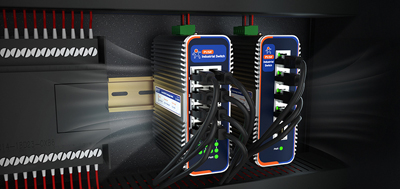
What anindustrial gatewaydoes: right at the site where the data is generated, it "translates" it into human language.
It connects to oil sensors and collects in real time: particle concentration, particle type, oil viscosity, oil temperature, cleanliness index…
Then, its built-in algorithm models kick in —
It doesn't just display "ferromagnetic particle concentration: 120 ppm."
It tells you:"Machine #3 spindle bearing — ferromagnetic particle concentration up 12% from last month, combined with declining oil viscosity trend. Judged as inner race early-stage wear. Recommend replacement within 30 days."
You don't need to understand oil analysis. You don't need to be an expert. You don't need to stare at a big screen.
You just need to arrange the replacement when it tells you "it's time."
This is the biggest difference between edge computing and cloud computing:
| Cloud Computing | Edge Computing | |
|---|---|---|
| Where is data processed? | Servers thousands of miles away | Right next to the machine |
| What does it output? | A pile of raw data | One human sentence: "Time to replace it." |
| What's the latency? | Seconds to minutes | Milliseconds |
| What if the network drops? | All data lost | Local analysis continues, uninterrupted |
Making decisions next to the machine, versus making decisions in the office looking at reports — those are two different worlds.
"Bearing lifespan extended by 2x" — that's not a slogan. It's a calculation.
The logic is simple:
Underreactive maintenance, the bearing is replaced "when it breaks." But by the time it "breaks," the bearing is usually already 60%–80% worn. That means you only used 40% of its life.
Underpredictive maintenance, the bearing is replaced "the moment wear begins." At that point, wear is only 10%–15%. You've used over 85% of its life.
85% ÷ 40% ≈2.1x.
That's where "2x lifespan extension" comes from. The bearing didn't get better — you finally stopped "wasting" it.
Let me run the numbers for you:
One spindle bearing. Design life: 8,000 hours. Purchase cost: 800 RMB.
| Mode | Actual Service Life | Annual Replacements (20 Machines) | Bearing Cost | Downtime Loss | Total Cost |
|---|---|---|---|---|---|
| Reactive Maintenance | 4,000 hours | 40 times | 32,000 RMB | 2,800,000 RMB | 2,832,000 RMB |
| Predictive Maintenance | 14,000 hours | 11 times | 8,800 RMB | 0 | 8,800 RMB + industrial gateway amortization |
2.83 million vs. less than 10,000.
The difference isn't technology. It's whether you heard the right signal at the right time.
You're thinking: "I get the logic, but our factory is different."
Let me guess what your "different" is:
"Our machines are too old. They don't have data interfaces."
— The industrial gateway supports Modbus, OPC UA, Profinet, and other mainstream industrial protocols. Even old machines can connect. Worst case, external sensors can still collect data.
"We don't have anyone who can read oil data."
— That's exactly why the industrial gateway exists. It doesn't need you to read it. It reads for you, translates for you, judges for you. You just look at the result.
"Isn't an industrial gateway expensive? Isn't deployment complicated?"
— The cost of one industrial gateway is roughly 1/100th of your single unplanned downtime loss. Deployment isn't complicated either: mount it next to the machine, connect the sensors and oil analyzer, configure the algorithm model, power it on, and it runs. No production line changes. No machine shutdowns.
"We tried data cards / cloud platforms. The data transmission is unstable."
— The industrial gateway processes locally. It doesn't depend on the cloud. Even if the network drops, it still analyzes, still warns. Data upload is just "backup," not "dependency."
Every one of your "differents" actually has a solution. You just haven't found the right tool yet.
There are quite a few industrial gateways on the market. But for the machine tool oil analysis scenario, there are a few thresholds you can't lower:
Must connect to oil sensors— particle counter, viscometer, temperature sensor. All three, non-negotiable.
Must have edge algorithm capability— not just data collection. It must be able to analyze locally, judge trends, and issue warnings.
Must be industrial-grade— next to a machine tool, there's oil mist, dust, vibration, and electromagnetic interference. Consumer-grade equipment can't survive.
Must support mainstream industrial protocols— whether your machine is Fanuc or Siemens, the industrial gateway must be able to connect.
Filter by those four rules, and the choices actually shrink quite a bit.
The one we use in our own projects is theUSR-M300 by USR IoT. Edge computing, multi-protocol access, industrial-grade protection, direct oil sensor connection. Deployment is genuinely simple — mount it, wire it, configure it, done.
But honestly, the product is just the vehicle. What really lets your bearing live two extra years isn't that industrial gateway —
It's that you finally decided to stop "gambling."
Let's go back to the story at the beginning.
Machine #3's spindle bearing — two weeks before the inner race shattered, the ferromagnetic particle concentration in the oil had already risen by 12%.
If there had been an industrial gateway at that time, it would have told Old Zhou on day one:
"Machine #3 spindle bearing — inner race early-stage wear. Recommend replacement within 30 days."
Old Zhou would have replaced it at the next scheduled maintenance.
The production line wouldn't have stopped.
The 120,000 RMB wouldn't have been lost.
That bearing would have lived two more years.
Your spindle bearing is also writing you a "health report" in oil.
The question is — are you going to keep not understanding it, or are you going to find a "translator"?
(Oil can't talk. But it knows everything. All it's missing is someone willing to listen.)