A field vehicle carries a tracking terminal, and its position shows up as a dot on a map. The same vehicle also has cameras, an operator panel and several sensors, and none of that data has a way out. Adding a second tracking terminal does not fix the problem — what is missing is not location but an uplink that stays up.
This split shows up on plenty of purchase lists. One class of device delivers a location record; the other delivers a routable network. Both names mention tracking or connectivity, yet the boundary between them is wide. Below, the two are taken apart first, then a way to work backwards from an on-site device list.
A GPS tracker delivers a location record.Its input is a GNSS antenna; its output is a set of fields — latitude, longitude, time, speed — usually pushed over a built-in cellular uplink to the vendor's own platform. Inside the box there is no Ethernet port or serial port to hand to another device, and no VPN stack. Add a camera and there is nowhere to plug in. Send data back to a head-office network through a tunnel and there is no tunnel.
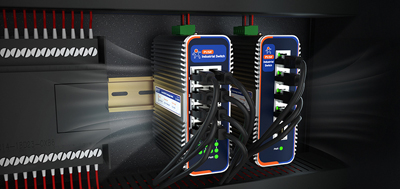
An industrial LTE router delivers a network.Its outputs are Ethernet ports, a serial port, and on some models Wi-Fi, with PLCs, cameras, industrial PCs (IPC) and operator panels attached below. The uplink can be wired broadband or 4G/5G cellular; the two can fail over to each other, and the cellular side can carry dual SIMs for redundancy. Positioning is an option on this class of device — fit a GNSS module and it reports location, leave it out and the box is a pure link.
The short version: a tracker ends at a platform account, while a router ends at a local network.
Step one — count the devices and interfaces.How many need RJ45, how many run over serial, whether cameras need a subnet of their own. This decides the port count and whether a serial port is needed at all. Fewer than three devices sharing one cabinet usually fits three copper ports. A dozen cameras plus a few industrial PCs calls for eight gigabit ports or more.
Step two — fix the uplink.Is there wired broadband on site? If not, is cellular the primary link or the backup? One SIM or two? With this settled, the fallback behaviour after a drop stops being an open question.
Step three — decide who owns the position data.If a dot on a map is enough, the vendor platform is the cheapest route. If position has to land in the same table as work orders, alarms and mileage, the model needs to expose location data locally — NMEA 0183 sentences, for instance — or at least offer an open interface.
Three steps in, most requirements land in one of the combinations below.
Position only, nothing else online.A tracking terminal is cheapest here: mount it, power it, watch the dots. The cost sits mainly in the data plan and the platform subscription.
Connectivity, no position.A fixed site with a PLC and an IPC in the cabinet needs one stable uplink. A pure routing model such as the USR-G806w fits: three Ethernet ports (1 WAN + 2 LAN, configurable as three LAN), a Qualcomm-based 4G module, and wired, cellular and Wi-Fi uplinks that can switch between one another. VPN covers PPTP, L2TP, IPSec, OpenVPN and GRE; OpenVPN can connect to three servers as a client and also act as a server itself. Power comes from either a terminal block or a DC jack, the operating range is -20 to 70 °C, there are hardware and software watchdogs, plus surge, EFT and ESD protection. The housing measures 104 × 102 × 28 mm, mounts on a wall or DIN rail, and a remote management platform handles parameter changes, reboots and firmware upgrades.
Both connectivity and position.For a fixed site with many devices that also has to report location, the USR-G809s gigabit edge router covers both: a positioning module supporting GPS and BeiDou, eight gigabit copper ports plus two gigabit SFP ports, one RS232 and one RS485 with DI/DO, dual SIM (one slot can be a built-in eSIM), DC 9–60 V wide input, DIN-rail mounting and a built-in watchdog. One box takes care of site connectivity and position reporting, which suits sites where several devices share a single uplink.
Assets that actually move — vehicles, AGVs, inspection robots — need more bandwidth and better mobility handling, and the USR-G816 fits that case: 5G cellular, GNSS as a factory option covering GPS, GLONASS, BeiDou and Galileo, NMEA 0183 output, one RS232/RS485 port at 1200–460800 bps, gigabit 1 × WAN (configurable as LAN) + 3 × LAN, dual SIM with optional built-in eSIM, DC 9–36 V wide input, a metal housing, level 3 EMC protection and a watchdog, DIN-rail or wall mounting. Outdoor or vehicle installations can look at the IP65 version of the same series, which also offers the GNSS option.
The rule reduces to one line: when PLCs, cameras and IPCs on site need continuous connectivity, the choice is an industrial LTE router; when the only requirement is knowing where an asset is, with no other device needing network access, a GPS tracker is enough.