Comprehensive Industrial Networking Hardware Enablement: A New Approach to Implementing Cellular Network Selection for Factory Automation
In the current era of deep penetration of Industry 4.0, factory automation's requirements for communication links have long moved beyond the primary stage of "connectivity is sufficient." Traditional wired Ethernet involves high cabling costs and significant difficulty in adjusting or retrofitting production lines. Non-cellular wireless solutions like WiFi/LoRa suffer from inherent shortcomings such as connection drops during mobile roaming, high packet loss rates under strong electromagnetic interference, and insufficient security protection. These are no longer able to meet the demands of new scenarios like flexible production, AGV cluster scheduling, and cross-factory equipment collaboration.
Building a dedicated cellular network adapted by leveraging a full range of industrial networking hardware such as fanless industrial PC, industrial router, industrial switches, and IoT gateway devices is becoming the core path for manufacturing enterprises to break through automation upgrade bottlenecks, fundamentally solving the long-standing communication pain points that have plagued factory manufacturers.
Unlike the generalized deployment logic of consumer-grade cellular networks, selecting a cellular network for factory automation scenarios is by no means simply purchasing public cellular services. Production processes, workshop environments, and business priorities vary greatly across different factories. Only by combining the capability characteristics of a full-stack of industrial networking hardware can the corresponding cellular standard be precisely matched to build a dedicated cellular network that balances stability, flexibility, and cost-effectiveness.
Communication needs in industrial scenarios are inherently layered: high-precision motion control and high-definition machine vision inspection scenarios require millisecond-level latency and 99% transmission reliability; conventional PLC data interaction and production line status reporting scenarios require wide coverage and stable connectivity; sensor monitoring in remote areas and outdoor equipment inspection scenarios require low power consumption and long endurance. By combining various types of industrial networking hardware, enterprises do not need to blindly pursue the most advanced 5G technology. Instead, they can overlay different cellular standards such as 4G LTE, 5G private networks, and LoRa as needed, achieving three-dimensional precise adaptation of "business-hardware-network."
The communication pain points faced by factory manufacturers in the past were often chain-like: difficult cabling increased retrofitting costs; unstable networks caused production halts; manual on-site operations for maintenance lowered operational efficiency; insufficient data transmission security posed risks of production data leakage. Industrial networking hardware with different positioning performs its own duties, complementing the capability gaps of cellular networks across the entire chain from access, transmission, and computing to operation and maintenance, systematically solving core pain points.
All industrial networking hardware adopts industrial-grade designs with wide temperature and voltage ranges and robust protection: core devices such as industrial router, industrial switches, and IoT gateway devices support an ultra-wide operating temperature range of -40℃ to 85℃. Their all-metal housings provide excellent resistance to electromagnetic interference, surge, and vibration. Even in machining workshops full of strong electromagnetic interference from machine tools, high-temperature and high-humidity metallurgical plants, and dust-dense cement production workshops, they can ensure 7×24 hours of uninterrupted stable operation. Paired with industrial-grade IoT cards featuring reinforced packaging and IP68 protection ratings, they can directly resist moisture and dust erosion, completely eliminating the frequent downtime issues of ordinary commercial hardware in harsh industrial environments.
The data packet loss rate of cellular networks built with these hardware can be controlled below 0.5%, perfectly meeting the stringent requirements of industrial PLC real-time control. A cross-factory machinery processing enterprise, relying on industrial routers to deploy a cellular wireless communication solution, shortened the collaborative deployment cycle of PLC data across 3 branch factories from 4 weeks under the traditional wired solution to 5 days. Subsequent flexible adjustments to production lines no longer require rewiring, improving production adjustment efficiency by over 70%.
Industrial networking hardware with different positioning can precisely match different cellular access scenarios, avoiding adaptation blind spots of single network solutions:
Industrial Modems: For low-speed, dispersed points such as electricity meters and environmental sensors, they support NB-IoT/4G Cat.1 cellular access. Battery-powered, they can achieve 3-5 years of endurance, enabling rapid data backhaul from devices in remote areas or old workshops without cabling, suitable for remote, low-power monitoring scenarios.
Industrial Routers: As the core access hub of the cellular network, they natively support 4G/5G cellular dial-up networking. Some models can also implement local distribution converting cellular network to WiFi, providing seamless roaming communication capabilities for AGV clusters and mobile operation terminals. The dual-SIM card redundant backup design enables millisecond-level automatic reconnection upon network interruption, ensuring uninterrupted high-bandwidth, high-definition monitoring, and precision control services. The decade-long bestseller model USR-G806w has served hundreds of thousands of industrial enterprises both domestically and internationally, supporting seamless integration into existing production line network architectures, completing cellular network deployment within minutes without modifying original automation system configurations.
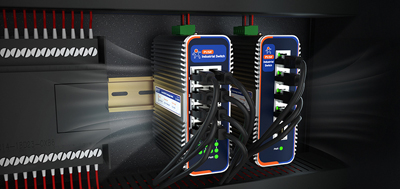
Industrial Switches: They can achieve local service isolation under cellular networks. Through VLAN partitioning, they logically separate motion control networks, vision inspection networks, and office management networks, prioritizing bandwidth resources for core industrial control services and preventing non-critical services from seizing transmission channels for control commands, increasing the annual online rate of critical services to over 99.99%.
IoT gateway devices break through the capability boundaries of traditional pure data transmission hardware. They integrate embedded operating systems and edge computing frameworks, supporting native parsing of over 15 mainstream industrial protocols. They can complete device data cleaning, filtering, and aggregation locally at the factory, eliminating the need to upload all raw data to the cloud via the cellular network. Data preprocessing latency can be controlled within 10ms, a significant advantage compared to the over 100ms transmission latency of traditional modems.
In automated scenarios involving robot collaboration, leveraging the low-latency transmission capability of cellular networks, IoT gateway devices can parse LiDAR sensor data streams in real-time, issue motion trajectory optimization commands locally, compress control loop latency to within 5ms, and even predict equipment failures through AI algorithm analysis of vibration sensors, reducing unplanned equipment downtime by 65% and increasing production efficiency by 22%. Even if the public cellular network is temporarily interrupted, IoT gateway devices can still execute linked control logic locally, preventing production lines from halting directly due to external network disconnection.
Fanless industrial PCs are deployed in the core weak-current equipment rooms of workshops, serving as the local dispatch core for cellular private networks, replacing traditional commercial servers in undertaking core computing tasks at the edge. They can aggregate operational data from all industrial networking hardware to build a visualized unified management platform. Factory operation and maintenance personnel can complete tasks such as viewing device status, monitoring signal strength, and setting traffic threshold alerts for the entire factory's cellular network locally without logging into the remote cloud. They can even remotely diagnose communication faults directly, eliminating the need to travel to remote sites for on-site troubleshooting, reducing overall O&M manpower input by 60%.
Leveraging the scheduling capabilities of fanless industrial PCs, factories can also build fully autonomous and controllable dedicated 5G cellular private networks. This is equivalent to deploying a miniaturized private cellular network within the factory, utilizing licensed or shared spectrum resources to fully grasp network control. Data can be processed throughout the entire workflow without leaving the factory premises, offering higher data security and privacy compared to public cellular networks, fundamentally avoiding the risk of core production process data leakage.
A large number of legacy automation equipment in old factories still uses RS485 serial communication, making direct equipment replacement extremely costly. Industrial serial to Ethernet adapters can directly convert traditional serial signals into network signals for access to the cellular private network. Without replacing the original legacy equipment, they enable old PLCs, electricity meters, and lighting control modules to quickly connect to the new-generation cellular network. The overall automation retrofit cost is reduced by over 40% compared to a full replacement solution, perfectly fitting the digital transformation budgets of traditional manufacturing enterprises.
This adaptable cellular network solution built upon a full range of industrial networking hardware goes beyond solving short-term communication stability issues. It can also solidify the foundation for the long-term digital upgrade of manufacturing enterprises. It completely breaks the mobile roaming constraints of traditional WiFi solutions, allowing devices like AGVs and mobile robots to operate seamlessly across the entire factory area, supporting truly flexible production. Simultaneously, it is compatible with eSIM industrial-grade cellular devices, enabling cross-regional deployment in any factory worldwide. Devices can automatically select the optimal carrier network without manual on-site SIM card replacement, significantly reducing the operational complexity of multinational factories.
As industrial cellular networks evolve towards the 5G fully connected era, this communication foundation built by industrial networking hardware can smoothly extend support for more advanced Industry 4.0 applications such as digital twins and flexible production line collaboration. This allows factories to achieve long-term evolutionary digital transformation goals in one step without repeatedly reconstructing communication infrastructure.