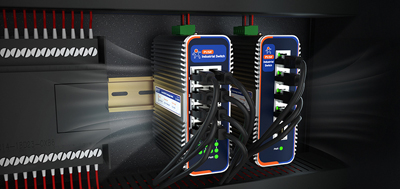
A mini PC runs your office fine. Put it inside a machine cabinet, and the story changes. Here's what actually separates an Industrial PC from a Mini PC — and how to tell which one you need.
Here's a scene you've probably seen: a manufacturer installs a mini PC to control a production machine. For two months it works fine. Then a hot week hits — the cabinet heats up, the fan spins faster, and one afternoon the machine just stops mid-cycle. The mini PC crashed. Restart, reboot, production line down for an hour.
The CPU wasn't the problem. The problem is that the mini PC was designed for a desk, not for a machine floor.
That's the whole difference in one sentence:a Mini PC is designed for an office desk — 8 hours a day, room temperature, clean power; an Industrial PC is designed for 24/7 operation in a cabinet, in heat, with voltage swings, talking to machines.If you're buying computers for machines, you need to know which design assumptions you're betting on.
Look at the case and you can already guess. A typical mini PC has a plastic enclosure and a small fan. That fan is the weakest link — one dust-clogged bearing and the CPU throttles, then reboots.
An industrial-grade machine like the PUSR Fanless Industrial Computer EG228: an aluminum housing does the heat dissipation, and there are no moving parts to fail. Its spec sheet states the operating range at-25°C to +75°C. The EG528, another ARM industrial computer, is built the same way — aluminum housing, fanless, and the same-25°C to +75°Cwide operating temperature.
What that means in practice: inside a closed cabinet on a summer afternoon, ambient temperature can easily pass 50°C. Most consumer mini PCs stop at 35–40°C on the spec sheet. An Industrial PC is built for the temperature it will actually live in.
How to check:read the "operating temperature" line on the spec sheet. And look for the word "fanless" — no moving parts is a reliability feature, not a cost cut.
A mini PC comes with a 12V or 19V wall adapter. That's fine at a desk. But on a factory floor you rarely have a clean wall outlet next to the machine — you have a24V DC power bus, or a vehicle's 12V/24V system, and the voltage dips and spikes every time a motor starts.
That's why the EG228 and EG528 specDC 9-36V wide power input with reverse polarity protection. Wide input means the device tolerates the dirty power you actually have on site; reverse polarity protection means a wiring mistake at 2 a.m. doesn't fry the board.
How to check:look at the power input range. If your site runs on a 24V bus and the spec says "9–36V", you can wire the device straight into the bus. If it says "12V adapter only", you've bought a desk computer.
A mini PC's ports — HDMI, a couple of USB — are made to talk to a monitor and a keyboard. An Industrial PC's ports are made to talk to machines.
Concrete example: the EG228 carries2×RS485 and 2×CAN FDin a DIN-rail-size fanless box, and its firmware speaks the languages of the field — IEC 61850, IEC 104, DLT645, DNP3.0, BacNet, and major PLC brands such as Siemens, Mitsubishi, Omron, Modbus, Delta, and Fatek. The EG528 goes further: 2×RS485 plus 2×RS485/RS232, dual Ethernet, and a built-in local SCADA/HMI.
If you're doing energy management across a large site, look at the EG828-EMS:4×Ethernet, 8×RS485, 2×CAN, 16×DI, 16×DO. That's an Industrial PC's job — standing between dozens of meters, PLCs, and relays, collecting and converting data all day.
How to check:list every field device you need to talk to (PLC, power meter, sensor, relay), note the wire type (RS485? CAN? discrete I/O?), then count the ports on the candidate. If you're reaching for USB-to-serial adapters, you're looking at the wrong product.
Three things you can't see in a photo but that decide survival in the field:
Watchdog.If the software hangs at 3 a.m., a mini PC stays hung until someone walks over. The EG228 and EG528 carry hardware + software dual watchdog — the device reboots itself and comes back to work. That's the difference between a 30-second hiccup and a line that stays down until morning.
EMC protection.Industrial spec includes high EMC protection, so a motor starting or a VFD switching next to the device doesn't reset it mid-cycle.
Mounting.A DIN-rail mount puts the device in the cabinet right next to the PLC and the power supply. A mini PC is a desk object; bolting it to a rail was never part of its design.
Be honest here — not every job needs one. Run this checklist:
Does it run24/7and unattended?
Is it installed in acabinet or non-air-conditioned roomwhere temperature can exceed ~40°C?
Does it draw power from aDC bus (12V/24V)instead of a wall outlet?
Does it need totalk to field devices— PLCs, meters, sensors — over RS485 / CAN / DI-DO?
Does a crash have areal cost(downtime, lost production, safety)?
If you answered yes to two or more, you need an Industrial PC. If it sits on an office desk, runs 8 hours a day, uses wall power, and a crash means "reopen the browser" — a mini PC is fine, and cheaper.
Once you've decided, the choice mostly comes down to software and I/O:
The order matters:decide the software first (Windows vs Linux), then the field I/O (what devices), then the environment (temperature and power).In that order, the right model usually picks itself.
A Mini PC is a computer with a desk job. An Industrial PC is a computer built for the floor: fanless aluminum body, -25°C to +75°C operating range, 9–36V wide power input, RS485/CAN/DI-DO to talk to machines, watchdog to recover on its own, and DIN-rail mounting so it lives where the work happens.
Both are good products — they're just built on different assumptions. And when your machine needs to run 24/7, you want the one that was designed for it.