You have a stack of RS-485 devices — meters, PLC, sensors — a network that speaks Ethernet, and a project due to go live next month. You open a supplier's catalog and see two product lines both labeled "RS-485 to Ethernet": Industrial PC and Serial Device Server. They overlap just enough to make you second-guess your judgment.
The good news: the decision is simpler than the catalogs make it look. One question settles most of it —consider whether you need to run your own software on the box, or just need to get the data onto the network.Below, we'll break down what each type of device actually does, then walk through real deployments so you can match one to your own workbench or plant floor.
A Serial Device Server is essentially a protocol translator with a power supply. It takes RS-232/RS-485 frames in on one side and pushes TCP/IP packets out the other. You configure it once through a web page, and after that it's invisible.
Take theUSR-TCP232-410s, PUSR's classic RS232+RS485 converter. On the hardware side, one RS-232 port and one RS-485 port working simultaneously feed a 10/100M Ethernet jack. At the firmware level, it does three things people actually pay for:
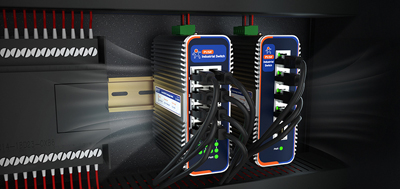
When you have more serial lines — say several RS-485 buses running to different machine groups — a multi-port unit like theUSR-N540delivers the four RS-485 ports you need in one 222×122×29 mm rail-mountable box, with each port independently configured. Same Cortex-M7-class engine, same Modbus gateway and edge-computing options, and one Ethernet uplink instead of four.
An Industrial PC is a computer. That sounds obvious, but it's the heart of the matter: it boots a full operating system, and what runs on it is up to you.
TheEG228is a typical example of the current ARM generation. Inside is an industrial-grade triple-core Cortex-A7 + Cortex-M0 processor at 1.2 GHz, 512 MB RAM and 8 GB storage — modest by desktop standards, but it ships with Ubuntu 22.04 preinstalled. In practice, you log in over SSH and get a Linux machine with2×RS485, 2×CAN FD, 2×Ethernet, 1×USB, plus 4G/Wi-Fi/Ethernet connectivity options. Node-RED comes preinstalled, so you can drag nodes into a flow — read a Modbus register, filter it, push it to a dashboard — before lunch is over. It also speaks protocols a plain converter never touches — IEC 61850, IEC 104, DLT645, DNP3.0, BACnet — and connects directly to mainstream PLCs such as Siemens, Mitsubishi and Omron.
When the I/O count grows, theEG828-EMSscales up to 4×Ethernet, 8×RS485, 2×CAN, 16×DI and 16×DO in one fanless box. And if the project workflow depends on Windows software — a vendor's configuration tool, a lab application with no Linux version — the x86 line covers that, e.g. theEC500with an i5-7200U, 8 serial ports and 5 RJ45 ports.
Before looking at any datasheet, answer these:
1. Is there logic you have to write yourself?If the deliverable is "field data appears on the SCADA/cloud," a Serial Device Server is enough — its Modbus gateway and MQTT uplink are configuration, not development. If the deliverable is "the box decides things" — local alarms, cross-protocol calculations, Node-RED flows, a local database, a custom HMI — you need an Industrial PC, because a converter can't host the software you need.
2. What sits on the wire besides RS-485?CAN FD, digital I/O, or mixed industrial protocols all push it toward an Industrial PC: a single EG228 brings both CAN FD and multi-protocol acquisition. Pure RS-485/RS-232 links point to a Serial Device Server.
3. Who maintains it, and where does it live?A Serial Device Server is configure-and-forget — no OS to patch, and industrial grades run from −40 °C to +85 °C. An Industrial PC runs a real OS (fanless ARM units like the EG228 are rated −25 °C to +75 °C), which means updates, logs and occasional admin work, in exchange for far more capability.
Electrical fire warning system.Fire alarm sensors on RS-485/RS-232 needed to report alarms to a remote server so staff could respond remotely. No local logic required — just protocol conversion and a reliable uplink. The USR-TCP232-410s connected the sensors to the network and forwarded the alarm data to the server. This is the textbook Serial Device Server job.
Factory and mine lighting.Lighting here was switched manually, with no linkage between production and monitoring, wasting energy. The 410s let the serial-controlled lighting join the network, enabling centralized control and automatic fault reporting. Again: data in, data out, no code at the edge.
Waterworks monitoring.The supply system's equipment still communicated over serial — single-machine operation, limited transmission distance, difficult maintenance. A serial-to-Ethernet converter running in TCP Server mode let the control room monitor every device on the network at any time.
Charging piles and shop-floor automation.Where several serial buses land in one cabinet, the 4-port USR-N540 concentrates them onto a single Ethernet link — in PUSR's documented charging-pile and industrial-automation cases, it removed the need for workers to monitor equipment on-site and fed data straight into the management layer.
Notice what these four cases have in common: the intelligence lives somewhere else — in the SCADA, the cloud, the management platform. The edge device only translates and forwards. That's exactly what a Serial Device Server is built for, and it's cheaper and faster to deploy than anything with an operating system.
Now picture a different job. A test bench in an engineering lab: RS-485 power analyzers, a few CAN-based motor controllers, digital signals to count and trip; you want to log everything locally, compute a rolling average, show a live dashboard, and push processed values — not raw registers — to a database. Tomorrow you'll add a second flow that reads a different protocol entirely.
Do this with converters and you end up gluing together hardware plus a separate PC running your glue code anyway. An ARM Industrial PC like the EG228 collapses it into one unit: the RS-485 and CAN ports are already on the board, Ubuntu and Node-RED are already installed, and 4G/Wi-Fi/Ethernet provide redundant paths back to the office network. When the bench graduates into a pilot line with dozens of signals, the EG828-EMS with 8×RS485, 16×DI and 16×DO takes over the same role without changing your software stack. And if the site must run a Windows-only tool — that's the moment to spec an x86 Industrial PC like the EC500.
One more pattern worth knowing:they compose.In large plants you'll often find Serial Device Servers doing simple, distributed serial-to-Ethernet conversion at the machine level, while one Industrial PC sits in the control cabinet aggregating, computing and reporting. Each device does the layer it's efficient at.
Whichever box you choose, the physical job is the same. Here's the method:
|
Your current situation |
Choose |
|
"Field data must reach SCADA/cloud, no local logic" |
Serial Device Server (USR-TCP232-410s, 1×RS232+1×RS485) |
|
"Several RS-485 buses in one cabinet" |
Multi-port Serial Device Server (USR-N540, 4×RS485) |
|
"I'll write flows, log locally, mix RS-485 + CAN, need Linux/Node-RED" |
ARM Industrial PC (EG228) |
|
"I/O-dense: many RS-485 buses plus DI/DO counting" |
High-density ARM Industrial PC (EG828-EMS) |
|
"My tooling is Windows-only" |
x86 Industrial PC (EC500) |
|
"Huge plant, serial everywhere, one control room" |
Serial Device Servers at machine level + one Industrial PC aggregating |
If there's a single line to take away:buy the Serial Device Server when the intelligence can live elsewhere, and buy the Industrial PC when the intelligence has to live in the box.Sort out your port requirements, check the temperature rating against your install site, then pick the smallest device that answers yes to every requirement on your checklist — that's the one you actually need.