In the digital diagnosis and treatment system of modern hospitals, almost all operating data of medical devices — from monitors and anesthesia machines in operating rooms, biochemical analyzers in clinical laboratories, CT and MRI devices in radiology departments, to hospital-wide vital sign monitoring terminals — are bound with exclusive timestamps. This seemingly insignificant time mark has long become the core foundation for linking diagnosis and treatment workflows and ensuring medical safety. However, for a long time, the information departments and clinical departments of a large number of hospitals have been plagued by the hidden pain point of inconsistent timestamps of medical devices, which even directly affects the accuracy and compliance of diagnosis and treatment in many scenarios.
The impact of medical device timestamp errors is far more serious than most people imagine. In emergency rescue scenarios, if there is a deviation of several seconds or even tens of seconds between the timestamps of multiple monitors, defibrillators and infusion pumps, it will be impossible to accurately match the drug administration time, vital sign changes and operation nodes when reviewing the rescue process afterwards. In case of medical disputes, diagnosis and treatment records with chaotic timestamps do not even have complete legal effect.
In the clinical laboratory, unsynchronized time of different testing devices will lead to logical contradictions in the generation time of multiple test reports from the same patient, interfering with doctors' judgment on the progression of the condition. In the hospital's smart ward system, excessive timestamp errors of hundreds of vital sign terminals will prevent the background system from accurately identifying the sequence of abnormal data, which is very likely to miss the key early warning window for sudden changes in the patient's condition.
Many hospitals have tried to manually calibrate the time on each device or perform simple network time synchronization through ordinary commercial switches. However, due to the wide variety of medical device brands, the fact that some old devices do not support the standard NTP protocol, the insufficient time synchronization accuracy of ordinary switches and the tendency of time drift during network jitter, it has never been possible to fundamentally solve the problem of unifying the timestamps of devices across the whole hospital.
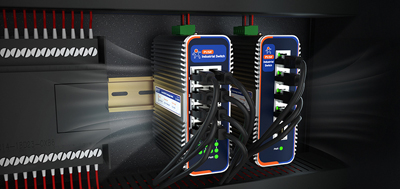
To completely solve this industry pain point, we cannot only rely on scattered manual calibration. It is necessary to build a high-precision time synchronization network adapted to the special needs of medical scenarios, and the industrial switch USR-ISG is a targeted solution built for such high-reliability and high-precision scenarios.
As an Ethernet switch designed for industrial-grade high-reliability scenarios, USR-ISG has undergone targeted optimization from the underlying hardware to protocol support, fundamentally solving the core problem of inconsistent timestamps of medical devices. It supports the IEEE 1588 PTP precise time synchronization protocol, with a synchronization accuracy reaching the sub-microsecond level — far higher than the millisecond-level time synchronization accuracy of ordinary commercial switches. Even when hundreds of medical devices of different brands and ages are connected, the timestamp error of all terminals can be controlled within 1 microsecond, fully meeting the strict requirements of medical scenarios for time accuracy.
At the same time, it is backward compatible with NTP/SNTP network time protocols. Even the old medical devices that have been in service for many years in the hospital and do not support the PTP protocol can complete precise time synchronization through this switch, without the need for hardware transformation of the original devices, which greatly reduces the upgrading and transformation cost of the hospital.
In addition to the core high-precision time synchronization capability, the overall features of USR-ISG are fully adapted to the complex medical network environment in hospitals. It adopts a full-gigabit port design, and some models support 10-gigabit uplink with line-rate non-blocking forwarding. Even in high-bandwidth load scenarios where a large number of high-definition CT images are transmitted in the radiology department, there will be no time synchronization delay caused by network congestion.
The whole machine adopts a fanless industrial-grade design, with wide-temperature and wide-voltage power input, supporting operation in extreme environments from -40℃ to 85℃. The metal shell has IP40 protection rating, and its anti-electromagnetic interference capability fully meets the EMC electromagnetic compatibility requirements of medical places, so it will not cause mutual signal interference with the precision medical devices in the operating room.
Meanwhile, it supports rich network management functions such as network loop protection, port mirroring and VLAN division. Hospitals can physically isolate the time synchronization network of medical devices from the ordinary office network, which not only guarantees the transmission priority of time synchronization data, but also prevents viruses and abnormal traffic from the office network from affecting the stable operation of medical devices.
In actual deployment and use, USR-ISG can also greatly reduce the operation and maintenance burden of the hospital's information department. It supports a visual Web management interface, paired with an intelligent alarm function. Once the time synchronization of a certain medical device is abnormal, the system will push alarm information to operation and maintenance personnel immediately, eliminating the need to manually check the time deviation of each device one by one. The built-in time synchronization log of the device can be stored for a long time, completely recording the time synchronization records of each medical device, which fully meets the requirements of the medical industry for data traceability and compliance audit.
At present, USR-ISG has passed a number of authoritative certifications including 3C, CE, FCC and ROHS, and has completed long-term deployment and verification in the operating rooms, smart wards and clinical laboratories of dozens of tertiary hospitals in China. Many hospitals have reported that after deployment, the timestamp unification rate of medical devices across the whole hospital reaches 100%, and the previously frequent problems such as time contradictions in diagnosis and treatment records and disordered early warning sequences have completely disappeared. This not only greatly improves the efficiency of clinical diagnosis and treatment, but also fully guarantees the compliance of medical data.
From the timestamp pain point that was difficult to unify even after repeated calibration in the past, to the high-precision synchronization of medical devices across the whole hospital today, USR-ISG, with its professional industrial-grade performance and targeted medical scenario adaptation capabilities, has built a stable, reliable and high-precision time synchronization base for hospitals. It ensures that every data mark of medical devices is accurate and traceable, and lays a solid underlying network foundation for clinical safety and digital diagnosis and treatment.