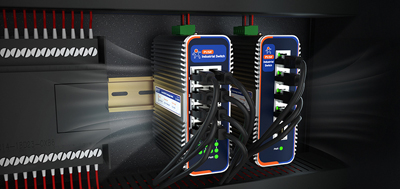
In automation projects, an industrial computer and a thin client often appear on the same purchasing list. Both may be compact, connect to displays and networks, and fit inside a control cabinet. Their roles, however, are different. Once it is clear which device processes data on site and which only presents information, the choices around CPU, RAM, display outputs, and serial ports become more practical.
A thin clientsuits applications that place screens and operator access next to equipment while SCADA, historical data, reports, or virtual desktops run on a server. The terminal mainly handles display, touch input, and network access. This supports centralized deployment: when several locations need the same system, software updates and data backups remain on the server rather than being maintained at every endpoint.
That approach depends on the server, network, and remote session being continuously available. If a site must keep collecting data, handling protocols, executing local logic, or retaining its HMI function during a network outage, a thin client cannot replace a local computer.
An industrial PCruns the application at the edge. It can connect directly to PLCs, meters, sensors, or cameras, and run data acquisition, protocol conversion, edge logic, and local monitoring inside the cabinet. This architecture is often more direct for standalone machines, small production lines, retrofit projects, or locations with intermittent network access.
For existing Windows SCADA software, databases, vendor drivers, or applications that must be installed locally, first confirm supported Windows versions, licensing, and storage requirements. Then select an x86 industrial computer. PUSR EC100 uses an Intel J6412 processor and provides two serial ports, two RJ45 ports, and two HDMI outputs. It fits compact control nodes that need dual displays and connect to a limited number of field devices. Where more serial equipment is involved, EC300 provides six serial ports, two RJ45 ports, HDMI, VGA, and DC 12–36 V input.
For Linux-based data acquisition, protocol integration, Node-RED flows, or light local monitoring, an ARM platform can be a better fit. USR-EG528 uses a quad-core Cortex-A53 processor and comes with Ubuntu 24.04, WukongEdge, and Node-RED. Its interfaces include two Ethernet ports, four serial ports, two USB ports, HDMI, and audio. Its built-in local SCADA/HMI supports on-site monitoring and control configuration; it should not be treated as equivalent to installing any Windows SCADA package.
List every connected device: PLCs, drives, power meters, barcode scanners, and displays. Note each protocol and physical interface. Then count the Ethernet, RS485, RS232, and USB ports required at the same time, leaving capacity for commissioning and later expansion.
For example, a machine requiring two isolated Ethernet networks, two RS485 buses, and a local display can map directly to the EG528's two Ethernet ports, two RS485 ports, two RS485/RS232 ports, and HDMI output. If a server collects all data and the site only shows the interface, the requirement is closer to a thin client. Display connections, touch method, and network redundancy then become the main checks.
For a single HMI or browser-based interface, high clock speed is not usually the first concern. Stable network sessions and display output matter more. When SCADA software, a database, protocol drivers, logging services, or several PLC connections must run at once, RAM and SSD capacity should follow the actual memory use of the software and the required data-retention period.
Avoid estimating server-side and local workloads as if they were the same. A server-hosted application calls for a review of server capacity and network availability. A locally hosted application calls for a review of the industrial PC's CPU, RAM, storage, and OS compatibility.
For control-cabinet installation, also check power input, electromagnetic conditions, temperature, heat dissipation, and unattended recovery. EG528 supports DC 9–36 V wide-range input and operation from -25°C to +75°C. Its aluminum enclosure and hardware-and-software dual watchdog are intended for continuous on-site operation. These characteristics address field reliability; they do not replace the role of a server.
An industrial PC is not simply a more powerful thin client, and a thin client is not a reduced industrial PC. When the application location, field wiring, concurrent tasks, and cabinet environment are documented first, the selection becomes clearer. For automation projects that must acquire data, process protocols, and provide local monitoring at the edge, an industrial computer should be selected from the required system and interfaces, not from the CPU model alone.