Cold-chain transport rarely fails because the hardware is too expensive. It fails when losses are already irreversible by the time the truck arrives. Poultry transport is a textbook case: temperature varies widely inside the trailer, ventilation is uneven, and a sudden heat spike can trigger heat stress within minutes. When birds die in batches, liability is hard to trace, and the cost of compensation and brand damage far exceeds whatever the monitoring equipment would have cost. A workable approach to constant-temperature poultry transport has to handle three things: sensing the in-trailer microclimate in real time, alerting within seconds when something goes wrong, and keeping every trip's data searchable and replayable.
The PUSR M300 industrial IoT gateway is built to deliver all three from a single onboard device. As one of the iot gateway devices in the PUSR lineup, it takes in temperature sensors, ventilation fans, GPS positioning, and onboard cameras through its serial ports, Ethernet ports, and I/O, then handles edge acquisition, local decision-making, and remote reporting while the vehicle is moving. Transport status stops being a driver's judgement call and becomes data that can be measured, alarmed on, and reviewed after the fact.
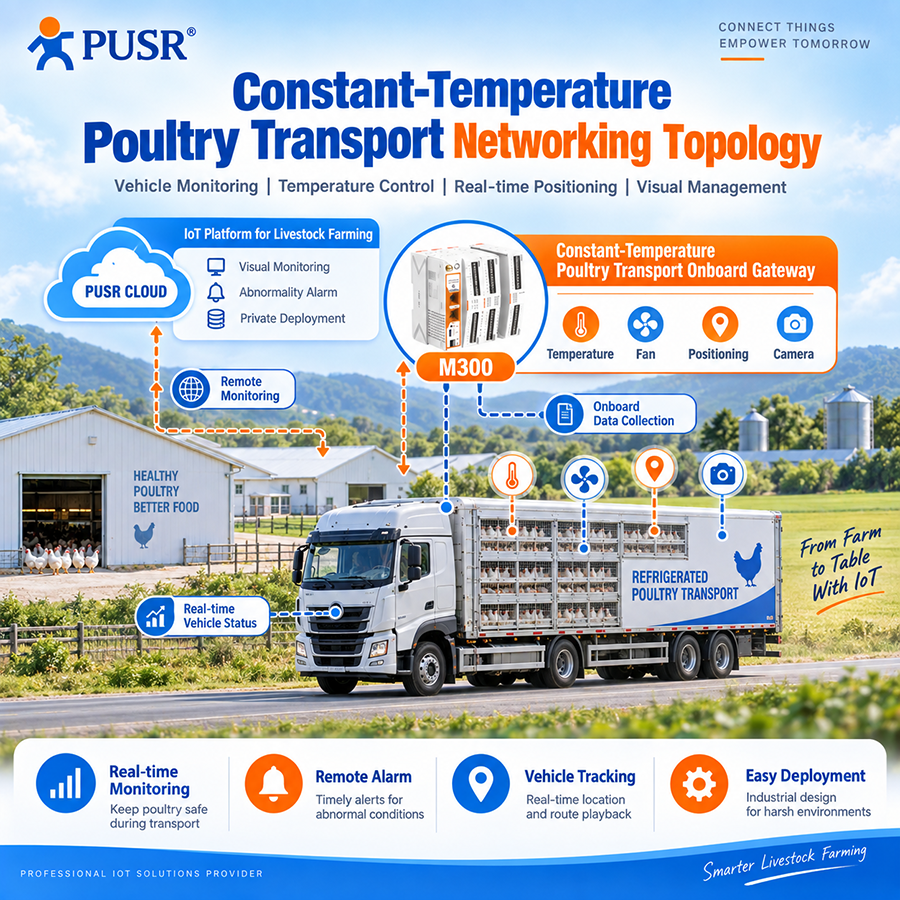
The core measurements in constant-temperature poultry transport are trailer temperature and ventilation. In the reference topology, the M300 connects four kinds of endpoints: temperature probes, fan control, a positioning module, and a camera.
Temperature probes usually run over RS485 or RS232 with Modbus RTU. Fan start/stop control can go through a DO output or an RS485 command. The positioning module supplies latitude, longitude, vehicle speed, and route history. The camera connects through an Ethernet port. The M300 provides one RS232/RS485 shared port, one dedicated RS485 port, one WAN/LAN port, one LAN port, plus 2 DI, 2 DO, and 2 current-mode AI channels. Serial, Ethernet, and I/O channels can be polled in parallel, with support for up to 2000 data collection points — more than enough for a multi-zone trailer and its peripherals.
If a vehicle has several temperature zones, or needs ammonia and humidity sensors added later, the M300's modular I/O design allows expansion with DI, DO, AI, and AO modules. There is no need to replace the main unit; expansion modules simply slide on.
Connectivity on the road is never stable. Tunnels, mountain terrain, and base-station handovers all interrupt 4G. If every decision depends on the cloud, the system goes blind the moment the signal drops.
The M300 lets reporting conditions and alarm thresholds be configured on the gateway itself. Temperature above a set ceiling, a fan that stops running, or a door opening unexpectedly can all trigger a local alarm, while the event is pushed over standard MQTT or TCP to PUSR Cloud, Alibaba Cloud, AWS, ThingsBoard, Azure, or another platform. Node-RED graphical programming can also combine temperature, position, and door status into custom logic — for example, "if temperature stays above 28°C for three minutes, start the fan and send an SMS to the dispatcher."
This split between edge decisions and cloud management keeps response times short and leaves the platform side to do what it does best: visualization, reporting, and long-term storage. It does not have to carry the risk of real-time control.
Poultry transport vehicles have no fixed network cable, so the M300's 4G/3G cellular uplink is the natural first choice. It also keeps Ethernet and ADSL interfaces available, so a vehicle back at the depot can switch to a wired connection and cut data costs. Routing, VPN, and firewall functions are built into the system, with no separate router required.
For a fleet manager this means one account is enough to see the live position, trailer temperature, fan status, and camera feed of many vehicles at once. The positioning module uploads the route, so any period of a trip can be replayed later. The camera documents loading and unloading, which reduces disputes.
Installing the M300 on a vehicle goes most smoothly in the following order.
The M300 suits poultry fleets that need to bring several kinds of endpoints together, run their own edge logic, and then report everything to one cloud. It accepts a wide input voltage range (DC 9–36 V), operates from -25°C to 75°C, carries Level 3 EMC protection, and mounts on a DIN rail or a wall — enough to handle trailer vibration and temperature swings. Vehicles go online over the built-in 4G/3G and switch to wired back at the depot. A Reload key restores factory settings if configuration parameters are ever lost, which reduces on-site maintenance cost.
Smaller fleets that only need remote temperature viewing can consider a lighter acquisition terminal. But when temperature, fans, positioning, and video all have to be managed together on one platform, an industrial gateway like the M300 opens up the whole chain in one step and avoids the stability problems that come from stitching several devices together.
The goal in constant-temperature poultry transport is not simply to fit a sensor. It is to make every trip evidence-based and every liability traceable. The M300, one of the iot gateway devices designed for exactly this kind of work, brings onboard data acquisition, edge control, remote cloud reporting, and alarm response together in a single unit, helping fleets keep heat stress and mortality losses within a manageable range.