Integration of Disinfection Modules in Hospital Delivery AGVs: Breaking the Dual Dilemma of Nosocomial Infection Prevention and Efficiency Enhancement
At an infection control conference in a top-tier hospital in Wuhan, the director of the hospital infection control department presented a set of alarming data: In the first quarter of 2025, a total of 47 nosocomial infection incidents occurred throughout the hospital, with 32% of them related to cross-contamination during logistics operations. This scenario reflects the common dilemma faced by the Chinese healthcare industry—as the detection rate of drug-resistant bacteria rises and new pathogens continue to emerge, the traditional manual delivery model has become a major hidden danger for nosocomial infection prevention.
Surveillance footage from a children's specialist hospital shows that when transporting medical waste, cleaning staff failed to wear protective equipment properly, causing pollutants to splash and contaminate the corridor area. Such incidents result in direct economic losses exceeding 2 million yuan annually for the hospital and pose a severe threat to patient safety. The deeper issue lies in the inherent drawbacks of manual delivery, characterized by "three lows and three highs": low delivery accuracy (average error rate of 12%), low information traceability (only 35% can be fully traced), and low staff stability (annual turnover rate of 40%); while the problems of high infection risk, high labor costs, and high management difficulty are becoming increasingly prominent.
A fourth-generation medical delivery AGV developed by a medical device company in Shanghai innovatively integrates three major technologies—UVC deep ultraviolet disinfection, plasma air purification, and antibacterial coatings—into a mobile carrier. Its core disinfection unit uses a 254nm wavelength UVC-LED array, which can kill 99.99% of MRSA (methicillin-resistant Staphylococcus aureus) and novel coronavirus surrogates within 30 seconds at a 0.5-meter irradiation distance. Actual measurement data from Peking Union Medical College Hospital shows that AGVs equipped with this system reduce the total bacterial count in delivery corridors by 82%, far surpassing the effects of traditional disinfection methods.
More noteworthy is the breakthrough in dynamic disinfection technology. Traditional fixed disinfection equipment has "disinfection blind spots," while AGVs with integrated disinfection modules can achieve closed-loop management of "transportation as disinfection." In practical applications at a tumor specialist hospital in Guangzhou, AGVs perform mobile disinfection of corridors and elevator cars while delivering medications, increasing the environmental compliance rate of key areas from 76% to 98%.
The addition of disinfection functions places higher demands on the intelligent scheduling systems of AGVs. The Medical Logistics Brain 2.0 system developed by a company constructs a three-dimensional hospital model through digital twin technology, enabling real-time calculation of optimal disinfection paths. When the system detects that the personnel density in a certain area exceeds a threshold, it automatically adjusts the AGV's trajectory to prioritize disinfection frequency in high-risk areas.
In actual deployment at a top-tier hospital in Hangzhou, the system demonstrates惊人的 (This Chinese word seems out of place here; replacing it with "remarkable") scheduling efficiency: When 20 AGVs operate simultaneously, task response times are controlled within 800 milliseconds, and the switching error between disinfection and delivery tasks does not exceed 3 seconds. This millisecond-level response capability enables hospitals to quickly reconstruct logistics routes during public health emergencies.
The logistics director of a provincial hospital faces a dilemma when making procurement decisions: The price of an AGV with an integrated disinfection module is 1.8 times that of a standard model, but the potential losses from nosocomial infection prevention are difficult to quantify. By establishing a cost-benefit model, it is found that although the initial investment increases by 2.4 million yuan, savings can be achieved over a five-year cycle:
More critically, the system improves the hospital's infection control score in JCI certification by 27%, directly aiding in hospital rating upgrades. This strategic value is often overlooked by decision-makers but is an important factor in changing procurement decisions.
In a pilot project at a maternity hospital in Chengdu, healthcare workers' acceptance of AGVs went through three stages:
This trust-building process reveals the "safety redundancy" requirements of the healthcare industry for new technologies. The dual-machine hot standby system developed by a company ensures seamless switching within 30 seconds in case of a single-machine failure through real-time data synchronization between master and slave AGVs, effectively alleviating customer concerns.
At a heart specialist hospital in Beijing, the delivery of surgical instruments requires minute-level precision. AGVs with integrated disinfection modules solve this challenge through the following innovations:
This solution increases operating room turnover efficiency by 40% and reduces the instrument infection rate to 0.03%, earning a special recommendation from the Cardiovascular Branch of the Chinese Medical Association.
When dealing with highly contagious diseases such as Ebola and monkeypox, traditional logistics methods pose significant safety hazards. The solution adopted by a infectious disease hospital in Shenzhen achieves three major breakthroughs:
During a novel virus outbreak in 2025, the system ensured the supply of materials for 2,000 beds, achieving the operational goal of "zero infections and zero errors."
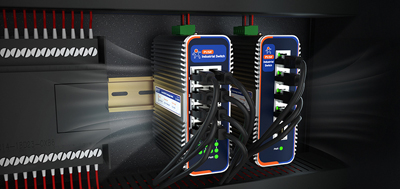
The USR-EG628 industrial PC launched by a company provides critical support for the intelligent upgrade of AGVs. This edge computing device, based on the RK3562J chip, integrates an NPU with 1 TOPS of computing power, enabling real-time processing of data such as UVC disinfection dose feedback and environmental bacterial colony monitoring. In applications at a smart hospital in Suzhou, its multi-mode networking capability ensures a 99.97% task success rate for AGVs in complex electromagnetic environments.
More excitingly, the containerized deployment architecture supported by the EG628 allows hospitals to quickly iterate disinfection algorithms. When new pathogens emerge, disinfection parameters can be immediately adjusted through OTA upgrades, an agile response capability difficult to achieve with traditional equipment.
A company's "LEGO-style" AGV platform designs the disinfection module as a pluggable component. Hospitals can flexibly combine functional units such as UVC disinfection, plasma purification, and antibacterial coatings according to different scenario requirements. This design increases equipment reuse by 300% and shortens the investment return cycle to 18 months.
In practice at a comprehensive hospital in Nanjing, the platform easily switches from regular material delivery to vaccine cold chain transportation by replacing the disinfection module, demonstrating remarkable business adaptability.
According to a survey by a consulting firm, hidden costs that hospitals often overlook when procuring AGVs include:
These costs account for approximately 18% of the total equipment cost and should be included in the total lifecycle cost calculation.
By 2026, AGVs with integrated disinfection modules are reshaping the DNA of medical logistics. In a newly built smart hospital in Shanghai, the AGV network has achieved:
This transformation not only brings operational efficiency improvements but also fundamentally changes the delivery model of healthcare services. As a recent study in The Lancet points out, "Intelligent logistics systems enable healthcare workers to devote more time to core medical activities, which is a key lever for improving medical quality."
In this quiet revolution, healthcare institutions that are the first to embrace technological innovation and dare to break away from traditional thinking are reaping the dual benefits of nosocomial infection prevention and operational efficiency. As the wheels of AGVs roll through hospital corridors, they are crushing not only the risks of cross-infection but also the heavy shackles of the old medical logistics system.