In the daily operations of large-scale livestock farming, barns serve as the core environment for animal growth, and their management efficiency directly determines production profitability and biosecurity levels. Drawing on years of hands-on practice in farming scenarios, we have found that the many pain points of traditional barn monitoring models are becoming a major obstacle to the digital upgrade of livestock enterprises. The IoT gateway device M300 offers a mature, field-proven solution for such scenarios, validated through numerous projects.
Based on actual operational feedback, most current barn monitoring systems in farming scenarios commonly face several long-standing and hard-to-resolve challenges:
Insufficient data collection capacity:
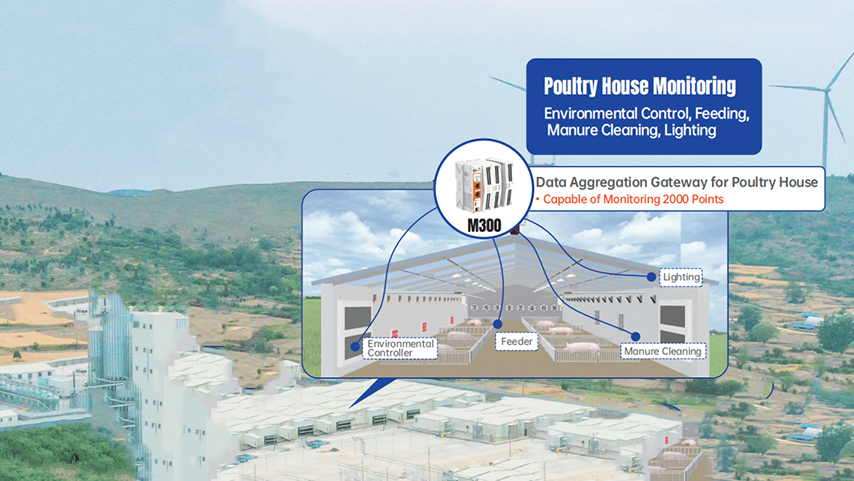
A single barn contains a large number of data points, including environmental controllers, feeders, manure removal systems, lighting, and more. Traditional gateways typically support only dozens to a hundred points, far from covering all equipment in the barn, leaving a significant amount of operational data in the blind zone.
Prominent conflict between real-time performance and reliability:
Traditional solutions rely on the cloud to process all data. Any network fluctuation can result in data transmission interruptions and command delays. In extreme cases, environmental control equipment may fail to respond in time, leading to excessive temperature and humidity fluctuations inside the barn, causing animal stress and other production incidents.
Difficulty in adapting to multi-device protocol compatibility:
Environmental controllers, feeders, and manure removal systems from different brands often use proprietary protocols. Traditional gateways involve high adaptation costs and long integration cycles, making it difficult to quickly achieve unified access for heterogeneous devices from multiple brands.
High operation, maintenance, and deployment costs:
Traditional monitoring systems require extensive manual configuration and debugging, with complex on-site installation. Subsequent point expansion and functional adjustments demand additional vendor visits, making it difficult for small and medium-sized farming teams to perform maintenance independently.
This solution adopts a three-tier "end-edge-cloud" architecture, fully aligned with the actual management needs of large-scale farming:
The bottom layer consists of various on-site execution terminals in the barn:
Including environmental controllers, feeders, manure removal systems, lighting systems, and all other on-site sensing and control units, responsible for collecting environmental data and executing specific farming operations.
The middle layer is the core barn data aggregation gateway M300, serving as the edge computing hub within the barn. It performs unified data collection from all on-site devices, local edge computing, and closed-loop linkage logic, while uploading processed data to the upper platform.
The top layer is the livestock IoT platform, featuring visual monitoring and alarm capabilities, while also supporting private deployment to meet farming enterprises' data security and localized management requirements, enabling centralized and unified management across multiple barns and sites.
The entire architecture has no redundant intermediate links, and all data flow paths have been specifically optimized for farming scenarios, ensuring both rapid response for local management and the convenience of remote centralized oversight.
As the core enabler of this solution, the M300 addresses long-standing pain points in traditional barn monitoring across multiple dimensions, including hardware capability, edge computing, and deployment maintenance:
A single M300 can support monitoring of up to 2,000 data points, fully covering the collection and control needs of all environmental, feeding, manure removal, and lighting equipment in a single barn, eliminating the need for multiple stacked gateways and significantly reducing hardware investment costs and deployment complexity.
Leveraging built-in edge computing capabilities, the M300 can process data and execute device linkages locally even when disconnected from the network, without relying on the cloud. It can perform closed-loop operations such as automatically starting or stopping fans when environmental parameters exceed limits, triggering timed feeding, and automatically adjusting lighting schedules, completely avoiding production risks caused by network fluctuations.
The M300 comes pre-integrated with hundreds of commonly used industrial protocols, enabling rapid adaptation to the vast majority of mainstream livestock equipment on the market, without requiring separate development of interface programs for different brands, greatly shortening project implementation cycles.
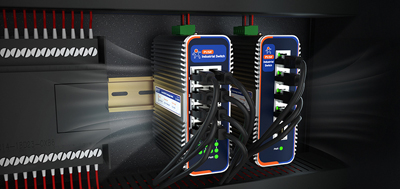
The device features industrial-grade design and supports both DIN-rail and lug mounting for quick installation. It can be deployed directly inside barn electrical control cabinets, operating stably over the long term in the harsh, high-humidity, dusty conditions of farming environments, without the need for additional specialized protective measures.
This solution has been practically validated through numerous large-scale farming projects. It contains no superfluous marketing features; every design element revolves around the actual management needs of farming scenarios. It can genuinely help farming enterprises reduce labor costs for barn management, minimize production losses caused by environmental anomalies, and provide stable, reliable underlying support for the digital transformation of livestock farming.