Against the backdrop of increasingly strict food safety supervision, many food enterprises have fallen into the same dilemma: despite investing massive resources in building traceability systems, they are repeatedly deemed non-compliant during inspections by regulatory authorities. An in-depth analysis of the root cause reveals that the vast majority of bottlenecks are concentrated in the most fundamental yet critical stage — production line data collection.
In traditional solutions, manual recording is prone to errors, protocols of different devices are not interconnected, and data uploads suffer from delays and disconnections, leading to breakpoints in the traceability chain. Even if enterprises supplement data afterwards, they cannot meet the core standard of "authentic, real-time and full-chain traceability" required by compliance regulations. The deployment of IoT gateway is now providing an efficient and feasible solution to this industry pain point.
On the production lines of many food and beverage manufacturers, multiple sets of automated equipment from different eras operate simultaneously: Siemens PLCs control the operation of production lines, various temperature and humidity sensors monitor the workshop environment in real time, handheld barcode scanners collect batch information at key stations such as raw material warehousing, batching and feeding, filling and sealing, and finished product packaging, while temperature control equipment in cold chain warehouses operates independently.
Traditional multi-device combined solutions require the deployment of at least three separate devices — a PLC, a protocol conversion gateway, and a 4G industrial router — to barely complete data aggregation. Under this mode, the management interfaces of different devices are independent of each other, and the troubleshooting chain is lengthy. This not only easily leads to problems such as data packet loss and disordered time sequences, but also results in an overall cost of 4,500 to 6,000 yuan, with subsequent maintenance consuming a huge amount of manpower.
More critically, traditional solutions have severely insufficient local response capabilities, with logic completely solidified through PLC programming, making subsequent expansion and debugging extremely complicated. Once new devices are added to the production line or processes are adjusted, parameters of multiple devices need to be reconfigured, which easily creates blind spots in data collection. Ultimately, this leads to incomplete and untimely updated information in the traceability system, making it impossible to pass compliance inspections.
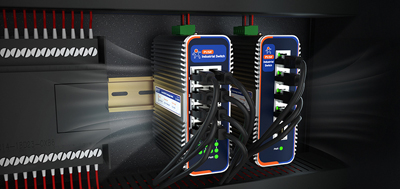
Targeting these industry pain points, integrated IoT gateways such as the USR-M300 are reconstructing the logic of production line data collection for food enterprises. Unlike traditional solutions that piece together multiple devices, it integrates all capabilities including protocol parsing, edge computing, 4G remote transmission, and IO expansion into a single host, with an overall cost starting at only about 1,100 yuan, fundamentally reducing the failure points caused by multi-device connections.
This type of edge gateway is built with hundreds of industrial protocols, enabling direct connection to various devices on the production line such as PLCs, sensors, barcode scanners, and temperature controllers without the need for additional configuration of multiple protocol conversion devices, completely solving the problem of incompatible protocols between devices of different brands. Taking the Siemens PROFIBUS bus production line commonly found in food enterprises as an example, the gateway can directly complete the seamless conversion of RS232 barcode scanner data to PROFIBUS protocol, allowing batch information to be synchronized to the PLC system in real time and automatically bound with production stations, process parameters, and timestamps, avoiding errors caused by manual entry from the source.
Leveraging the drag-and-drop programming capability of Node-RED, the gateway can also achieve millisecond-level local linkage. Enterprises can quickly configure data preprocessing rules without complex PLC programming: automatically verifying the format of batch data uploaded by barcode scanners, filtering invalid information from repeated scans, and issuing immediate local alarms for abnormal data. This not only reduces the load on the production line control system, but also ensures the accuracy and real-time performance of the collected data. Meanwhile, its modular IO expansion modules support cascading on demand. When new monitoring points are added to the production line later, there is no need to replace the gateway host — expansion can be completed simply by adding expansion modules, adapting to the continuously iterating production needs of food
Currently, this type of industrial-grade edge gateway has passed a number of domestic and international authoritative certifications including 3C, CE, FCC and ROHS. With industrial-grade anti-interference and electrical isolation design, it is fully adapted to the complex electromagnetic environment of food production workshops and operates stably and reliably for a long time. It not only significantly reduces the comprehensive cost for enterprises to build traceability systems, but also helps enterprises move the food safety supervision gate forward, shifting from "post-event traceability" in the past to "pre-event prevention". While meeting compliance requirements, it also lays a digital foundation for the brand trust of enterprises.