A round of switch selection questions in an industrial control community drew dozens of replies, each pushing a different familiar brand, and the opinions never converged. One remark pulled the discussion back: nobody took the mean time between failures published by vendors seriously. Someone described the figure as large enough that the unit would still be running when a great-grandchild came to replace it, and someone else added that of the twenty-odd units on site, more than ten had already been swapped. The two remarks together point at something other than whether the number is honest: the question is which stretch of time it covers. From power-up to retirement, an industrial Ethernet switch passes through several stretches, and MTBF covers only one of them. The rest have their own owners.
MTBF is derived by adding up component failure rates and combining the result with accelerated aging tests, and the conditions sit in the fine print: a stated temperature, a stated electrical stress, a stated duty cycle. It is the expected value for a production batch, not a life commitment for the unit in hand, and that distinction is the one usually skipped. Temperature matters most here. Component failure rates rise with temperature, and the stated range refers to the air around the device, to which a cabinet adds the unit's own heat plus heat from nearby variable frequency drives and switching power supplies. Someone mentioned a machine that had been reporting 54 degrees Celsius for a long time. It did not fail on that account, but the actual conditions had already drifted away from the ones used for the calculation.
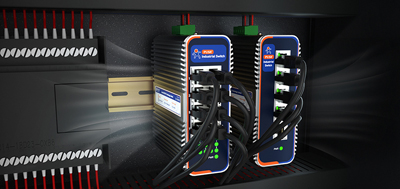
Treat temperature as an input rather than an outcome: measure two points during the hottest period of the year, the air temperature at intake height and the surface temperature of the housing, and keep a margin of twenty degrees Celsius or more below the stated upper limit. The USR-ISG and ISF series are rated for -40 to 85 degrees Celsius, with an aluminium alloy housing and fanless cooling, IP40, DIN rail mounting, a wide DC 9.6-60 V input and dual redundant power inputs, so a cabinet 24 V supply that dips as motors start and stop still leaves the switch running. One measurement settles the margin question, and it takes less effort than comparing hour counts.
MTBF counts random failures that the product brings on itself under stated conditions. External events are not part of it. An engineer once summed it up this way: most failures seen on site were not dead chips, they were somebody shorting 120 volts AC into a network cable. Events of that kind do not become fewer as MTBF goes up. What stops them is protection at the ports: whether the Ethernet ports and the power input carry lightning and surge protection, and what the figure on the datasheet is, in kilovolts. On the USR-ISG and ISF series, both the Ethernet ports and the power input carry 6 kV lightning and surge protection, along with reverse polarity protection and short circuit protection, so a short cuts power quickly rather than letting an incident spread. The kilovolt figure on that line can be checked, which makes it more useful than an average of hundreds of thousands of hours.
MTBF covers time in operation. The stretch from applying power to being usable is not in it. In the same discussion somebody noted that a managed switch takes several minutes to come up, and the more complex the configuration, the longer the wait. On an ordinary day that is a complaint. On the day a unit gets replaced, it is part of the downtime. An unmanaged switch has no such stage: it starts forwarding as soon as power is applied and the port LEDs come on, so swap time is roughly equal to power-up time. Neither form is better in the abstract. It comes down to whether the site needs VLANs, ring redundancy and diagnostics. If it does, build the startup time into the recovery window. If it does not, recovery is nothing more than unplugging and plugging back in.
MTBF ends at the moment of failure. What follows belongs to maintainability, and it is made of four small things: whether the unit can be pulled out and dropped in inside the cabinet, where a DIN rail clip beats screw fixing; whether the latch needs a tool, since somebody complained about a series whose ports sat so deep that the latch could only be pressed with a tool; whether configuration has to be restored, which an unmanaged switch does not have since it works as soon as it is fitted; and whether a spare sits in the cabinet. With twenty-odd units on site and more than ten already swapped, spares are stocked against the unit count, not against MTBF. Leave any one of the four unprepared and a high number still means ten extra minutes standing in front of the cabinet.
MTBF says how long a single unit can run. It does not say how many years the model stays in supply. Machines delivered in batches are most exposed here: once a model is discontinued, spares, acceptance criteria and delivery documents all have to change with it. The safer arrangement is to keep two or three interchangeable tiers within the same series, with matching interfaces and mounting form, so moving between tiers changes quantities rather than documentation. The USR-ISG and ISF series offer 5-port and 8-port versions in Fast Ethernet and Gigabit Ethernet, with a 16-port option once the device count passes eight; models with PoE, compliant with IEEE 802.3af/at at up to 30 W per port, suit cameras and APs that need power nearby; managed models with SFP fiber ports suit cross-workshop and long-distance backhaul, and models supporting ERPS suit outdoor sites and long links, where a link failure heals in milliseconds. Certification covers 3C, CE, FCC and RoHS. Asking about lead time at the ordering stage is easier than hunting for a substitute later.
MTBF is not a false number. It answers a different question: how often a batch of components suffers a random failure under stated conditions. What the unit in the cabinet faces are external events, the wait at power-up, the ten minutes of swapping, and whether the same model can still be bought in year eight. When choosing an industrial Ethernet switch, the useful question is not whether the hour count is accurate, but whether each of those stretches has someone responsible for it, and how to verify that at acceptance: measure two temperature points, check the kilovolt figure on the datasheet, and time the interval from power off to the ports forwarding again. Once those three are done, what remains is brand preference.
1. Is a higher MTBF always better?
Comparable within one vendor under one calculation method; across vendors it means little, since test conditions and component lists differ. It answers how often a batch sees a random failure, not how many years the unit in hand will last, and it does not cover external events, power-up waiting or swap time.
2. MTBF or warranty period: which is worth more?
The warranty period lands better. A warranty is the period a vendor is willing to stand behind, written into a contract and enforceable; MTBF is a calculated value that cannot be rechecked once conditions change. Read both: the warranty years give the floor, while temperature, power supply and protection set the practical ceiling.
3. Is an unmanaged switch less reliable?
Not on the same axis as a managed one. An unmanaged switch has no configuration and works as soon as it is fitted, so recovery after a failure is almost entirely power-up time; a managed one adds a startup wait and configuration restore. Whether management functions are wanted depends on whether the site uses VLANs, ring redundancy and diagnostics, not on reliability.
4. Does a rating of -40 to 85 degrees Celsius mean a cabinet is safe?
The stated temperature refers to the air around the device, and a cabinet adds the unit's own heat plus heat from nearby drives. The practice is to measure two points: air temperature at intake height and housing surface temperature, keeping twenty degrees Celsius or more below the stated upper limit. When measurements approach the limit, move the unit or improve ventilation before considering a different model.
5. Where does the downtime of a switch swap usually go?
Mostly not into the device itself, but into four small things: mounting method, where a DIN rail clip is faster than screw fixing; whether the latch and ports are easy to work with; whether configuration has to be restored; and whether a spare is on site. Timing each of these before a swap is more accurate than estimating afterwards.
6. Can ring redundancy replace a high MTBF?
The two govern different things. MTBF is how often a single unit fails on its own; ring redundancy addresses how soon service recovers after a link break, which matters more at outdoor sites and on long links. Confirm that the target model supports ERPS; do not assume the whole series does.
7. How many spares should be stocked?
Against the unit count on site and the swap time, not against MTBF. Machines from the same batch use the same model, so one or two units that can be fitted directly are enough. Multi-site projects are better served by a single model so spares are interchangeable, with firmware version and port layout recorded in the delivery documents so a replacement does not have to be worked out from scratch.