The confusion between "LTE" and "4G LTE" is not just semantic. It reflects the evolution of the 3GPP standard itself, and understanding this distinction matters when selecting routers for industrial deployments where network compatibility determines system reliability.
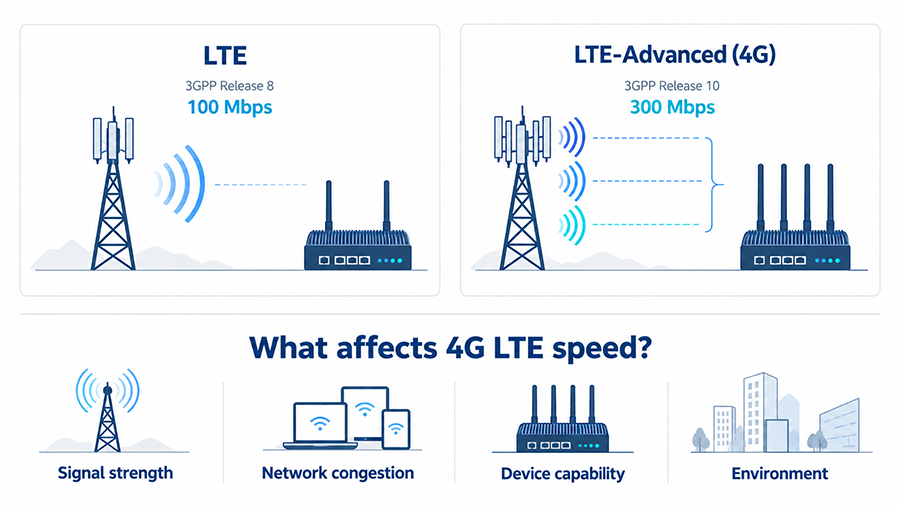
LTE: (Long-Term Evolution) was first specified in 3GPP Release 8 (2009) as a pure packet-switched network architecture—no circuit-switched voice layer. The peak downlink rate in Release 8 was 100 Mbps with 20 MHz bandwidth. Many in the industry still call this "quasi-4G" because the International Telecommunication Union (ITU) did not officially recognize Release 8 as meeting the true 4G benchmark.
True 4G:arrived with 3GPP Release 10 (2011), coden amed LTE-Advanced. This release introduced carrier aggregation (combining multiple frequency bands), 4×4 MIMO antenna support, and a theoretical peak of 300 Mbps download. ITU formally recognized LTE-Advanced as a genuine 4G technology in 2010.
It's crucial to understand that 4G LTE speed is influenced by multiple factors, including signal strength, network congestion, device capabilities, and even the physical environment. Therefore, boosting 4G LTE speeds requires a holistic approach that considers all these variables.
One of the most effective ways to improve 4G LTE speeds is to enhance signal strength. Weak signal strength can significantly reduce data transmission rates. To improve signal reception, consider using signal boosters or relocating your devices closer to the nearest cell tower. Additionally, using devices with high-quality antennas can also help improve signal reception.
Another important factor to consider is network congestion. When multiple devices are trying to access the network simultaneously, it can lead to slower speeds. To mitigate this issue, consider scheduling data usage during off-peak hours or using devices that support carrier aggregation, which allows multiple LTE signals to be combined for faster speeds.
Device capabilities also play a role in determining 4G LTE speeds. Ensure that your devices are compatible with the latest LTE standards and are equipped with the necessary hardware to support high-speed data transmission. Upgrading to newer devices or using devices specifically designed for optimal LTE performance can significantly improve speeds.
In addition to these hardware-related factors, the physical environment can also affect 4G LTE speeds. Interference from buildings, trees, or other obstacles can weaken the signal. In such cases, consider using devices with MIMO (Multiple Input Multiple Output) technology, which uses multiple antennas to overcome interference and improve signal quality.
Moreover, optimizing the network settings on your devices can also help boost 4G LTE speeds. This includes updating your device's operating system and firmware to the latest versions, disabling unnecessary background applications and services that may be consuming bandwidth, and using data-saving modes when possible.
It's worth noting that the quality of the LTE network itself can vary depending on the service provider. If you're experiencing slow speeds despite trying the above techniques, it may be worth exploring other service providers or considering upgrading to a more advanced technology like 5G.
Boosting 4G LTE speeds requires a comprehensive approach that considers multiple factors. By enhancing signal strength, managing network congestion, using capable devices, overcoming physical obstacles, optimizing network settings, and exploring service provider options, you can significantly improve your 4G LTE experience and achieve faster speeds.
The performance gap between "LTE" and "4G LTE" routers traces directly to the 3GPP standard evolution. Each release introduced specific feature sets that determine what industrial applications a router can support.
| 3GPP LTE Release Evolution (Release 8 - Release 15) | ||||||
| 3GPP Release | Launch Year | LTE Category Range | Max Downlink | Max Uplink | Key Features Added | Typical Industrial Use Case |
| Release 8 | 2009 | CAT1-CAT4 | 100 Mbps | 50 Mbps | First LTE architecture, 2x2 MIMO, flat packet-switched design | Basic remote monitoring, low-frequency SCADA polling |
| Release 9 | 2010 | CAT4 | 150 Mbps | 75 Mbps | MBMS multicast, positioning optimization, reduced RF power | IoT sensor networks, multi-site CCTV |
| Release 10 | 2011 | CAT4-CAT6 | 300 Mbps | 150 Mbps | Carrier aggregation (2CA), 4x4 MIMO, uplink/downlink slot optimization | HD video backhaul, cloud-connected HMI, multi-device edge sites |
| Release 11 | 2012 | CAT6-CAT12 | 600 Mbps | 150 Mbps | 3-carrier aggregation, 256QAM downlink, D2D direct connect | Connected vehicle T-BOX, industrial real-time control |
| Release 12 | 2014 | CAT6-CAT13 | 600 Mbps | 300 Mbps | Licensed assisted access (LAA), D2D enhancement, low-latency optimization | Industrial automation, V2X communication |
| Release 13 | 2016 | CAT12-CAT20 | 600 Mbps | 150 Mbps | LTE-WLAN aggregation, enhanced IoT (NB-IoT, LTE-M) | Smart campus Wi-Fi offload, massive IoT deployment |
| Release 15 | 2018 | CAT20-CAT22 | 2000 Mbps | 316 Mbps | 5G NR non-standalone (NSA), 1024QAM (CAT22) | 5G-ready industrial routers, 4G fallback at 2 Gbps |
Source: 3GPP Technical Specification Group Radio Access Network (TSG-RAN), releases 8 through 15.
LTE Category Comparison for Industrial Router Selection
LTE Category (abbreviated as CAT, defined by 3GPP) is the most reliable way to compare industrial LTE routers across vendors. The CAT number reflects the modem's hardware capabilities, not marketing language.
| Parameter | CAT4 (R8–R9) | CAT6 (R10) | CAT12 (R11–R12) | CAT20 (R14) |
| Max Download Speed | 150 Mbps | 300 Mbps | 600 Mbps | 2,000 Mbps (2 Gbps) |
| Max Upload Speed | 50 Mbps | 50 Mbps | 100 Mbps | 150 Mbps |
| Carrier Aggregation | None | 2 carriers (2CA) | 3 carriers (3CA) | Up to 7 carriers (7CA) |
| Max Single Carrier Bandwidth | 20 MHz | 20 MHz (40 MHz total) | 20 MHz (60 MHz total) | 20 MHz (100 MHz total) |
| Downlink Modulation | 64QAM | 64QAM | 256QAM | 256QAM |
| Uplink Modulation | QPSK / 16QAM | QPSK / 16QAM | 64QAM | 64QAM |
| MIMO Configuration | 2×2 | 2×2 | 4×4 (DL) / 2×2 (UL) | 4×4 |
| 3GPP Release | R8 / R9 | R10 | R11 / R12 | R14 |
| Typical Hardware Cost | Low | Medium | Medium–High | Very High |
| Best For | Basic monitoring, CCTV, POS | SMB connectivity, video conferencing | Enterprise WAN, multi-site data aggregation | 5G fallback, premium FWA |
Field note:Actual achievable throughput depends on four factors:
① operator spectrum allocation and carrier aggregation support,
② signal strength (RSRP/SINR),
③ antenna design (2×2 vs 4×4 MIMO external antennas),
④ network congestion during peak hours.
A CAT12 router in a network that does not support 3CA will perform similarly to a CAT6 device.
A router marketed as "4G LTE" could be Release 8 (100 Mbps), Release 9 (150 Mbps), or Release 12 (600 Mbps). The 3GPP Release number and the LTE Category are the only reliable indicators of actual performance. Always verify both on the product datasheet
It's important to note that LTE (Long-Term Evolution) and 4G are closely related terms, often used interchangeably. However, there are subtle differences that set them apart. LTE is a wireless broadband technology that was developed to enhance the performance and efficiency of mobile networks. It represents the fourth generation (4G) of mobile telecommunications technology, providing significantly faster data transmission speeds and improved network capacity compared to its predecessors.
Now, let's delve into the differences between LTE and 4G lte router.
LTE routers are specifically designed to operate on the LTE network. They are compatible with LTE frequencies and protocols, enabling them to connect to the LTE network and provide high-speed wireless internet access. LTE routers are typically more advanced and offer a range of features such as MIMO (Multiple Input Multiple Output) technology for improved signal reception, carrier aggregation for increased bandwidth, and support for multiple users and devices.
On the other hand, 4G lte router are broader in scope, encompassing a range of technologies and frequencies that fall under the 4G umbrella. While LTE is a subset of 4G technology, 4G lte router can also support other 4G technologies, such as WiMAX or HSPA+. This flexibility allows 4G lte router to operate on a variety of networks, depending on the availability and compatibility of the specific technology in a given region or operator.
In terms of performance, LTE routers generally offer superior speeds and reliability compared to 4G lte router that rely on older or less advanced 4G technologies. LTE's advanced features and optimized network design make it capable of handling higher data volumes and providing a more consistent and reliable connection.
LTE routers are often preferred in industrial IoT applications due to their ability to handle a large number of connected devices and provide secure, reliable connectivity. They are often deployed in remote locations or areas with limited wired internet access, enabling seamless data transmission and remote monitoring.
It's worth noting that the availability and coverage of LTE networks can vary depending on the region and service provider. In some areas, 4G lte router may be a more viable option due to the availability of other 4G technologies or the limitations of LTE coverage.
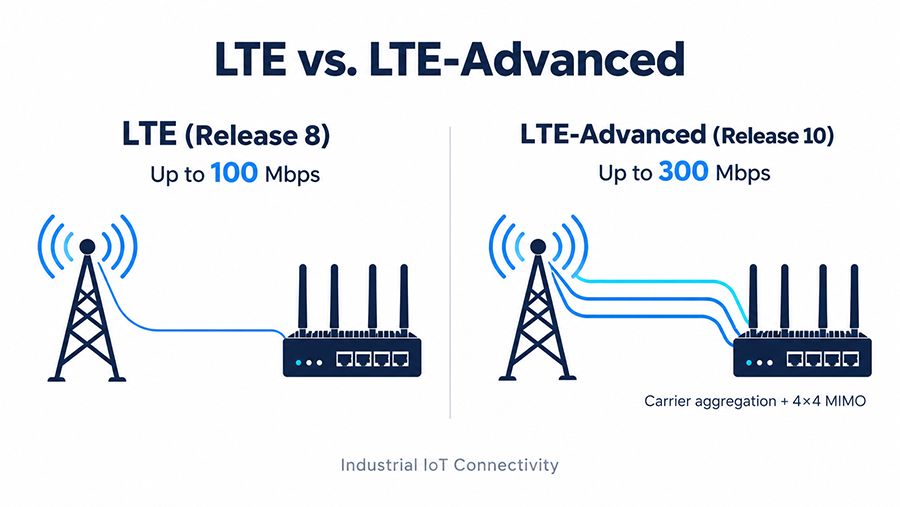
While LTE and 4G lte router both provide wireless internet access, there are key differences in their technology, capabilities, and applications. LTE routers offer faster speeds, advanced features, and are preferred in industrial IoT scenarios. On the other hand, 4G lte router offer flexibility and compatibility with a range of 4G technologies, making them suitable for various scenarios and regions. When choosing between LTE and 4G lte router, it's important to consider the specific requirements and constraints of your industrial IoT application.
LTE and 4G: What the Industry Terms Actually MeanThe confusion between "LTE" and "4G LTE" is not just semantic. It reflects the evolution of the 3GPP standard itself, and understanding this distinction matters when selecting routers for industrial deployments where network compatibility determines system reliability.
LTE: (Long-Term Evolution) was first specified in 3GPP Release 8 (2009) as a pure packet-switched network architecture—no circuit-switched voice layer. The peak downlink rate in Release 8 was 100 Mbps with 20 MHz bandwidth. Many in the industry still call this "quasi-4G" because the International Telecommunication Union (ITU) did not officially recognize Release 8 as meeting the true 4G benchmark.
True 4G arrived with 3GPP Release 10 (2011), codenamed LTE-Advanced. This release introduced carrier aggregation (combining multiple frequency bands), 4×4 MIMO antenna support, and a theoretical peak of 300 Mbps download. ITU formally recognized LTE-Advanced as a genuine 4G technology in 2010.
-A router labeled "LTE-only" typically means it supports Release 8 or Release 9 (100–150 Mbps download).
-A router labeled "4G LTE" usually means it supports Release 10 or later (300+ Mbps with carrier aggregation).
-Some vendors market Release 9 routers as "4G" because they support both FDD and TDD bands—but this does not mean they meet LTE-Advanced specifications.
This is why checking the actual 3GPP Release version—and the LTE Category (CAT)—matters more than the marketing label.
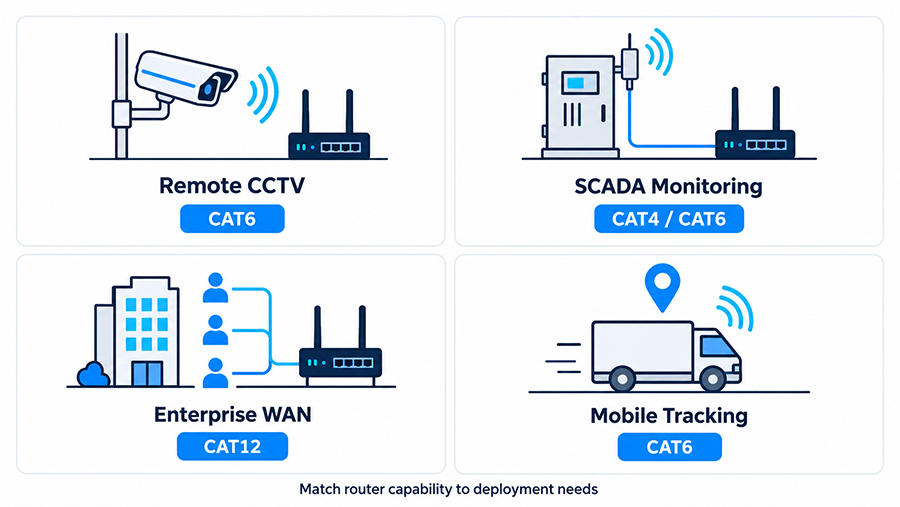
Based on industrial IoT deployments across sectors including manufacturing, transportation, and environmental monitoring, here are practical guidelines for matching router class to real-world requirements.
Requirement:10–20 Mbps sustained upload per camera, 24/7 operation, outdoor temperature range −40°C to +75°C.
Recommendation:CAT6 router with 2×2 MIMO antenna. A single HD camera streams at 4–8 Mbps (H.265). For 2–4 cameras per site, CAT6's 300 Mbps downlink / 50 Mbps uplink provides comfortable headroom. CAT4 is sufficient for a single camera but leaves no room for future upgrades.
What vendors rarely mention:During network congestion (evening hours in populated areas), upload speeds on shared LTE networks can drop 40–60%. Choose CAT6 even if CAT4 "meets the spec on paper" to maintain video quality during peak times.
Requirement:Small packets (100–500 bytes) at 1–10 second intervals, sub-100ms latency, 99.9% uptime, rainforest or desert environment.
Recommendation:CAT4 or CAT6 with dual SIM failover and wide-temperature industrial rating. SCADA workloads are latency-sensitive, not bandwidth-hungry. The critical factors here are connection stability, fast SIM failover, and the ability to maintain 3G fallback when LTE coverage is intermittent.
What vendors rarely mention:A CAT4 router with excellent antenna diversity (separate main + diversity ports) often outperforms a CAT6 router with a single integrated antenna in weak-signal rural deployments. Antenna design matters as much as CAT number.
Requirement:50+ concurrent users, VoIP, cloud ERP access, HD video conferencing, active-active dual-router redundancy.
Recommendation:CAT12 router with 4×4 MIMO, 3-carrier aggregation, and dual SIM per router. Enterprise workloads combine high download bandwidth (cloud ERP), high upload bandwidth (video conferencing at 10–25 Mbps per stream), and low latency (VoIP jitter < 30ms). Only CAT12's 600 Mbps / 100 Mbps with carrier aggregation handles all three simultaneously without contention.
What vendors rarely mention:Carrier aggregation only works if the local operator broadcasts multiple bands with the same MNC/MCC configuration. Before deploying CAT12 site-wide, test carrier aggregation availability at each branch location. If only single-band LTE is available, CAT12 delivers no advantage over CAT6.
Requirement:GPS + cellular data streaming at 1-minute intervals, vibration resistance, 12–36V DC input, cellular handoff between cell towers every 1–5 km.
Recommendation:CAT6 with LTE Category-based handoff optimization and automotive-grade MIMO antenna. Mobile environments introduce Doppler shift and rapid cell tower transitions. CAT6's LTE-Advanced architecture (Release 10+) includes improved handoff procedures that reduce data interruption during tower switching from ~500ms (Release 8) to ~100ms.
What vendors rarely mention:For rail or long-haul trucking where the asset crosses multiple operator networks, ensure the router supports band locking to a preferred operator profile—otherwise the device may camp on a nearby tower with poor backhaul, reducing throughput to 3G-like speeds.
Q: Is LTE faster than 4G, or is 4G faster than LTE?
A: Neither is inherently faster because LTE is a subset of 4G technology. All LTE-Advanced (Release 10+) routers are 4G. Older LTE-only routers (Release 8) are technically slower than true 4G LTE-Advanced routers. When comparing devices, look at the LTE Category number rather than the "LTE" or "4G" label.
Q: What does LTE Category (CAT) mean for industrial routers?
A: LTE Category is a 3GPP-defined classification that specifies a modem's maximum theoretical performance. CAT4 (Release 8) supports up to 150 Mbps download. CAT6 (Release 10) supports up to 300 Mbps with 2-carrier aggregation. CAT12 (Release 11) supports up to 600 Mbps with 3-carrier aggregation and 4×4 MIMO. Higher CAT numbers mean faster potential speeds, but actual performance depends on the carrier's network capabilities.
Q: Can an LTE router work on a 4G network, and vice versa?
A: Yes—modern 4G LTE routers are backward compatible. A CAT6 or CAT12 router will automatically negotiate the best available connection, whether the local cell tower broadcasts LTE Release 8 signals or LTE-Advanced signals. The router's speed will be limited by whichever is available.
Q: How do I know if my carrier actually supports carrier aggregation?
A: Carrier aggregation support varies by region and operator. Check your carrier's technical documentation or contact their enterprise support team. You can also verify by checking the router's status page, which typically displays the current LTE category and active bandwidth configuration.
Q: When should I choose a 5G router instead of a 4G LTE router?
A: If your deployment requires sustained throughput above 500 Mbps, ultra-low latency (sub-10ms) for real-time control, or connectivity in areas with mature 5G coverage, a 5G router makes sense. For most industrial IoT applications—remote monitoring, SCADA data collection, CCTV backhaul—a high-end 4G CAT12 router delivers 600 Mbps at roughly 40–60% of the cost of a 5G solution, with wider network coverage today.